Our Short List of 3
- ASIN: B0044P3J2I (candidate — from indexed Amazon US listing data; the live product page could not be read at the time of writing)
- Chemistry: lithium iron disulfide, single use
- Voltage: 1.5 V
- Pack: 12 cells, model L91

- ASIN: B00JHKSN76 (candidate — from indexed Amazon US listing data; the live product page could not be read at the time of writing)
- Chemistry: NiMH, rechargeable, low self-discharge
- Voltage: 1.2 V
- Capacity: minimum 1,900 mAh, typical about 2,000 mAh (maker figures)
- ASIN: B00JHKSL28 (candidate — from indexed Amazon US listing data; the live product page could not be read at the time of writing)
- Chemistry: NiMH, rechargeable, low self-discharge
- Voltage: 1.2 V
- Capacity: minimum about 2,500 mAh class (maker figures for the BK-3HCCA series)
All 5 Picks at a Glance
| Product | Specs | Action |
|---|---|---|
| 1. Energizer Ultimate Lithium AA (12 pack) — best for cold, storage and high-drain outdoor gear |
| Check price on Amazon |
| 2. Panasonic eneloop AA (4 pack) — best rechargeable for everyday devices |
| Check price on Amazon |
| 3. Panasonic eneloop pro AA (4 pack) — best rechargeable for high-drain devices |
| Check price on Amazon |
 4. Duracell Coppertop AA (28 pack) — best alkaline for stocking the household drawer |
| Check price on Amazon |
 5. Energizer MAX AA (16 pack) — best alkaline alternative with long storage life |
| Check price on Amazon |
Key takeaways
- Compare the best AA batteries across lithium, alkaline and rechargeable NiMH: Energizer Ultimate Lithium, Duracell Coppertop, Energizer MAX and Panasonic eneloop picks matched to your devices.
As an Amazon Associate we earn from qualifying purchases.
Affiliate Disclosure: This article contains affiliate links. If you buy through a link on this page, we may earn a commission at no extra cost to you.
There is no single best AA battery, because AA is a size, not a chemistry. Inside the same 14.5 mm by 50.5 mm cylinder you can buy three quite different products: alkaline cells that are cheap and familiar, lithium cells that shrug off cold and sit in a drawer for decades, and rechargeable nickel-metal hydride (NiMH) cells that cost more up front and then work for years. Picking well is mostly a matter of matching the chemistry to the device. A trail camera that lives outside all winter, a games controller that eats a set of cells every month, and a wall clock that sips power for two years are three different jobs, and the honest answer for each one is a different battery.
This guide compares five widely sold AA options on Amazon US, covering all three chemistries, and explains which device each one actually suits. The specifications are taken from the manufacturers’ published data and product listings; we have not tested these cells ourselves, and where a claim comes from the maker rather than an independent test, the text says so. A note on verification: Amazon product pages could not be read live at the time of writing, so every ASIN below is listed at candidate level, supported by indexed Amazon US listing data. Check the pack count and chemistry on the listing before you buy, because several of these products are sold in many pack sizes under similar names.
The three AA chemistries, in plain terms
Alkaline (1.5 V, single use). The default AA. Alkaline cells are inexpensive, available everywhere, and deliver their best value in low and moderate drain devices: remote controls, clocks, wireless mice, and toys that are used occasionally. Their weakness is high drain and cold. In a camera flash, a powerful torch or a games controller used daily, an alkaline cell’s voltage sags early, and below freezing its performance falls off sharply. Makers typically guarantee around ten to twelve years of storage life on premium alkaline lines.
Lithium iron disulfide (1.5 V, single use). Sold mainly as Energizer Ultimate Lithium in the AA size. These cells are noticeably lighter than alkaline, keep working in severe cold and heat, and hold their charge in storage far longer — Energizer rates the current version for up to 25 years in storage and an operating range from about minus 40 to plus 60 degrees Celsius, per its data sheet. They also hold their voltage flatter under heavy load, which is why they dominate in trail cameras, outdoor sensors and high-drain torches. The cost per cell is several times that of alkaline, so they are wasted in a television remote.
NiMH rechargeable (1.2 V, reusable). Panasonic’s eneloop family is the reference point. NiMH cells are recharged hundreds of times, which makes them by far the cheapest way to power anything that drains batteries regularly. The trade-offs are the lower nominal voltage (1.2 V instead of 1.5 V, which a small number of devices dislike), the need to own a charger, and self-discharge — although modern low-self-discharge designs like eneloop hold most of their charge for months or years in a drawer. For controllers, children’s toys, camera flashes and torches in daily use, rechargeables are usually the correct answer.
The picks
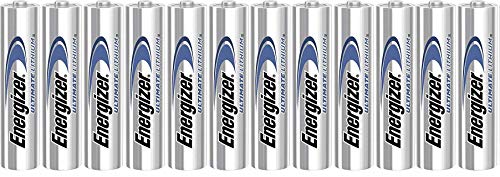
1. Energizer Ultimate Lithium AA (12 pack) — best for cold, storage and high-drain outdoor gear
- ASIN: B0044P3J2I (candidate — from indexed Amazon US listing data; the live product page could not be read at the time of writing)
- Chemistry: lithium iron disulfide, single use
- Voltage: 1.5 V
- Pack: 12 cells, model L91
If a device lives outdoors, gets used hard, or must simply work the first time after sitting idle for a year, this is the cell to put in it. Trail cameras are the classic case: an alkaline set that dies in the first cold snap costs you a season of images, while lithium cells keep their voltage in frost and deliver far more shots per set. The same logic applies to outdoor weather station sensors, GPS units on winter trips, powerful LED torches, and the emergency torch and radio in a car kit, where the long storage life means the batteries you fitted and forgot are still alive when you reach for them. At roughly two thirds the weight of an alkaline cell, they are also the pick for backpacking, where a spare set rides in your pack for days.
The honest limitation is cost per cell. In a remote control or a clock, an Ultimate Lithium delivers no benefit you will ever notice over an alkaline cell costing a fraction as much. Keep a pack for the devices that justify it, not as a whole-house default.
2. Panasonic eneloop AA (4 pack) — best rechargeable for everyday devices
- ASIN: B00JHKSN76 (candidate — from indexed Amazon US listing data; the live product page could not be read at the time of writing)
- Chemistry: NiMH, rechargeable, low self-discharge
- Voltage: 1.2 V
- Capacity: minimum 1,900 mAh, typical about 2,000 mAh (maker figures)
The standard eneloop is the rechargeable to buy if you are not sure which rechargeable you need. Its capacity is not the highest on this page, but its combination of low self-discharge, consistent performance from cell to cell, and a very long rated cycle life makes it the most forgiving option: charge a set, put it in a drawer, and it is still ready months later, which cheaper high-capacity cells often are not. In controllers, wireless keyboards, mice, toys and torches that see regular use, a rotating set of eneloops replaces box after box of disposables.
Two practical notes. First, you need a decent NiMH charger; a smart charger that monitors each cell individually will get far more life out of any rechargeable than a basic timer-based unit. Second, the 1.2 V nominal voltage occasionally trips up devices with crude low-battery warnings, which may report a freshly charged NiMH cell as partly used. The cell is fine; the gauge was calibrated for alkaline.
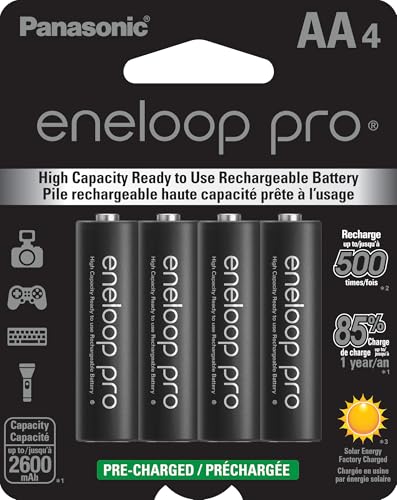
3. Panasonic eneloop pro AA (4 pack) — best rechargeable for high-drain devices
- ASIN: B00JHKSL28 (candidate — from indexed Amazon US listing data; the live product page could not be read at the time of writing)
- Chemistry: NiMH, rechargeable, low self-discharge
- Voltage: 1.2 V
- Capacity: minimum about 2,500 mAh class (maker figures for the BK-3HCCA series)
The eneloop pro trades cycle life for capacity. Each cell stores roughly a quarter more energy than the standard eneloop, and it delivers that energy well under heavy load, which is exactly what camera flashes, high-output torches, radio-controlled models and busy games controllers demand. Photographers in particular favour this cell because flash recycle times stay short deep into a shoot, where standard cells start to lag.
That trade is real, so choose deliberately. A set of pros cycled hard every day will wear out sooner than standard eneloops, and for low-drain duty — a remote, a clock, a sensor — the extra capacity buys nothing, because the standard cell already lasts for months between charges. Buy pros for the two or three genuinely hungry devices in the house, and standard eneloops for everything else rechargeable.
4. Duracell Coppertop AA (28 pack) — best alkaline for stocking the household drawer
- ASIN: B0B1DF9NVJ (candidate — from indexed Amazon US listing data; the live product page could not be read at the time of writing)
- Chemistry: alkaline, single use
- Voltage: 1.5 V
- Pack: 28 cells in a reclosable pack
Coppertop is the familiar household default, and its case rests on two things: predictable performance in ordinary devices, and a storage guarantee long enough that a bulk pack bought today is still trustworthy years from now. The 28-cell reclosable pack suits the way most homes actually use AAs — a few at a time, across remotes, toys, clocks, bathroom scales, wireless mice and the occasional torch — and the pack keeps the spares together instead of loose in a drawer, which also reduces the chance of cells shorting against keys or coins.
As with any alkaline, keep expectations in the right place. In high-drain or cold-weather duty the lithium pick above will outlast it several times over, and in devices you feed weekly, either eneloop will cost less within a few months. Coppertop earns its place as the general-purpose stock, not as a specialist.
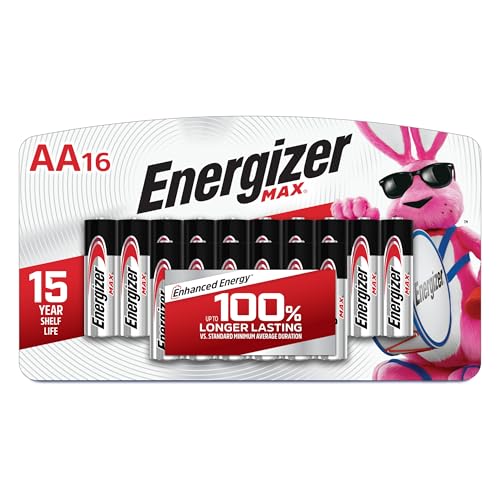
5. Energizer MAX AA (16 pack) — best alkaline alternative with long storage life
- ASIN: B004RFF57C (candidate — from indexed Amazon US listing data; the live product page could not be read at the time of writing)
- Chemistry: alkaline, single use
- Voltage: 1.5 V
- Pack: 16 cells, model E91LP-16
Energizer’s MAX line is the direct rival to Coppertop, and in ordinary household service the practical difference between the two big alkaline brands is small. MAX earns its slot here on its leak-protection positioning: Energizer states the cells are designed to guard against damaging leaks for up to two years after the cell is fully discharged, which matters in the devices people forget — the spare torch in a glovebox, the seasonal decoration, the rarely used game or toy. Its ten-year storage rating is slightly shorter than the Duracell guarantee, but still far longer than a typical household pack survives before being used up.
Choose between MAX and Coppertop on pack size and whichever listing is current when you order; choose either of them over no-name alkaline for anything you would be annoyed to find corroded. And keep the same boundary in mind: neither alkaline is the right cell for a freezing trail camera or a controller that empties a set every fortnight.
Which AA should you buy? A device-by-device summary
- Trail cameras, outdoor sensors, winter gear, emergency kits: Energizer Ultimate Lithium. Cold tolerance and storage life are the whole game.
- Games controllers, toys, torches and flashes in regular use: Panasonic eneloop for general duty, eneloop pro for the hungriest devices. Rechargeables repay their cost quickly at this drain rate.
- Remotes, clocks, mice, keyboards and occasional-use gadgets: Duracell Coppertop or Energizer MAX. Alkaline is cheap, ready instantly, and lasts for years at this drain.
- A drawer stock for a whole household: one bulk alkaline pack for the small stuff, one lithium pack reserved for outdoor and emergency devices, and a charger with eneloops for the devices that eat batteries. Most homes need all three chemistries, each in its lane.
Buying and handling notes
Buy the pack size you will actually finish. Disposable cells age in the drawer, so a giant pack is only a bargain if your household genuinely uses that many before the storage guarantee runs down. Store cells cool and dry, keep them in their packaging until needed, and never mix old and new cells, different chemistries, or different brands in the same device — the weakest cell limits the set and is the one most likely to leak. Do not attempt to recharge a cell that is not marked rechargeable, and recycle used cells through a local battery collection point rather than household waste where facilities exist. Finally, when a listing offers several pack sizes, confirm the count and the chemistry on the page before ordering; lithium, alkaline and rechargeable AA listings sit side by side in search results and are easy to confuse at a glance.
Frequently asked questions
Can I mix lithium and alkaline AAs in one device? No. They discharge at different rates and behave differently under load, so the set performs badly and the weaker cells can be driven into leakage. Fit a full set of one chemistry, all fresh or all charged together.
Why does my device say a freshly charged eneloop is half empty? Because its battery gauge expects 1.5 V alkaline cells, and a NiMH cell runs at about 1.2 V for most of its discharge. The eneloop still delivers its full capacity; the gauge is simply misreading the voltage. A small number of devices genuinely misbehave on 1.2 V, and for those, lithium or alkaline cells are the fix.
Are lithium AAs rechargeable? The Energizer Ultimate Lithium cells in this guide are not. Rechargeable lithium AA products do exist, usually with built-in regulation and USB charging, but they are a different product type and are not covered by the picks here. Never put a single-use lithium cell in a charger.
How long will alkaline AAs really last in storage? The makers guarantee ten to twelve years on the premium lines listed here, provided the cells are stored at ordinary room temperature. Heat shortens that considerably, which is one more reason the lithium cell, with its far longer rating, is the better emergency-kit choice.
Bottom line
Match the chemistry to the job and AA buying becomes simple. Energizer Ultimate Lithium owns the cold, the outdoors and the emergency drawer. Panasonic’s eneloop and eneloop pro own anything you power week in and week out, split between them by how hungry the device is. Duracell Coppertop and Energizer MAX cover the long tail of ordinary household gadgets at the lowest cost per cell. Stock each chemistry for its own lane, and no device in the house needs to go dark for want of the right battery.