Key takeaways
- Seed packets for summer window boxes compared by habit and seed count: trailing petunia, sweet alyssum, dwarf French marigold, and jewel nasturtium.
A window box holds a shallow strip of soil, dries out faster than any bed, and sits at eye level, so the real decision is not which flower looks best in a photo. It is which growth habits can share that narrow space: one plant to spill over the front edge, one low filler to close the gaps, and one compact upright for height. Buying those roles as seed packets means matching each packet’s stated habit to a layer, because a box planted with one upright flower looks bare at the rim all summer.
This roundup is for balcony and railing-box gardeners, anyone dressing a sunny kitchen window, and anyone filling several boxes without buying transplants for each one. Every pick is a seed packet chosen from its Amazon listing name and specifications — seed count, botanical name, and growth habit — and the four split into a trailing petunia, a spreading sweet alyssum in two colors, a dwarf French marigold, and a dwarf nasturtium with large, easy-to-handle seed.
Quick Picks
As an Amazon Associate we earn from qualifying purchases
| Product | Best for | Key spec from title |
|---|---|---|
| BuggyBeds Petunia Seeds | Trailing color over the front edge | 300 seeds, trailing, long-blooming |
| Survival Garden Seeds Sweet Alyssum 2-Variety Pack | Low fragrant filler in two colors | Royal Carpet and Carpet of Snow |
| RDR Seeds Petite French Marigold | Compact upright middle layer | 400 seeds, mounds about 6 inches |
| KVITER Jewel Nasturtium Seeds | Easy sowing with edible blooms | 75 seeds, dwarf Tropaeolum nanum |
How to Choose
Match Each Packet to a Layer of the Box
A finished window box reads in three layers, and seed packets should be bought by layer rather than by flower name. The spiller goes along the front edge and trails downward, hiding the box itself. The filler spreads low between the other plants so no soil shows through. The upright layer stands in the middle or back and stays compact enough not to shade the rest. When a listing states a trailing, spreading, or dwarf habit, that word is doing real work: a tall border variety in a shallow box flops, crowds its neighbors, and drinks the limited soil dry.
Read Seed Count Against Seed Size
Packet counts in this category range from dozens to thousands, and the number only makes sense next to the size of the seed. Nasturtium seed is pea-sized, so 75 seeds is a workable supply that you place one by one exactly where plants should stand. Petunia and alyssum seed is dust-fine, so a few hundred seeds disappear quickly once you scatter them over several boxes and thin the extras. Judge a packet by how many finished plants it can realistically produce in your boxes, not by the biggest count on the shelf, and expect to sow more of the fine seed than you keep.
Check Heat and Sun Tolerance for Your Aspect
Window boxes against a south or west wall bake in reflected heat, and shallow soil gives roots no cool depth to escape into. For those spots, listings that state heat tolerance and long blooming earn their place, because a flower that sulks in July leaves the box empty at its peak viewing season. Boxes on north or east walls get gentler light, where spreading fillers and nasturtiums carry more of the display. Be honest about which wall the box hangs on before ordering, since the same packet that thrives on one side of a house can stall on the other.
Plan the Sowing Calendar Backwards
Summer flowers from seed run on very different clocks. Slow starters such as petunia need to be sown indoors weeks before the last frost to bloom on schedule, while marigold and nasturtium can go straight into the box once nights warm up and still flower in good time. The alyssum packet in this roundup states its own window — direct sow outdoors after frost, or start indoors six to eight weeks ahead — and that kind of listing guidance is worth following over generic advice. Count backwards from when you want color, then pick packets whose lead time still fits.
The 4 Best Options
BuggyBeds Petunia Seeds, 300 Count
If the front edge of the box is what people see from the street, this is the packet built for that job: the listing names window boxes directly and describes the plants as trailing, heat-tolerant, and long-blooming. That combination suits a sunny box that gets reflected heat off siding, where a spiller has to keep flowering instead of pausing in midsummer. The 300-seed count gives you enough fine seed to sow generously and thin, and the listing also notes the flowers attract pollinators, a pleasant bonus outside a kitchen window.
Specs
- Seed count: 300 seeds
- Growth habit: trailing flowers, per the listing
- Bloom period: long-blooming
- Special feature: attracts pollinators
- Sun and heat: heat-tolerant, low-maintenance care
- Intended use: garden borders, patios, and window boxes
- Packet size: 1 x 1 x 0.35 inches, 0.176 ounces
Best for: Sunny, hot boxes where you want one trailing plant to carry the front edge all season.
Watch out for: Petunia seed is dust-fine and slow to start, and the listing does not state a pelleted form, so sow indoors early and handle the seed carefully.
Survival Garden Seeds Sweet Alyssum, 2 Varieties
This purchase covers the filler layer in two colors at once: a purple Royal Carpet packet and a white Carpet of Snow packet, both Lobularia maritima. Sweet alyssum grows compact and spreading, so it knits along the front lip of the box and between taller plants, and the listing highlights the fragrance that makes it welcome under an open window. The seed is heirloom, non-GMO, and untreated, and the listing gives a clear sowing choice — direct sow outdoors in early spring after frost, or start indoors six to eight weeks before the last frost date.
Specs
- Varieties included: Royal Carpet (purple) and Carpet of Snow (white)
- Botanical name: Lobularia maritima
- Seed type: heirloom, non-GMO, untreated
- Growth habit: compact and spreading
- Bloom trait: fragrant blooms, long flowering season
- Sowing: outdoors after frost, or indoors 6 to 8 weeks before last frost
Best for: Edging the front of the box and threading scent and low color between taller plants.
Watch out for: The listing does not state a seed count for this two-variety pack, so check the packets on arrival if you are filling many boxes.
RDR Seeds Petite French Marigold, 400 Seeds
Every box needs something upright that knows its place, and this petite French dwarf mix is bred to stop at compact mounds of about six inches, in gold, orange, and red. That height fills the middle of a shallow box without leaning over the spillers or shading the filler, and French marigolds hold up well once summer heat settles in. The packet holds 400 heirloom, non-GMO seeds grown in the USA, packed in a moisture-proof pouch, which matters if you plan to sow in stages across several boxes rather than all at once.
Specs
- Seed count: 400 seeds
- Variety: Petite French Dwarf marigold mix
- Mature size: compact mounds about 6 inches
- Colors: gold, orange, and red
- Seed type: heirloom, non-GMO, USA grown
- Packaging: moisture-proof pouch
Best for: A low, warm-colored middle layer in sunny boxes that will not outgrow a shallow planter.
Watch out for: It is a mixed blend, so you cannot control which color lands where, and the seed wants warm soil — sow after frost or start it indoors.
KVITER Jewel Nasturtium Seeds, 75 Count
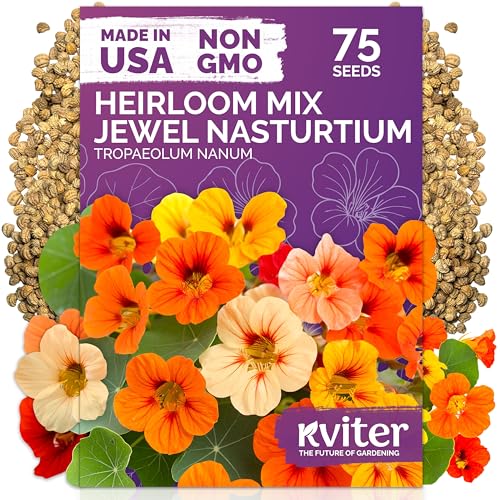
Nasturtium is the forgiving option for gardeners who dislike handling dust-fine seed: these are large seeds you can place by hand at exact spacings. The Jewel Mix is a dwarf Tropaeolum nanum in red, orange, yellow, and gold, and the listing places it in beds, baskets, and window boxes, where the plants mound and trail over the rim. The blooms and leaves are edible, which gives a kitchen-window box a second job, and the resealable packet blocks moisture, so leftover seed stores cleanly for a second sowing later in the season.
Specs
- Seed count: 75 seeds
- Botanical name: Tropaeolum nanum
- Variety: Jewel Mix, dwarf
- Colors: red, orange, yellow, and gold
- Seed type: heirloom, per the listing
- Edible: flowers and leaves edible, per the listing
- Packaging: resealable, moisture-blocking packet
Best for: Beginners and kitchen windows — big seeds, quick results, and blooms you can pick for salads.
Watch out for: Seventy-five seeds cover a few boxes, not a long railing run, and overly rich soil pushes leafy growth at the expense of flowers.
Which One Fits Your Situation
A Sun-Blasted South-Facing Box
Start with the BuggyBeds petunia along the front edge, since its listing pairs trailing growth with heat tolerance, then back it with the RDR petite French marigold in the middle. Both are chosen for hot, bright exposure, and the marigold’s six-inch mounds will not shade the petunia spilling below. Water will still decide the outcome in a shallow box, but this pairing gives the display its best chance of lasting through August.
Fragrance Under an Open Window
Build the box around the Survival Garden Seeds sweet alyssum pack, using the white Carpet of Snow near the ends and the purple Royal Carpet through the middle. Alyssum’s scent carries on still evenings, which is exactly when a kitchen or bedroom window stands open. Add the KVITER nasturtium at the corners for trailing leaves and peppery edible blooms, and keep the marigold out — its foliage scent is an acquired taste at close range.
A Late Start With No Indoor Setup
Skip the slow starters and direct sow. The RDR marigold and the KVITER nasturtium both go straight into the box once the soil warms, and both germinate without lights, trays, or a windowsill nursery. The nasturtium’s large seeds are the easiest to space by hand, and the marigold fills in fast behind them. You give up the petunia’s long season, but the box still reaches full color in summer.
Several Boxes on One Seed Order
Stretch the order by role, not by flower. Use the alyssum as the shared filler across every box, the petunia as the repeated spiller, and then vary only the middle layer — marigold in the sunny boxes, nasturtium where you want edible blooms. Repeating two packets keeps the design coherent from box to box, and the resealable nasturtium packet and moisture-proof marigold pouch store well between sowings.
Common Mistakes
- Planting one habit in all three layers, so the box has height but nothing trailing over the front edge and bare soil showing between plants.
- Burying dust-fine petunia or alyssum seed under a thick layer of mix; fine seed sown too deep often never reaches the light it needs.
- Ordering by seed count alone, without weighing seed size — 75 large nasturtium seeds can plant more deliberately than hundreds of scattered fine seeds.
- Starting slow seed at the same time as fast seed, then wondering why the box blooms in uneven waves weeks apart.
- Crowding a shallow box as if it were a garden bed; window box soil dries fast, and overcrowded plants compete for water from the first hot week.
Frequently Asked Questions
When should I start window box flower seeds?
Count backwards from your last frost. Slow packets such as petunia need an indoor start weeks ahead, while the alyssum listing in this roundup suggests sowing indoors six to eight weeks before the last frost or directly outdoors after it. Marigold and nasturtium are usually direct sown into the box once nights stay warm, which makes them the simplest choice for a late start.
How many seeds does one window box need?
Fewer finished plants than most people expect: a standard box usually holds a row of spillers along the front, a middle row of compact plants, and filler tucked between them. Sow more seed than the final plant count, especially with dust-fine petunia and alyssum, then thin to the spacing the packet states. Large nasturtium seed can be placed one per intended plant, with a few spares.
Which of these flowers trail over the edge of the box?
The BuggyBeds petunia is the true spiller here — its listing describes trailing growth made for borders, patios, and window boxes. The KVITER nasturtium mounds first and then trails over the rim as stems lengthen. Sweet alyssum spreads low and softens the front lip rather than hanging, and the petite French marigold stays upright, so it belongs in the middle layer instead.
Can I save leftover seed for next summer?
Usually yes, if the packets stay cool, dry, and sealed. The marigold pouch in this roundup is moisture-proof and the nasturtium packet reseals, which helps. Fine seed such as petunia and alyssum loses vigor faster than large seed, so plan to use those packets first and treat any second-season sowing as a bonus rather than the main plan.