Our Short List of 3
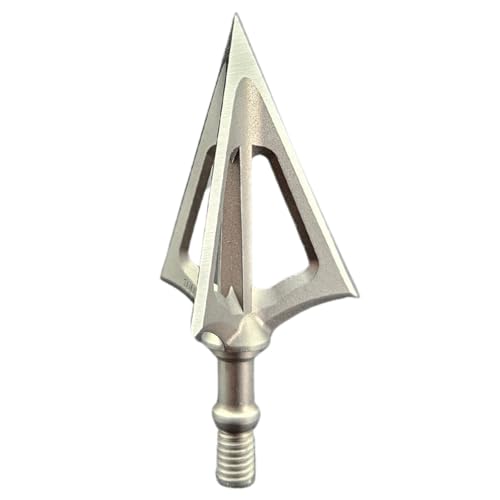
- Best for: Hunters who want a 100 grain head with zero moving parts.
- Weight: 100 grains
- Blades: 3 fixed blades, one-piece construction
- Cutting diameter: 1-1/16 inches
- Material: stainless steel, metal injection molded

- Best for: Deer hunters who want a wide cut without leaving the 100 grain class.
- Weight: 100 grains
- Blades: 2 rear-deploying mechanical blades
- Cutting diameter: 2 inches
- Blade thickness: .035 inch stainless steel

- Best for: Hunters who want one proven 100 grain mechanical with easy-to-find spares.
- Weight: 100 grains
- Blades: 2 SlipCam rear-deploying blades
- Cutting diameter: 2 inches
- Blade thickness: .035 inch stainless steel
All 4 Picks at a Glance
| Product | Specs | Action |
|---|---|---|
| G5 Montec Crossbow, 100 Grain |
| Check price on Amazon |
| Rage Hypodermic Crossbow, 100 Grain |
| Check price on Amazon |
| Rage Crossbow X, 100 Grain |
| Check price on Amazon |
 Swhacker 4 Blade Hybrid Crossbow, 125 Grain |
| Check price on Amazon |
Key takeaways
- Compare crossbow broadheads by grain weight, from 100 grain fixed and mechanical heads to a 125 grain hybrid, and match head weight to your bolt.
Grain weight is the one broadhead spec that changes how the whole bolt behaves, not just what happens at the target. Add 25 grains at the front and the bolt’s balance point moves forward, the trajectory drops a little sooner, and the field points you sighted in with may no longer match. Pick a head that is too light for a fast bow and groups can open up. So the real decision is which weight class your bolt setup was built around, then which blade design to run at that weight.
This guide is for deer hunters shooting factory bolts, owners of fast crossbows whose light heads group poorly, and anyone building a heavier bolt on purpose. Every head below was chosen from its Amazon listing name and product details, with the grain weight printed in the listing itself, and the lineup spans the standard 100 grain class and the 125 grain step up.
Quick Picks
As an Amazon Associate we earn from qualifying purchases.
| Product | Best for | Key spec from title |
|---|---|---|
| G5 Montec Crossbow | Fixed-blade shooters at the standard weight | 100 grain, 3 fixed blades |
| Rage Hypodermic Crossbow | The widest cut in the 100 grain class | 100 grain, 2 inch cut |
| Rage Crossbow X | A crossbow-specific mechanical that stays simple | 100 grain, SlipCam rear deploy |
| Swhacker 4 Blade Hybrid Crossbow | Stepping up to a heavier front end | 125 grain, blades open to 2.25 inches |
How to Choose
Start From Your Total Bolt Weight, Not the Head Alone
A broadhead’s grain weight only makes sense as part of the finished bolt. Crossbow makers publish a minimum total bolt weight for each model, and the head is the easiest place to add or trim grains. Check what your bolts weigh with the field points you already own, then pick a head in the same class so the sight picture barely changes. If your setup was tuned around 100 grain points, a 100 grain head keeps your practice sessions and hunting arrows on the same trajectory, which removes one variable when the season opens.
What the Extra 25 Grains Actually Buy
Moving from 100 to 125 grains pushes more of the bolt’s mass toward the front, raising front-of-center balance. That usually settles a bolt down at speed and carries momentum through resistance, which is why heavy setups favor it. The trade is trajectory: the heavier bolt leaves slower and drops faster past mid-range, so holdover habits built on light bolts stop working. A 150 grain head pushes the same idea further for very fast bows and short, heavy bolts, but it only helps when the whole package was planned around it.
Match the Blade Design to the Weight Class
Weight and design interact. A wide mechanical at 100 grains asks a lot of a slower bow, because opening two big blades consumes energy that a light bolt may not spare. Fixed heads at the same weight keep cutting from the moment of contact and shrug off quartering angles, but their exposed blades can steer a fast bolt if alignment is poor. Hybrids split the difference: a small fixed bleeder starts the cut, then the main blades open inside. Decide the weight your bolt needs first, then pick the design your bow’s speed can drive properly.
Read the Listing Variant Before You Trust the Number
Many broadhead listings group several grain weights under one page, and the weight in the headline is not always the variant in the cart. Open the product details and confirm the grain printed there matches the option selected, along with the pack count and whether a practice head is included. Also check what the retention system needs over time: collars and bands are consumables, while a one-piece fixed head needs only a flat stone. A head that looks simple can get complicated if its small parts are hard to source mid-season.
The 4 Best Options
G5 Montec Crossbow, 100 Grain
- Best for: Hunters who want a 100 grain head with zero moving parts.
- Weight: 100 grains
- Blades: 3 fixed blades, one-piece construction
- Cutting diameter: 1-1/16 inches
- Material: stainless steel, metal injection molded
Hunters who want a 100 grain head with zero moving parts.
Fixed blades can plane on fast bows if bolts are not aligned; spin-check every head.
The Montec Crossbow is the reference point for the 100 grain class: a one-piece fixed head with nothing to deploy, nothing to band, and nothing to inspect before a shot. Because it is machined from a single piece of stainless steel, the ferrule and blades cannot loosen or shift, and the cut-on-contact tip starts working immediately. For hunters whose bolts were built around 100 grain field points, it swaps in with the least disruption, and its modest cutting diameter tends to fly close to field points from well-tuned bows.
Rage Hypodermic Crossbow, 100 Grain
- Best for: Deer hunters who want a wide cut without leaving the 100 grain class.
- Weight: 100 grains
- Blades: 2 rear-deploying mechanical blades
- Cutting diameter: 2 inches
- Blade thickness: .035 inch stainless steel
Deer hunters who want a wide cut without leaving the 100 grain class.
Shock Collars are consumables; carry spares and replace any collar that looks nicked.
Within the same 100 grain class, the Hypodermic Crossbow takes the opposite approach: two rear-deploying blades that stay closed in flight, then open to a full 2 inch cut. The hypodermic tip and steel ferrule are built for the impact speeds modern crossbows produce, and the Shock Collar holds the blades against the launch forces that can open lesser mechanicals early. It suits hunters who shoot deer at moderate ranges and want the largest wound channel a 100 grain head can deliver, provided the bow has energy to spare.
Rage Crossbow X, 100 Grain
- Best for: Hunters who want one proven 100 grain mechanical with easy-to-find spares.
- Weight: 100 grains
- Blades: 2 SlipCam rear-deploying blades
- Cutting diameter: 2 inches
- Blade thickness: .035 inch stainless steel
Hunters who want one proven 100 grain mechanical with easy-to-find spares.
Confirm the selected variant is the 100 grain crossbow version before ordering.
The Crossbow X is Rage’s long-running crossbow-specific mechanical, and it earns its place here as the straightforward 100 grain option: a SlipCam rear-deploy design on an aluminum ferrule, with the Shock Collar system keeping blades shut until impact. Its 2 inch cut matches the Hypodermic, but the build is simpler and the model has been in crossbow quivers for years, so replacement blades and collars are easy to find. For a hunter standardizing on one 100 grain mechanical across several bows, that parts availability matters as much as the specs.
Swhacker 4 Blade Hybrid Crossbow, 125 Grain
- Best for: Fast crossbows and heavy-bolt builds that need a 125 grain front end.
- Weight: 125 grains
- Blades: 4 total, fixed bleeder blades plus expanding main blades
- Cutting diameter: main blades open to 2.25 inches
- Blade material: high carbon steel
Fast crossbows and heavy-bolt builds that need a 125 grain front end.
The extra 25 grains change trajectory; re-sight with the actual heads before hunting.
The Swhacker hybrid is the step-up pick for bolts that need more weight up front. At 125 grains it raises front-of-center balance over any 100 grain head, and its two-stage cutting design protects the main blades: the fixed bleeder blades open the hide first, then the main blades deploy inside, reaching a 2.25 inch cut with edges that have not touched hide or hair. That makes it a considered choice for fast bows that group poorly with light heads, or for hunters deliberately building a heavier bolt for larger game.
Which One Fits Your Situation
Your Bow Shipped With 100 Grain Field Points
Stay in the class the bow was set up for. The Montec Crossbow keeps things simplest, with no collars or blades to manage, and it should group close to your practice points. Choose the Crossbow X instead if you prefer a mechanical and want the wider cut, since it holds the same 100 grain weight and will not shift your sight picture.
Your Fast Bow Groups Poorly With Light Heads
Add weight before you change anything else. The Swhacker hybrid at 125 grains moves the balance point forward, which often calms a fast bolt down, and its bleeder-first design keeps the wide main blades from wasting energy at the surface. Budget an afternoon to re-sight, because the heavier bolt will print lower at distance.
Short Shots at Deer in Thick Cover
At close range, trajectory differences between grain classes barely matter, so take the cut. The Hypodermic Crossbow opens to 2 inches and its steel ferrule handles steep angles better than most wide mechanicals. Keep shots honest, check the Shock Collar before every hunt, and this is the head that leaves the clearest trail to follow.
One Head for Practice Blocks and the Season
Pick the head with the least upkeep. The Montec Crossbow can be touched up on a flat stone after target work and returned to the quiver, with no collars, bands, or replacement blades to track. Mechanicals shot into targets usually need fresh retention parts before they are hunt-ready again, which adds a chore the fixed head never asks for.
Common Mistakes
- Mixing 100 and 125 grain heads in the same quiver, then wondering why two bolts group apart at forty yards.
- Sighting in with 100 grain field points and hunting a 125 grain head without confirming where it actually lands.
- Trusting the grain weight in a listing headline while the selected variant in the cart is a different weight.
- Dropping below the crossbow maker’s minimum total bolt weight to gain speed, which strains limbs and voids coverage on many models.
- Shooting a wide mechanical from a slow bow and blaming the head when the real problem is energy the setup never had.
Frequently Asked Questions
Does 25 grains really change where a bolt hits?
Yes, mostly at longer ranges. Inside twenty yards the difference between a 100 and a 125 grain head is small, but the heavier bolt leaves slower and keeps dropping, so the gap grows with distance. Any time you change head weight, confirm the point of impact at your longest realistic shot rather than assuming the sight still holds.
What grain weight do most crossbow setups use?
The 100 grain class is the default for most factory bolts and the weight most crossbow packages are sighted around. The 125 grain class is the common step up for hunters who want more front-of-center balance or a heavier total bolt. Heavier 150 grain heads exist for specialized builds, but they are a deliberate project rather than a casual swap.
Can I run a heavier head than the one my bow came with?
Usually, as long as the finished bolt stays above the maker’s minimum total weight and you re-sight afterward. Adding grain is the safe direction for the bow itself; the cost is a slower bolt and a steeper trajectory. Going lighter than the maker’s floor is the risky direction, since underweight bolts stress limbs, cams, and strings.
Should my practice head match my hunting head weight?
Match the weight first and the shape second. A field point or practice head of the same grain keeps your trajectory honest, which matters more than identical flight. Fixed heads often group close to same-weight field points, while wide mechanicals can print differently, so fire at least one hunting head at a target before the season to confirm.