Key takeaways
- Compare the best toe clip pedals for a road bike: complete cage-and-strap pedal sets in 9/16-inch fitting that work with regular shoes, no cleats needed.
As an Amazon Associate we earn from qualifying purchases.
Affiliate Disclosure: This article contains affiliate links. If you buy through a link on this page, we may earn a commission at no extra cost to you. Product details come from the manufacturer’s and retailer’s product pages, and availability can change, so please confirm the exact version, thread size and included straps on the product page before you order.
Toe clip pedals are the oldest form of foot retention in cycling, and for a road bike rider who does not want cleats, they still make a great deal of sense. A toe clip is a cage, usually metal or reinforced resin, that bolts to the front of the pedal and loops over the front of your shoe. A strap passes through the clip and around your foot, holding the shoe in a consistent position on the pedal. Used loosely, the system simply stops your foot sliding forward and keeps the ball of your foot over the pedal axle. Used firmly, it also lets you pull through the back of the pedal stroke and keeps your feet attached over rough surfaces.
That is a different promise from a clipless pedal, and this guide keeps the two separate on purpose. Every pick below is a complete pedal set sold with toe clips and straps fitted or included, designed to be ridden in ordinary trainers or flat cycling shoes. None of them requires a cleated shoe, none of them locks your foot in mechanically, and all of them let you pull your foot out backwards or sideways in the way riders have done for decades. If you want a mechanical cleat system instead, you need a different guide entirely.
Almost every complete toe clip pedal set sold today shares the same fitting: a 9/16-inch spindle thread, which is the standard pedal thread on the vast majority of adult road bikes. That makes choosing mostly a question of materials, cage size, strap design and how much adjustment you want. The four sets below cover the sensible range: a proven all-rounder, a straightforward pre-installed budget design, a wider aluminium option for bigger shoes, and a compact everyday version from the same family as our top pick. All four are resin-and-alloy or aluminium designs rather than traditional all-metal quill pedals, which reflects what is actually sold as a complete clip-and-strap set on the market today.
Our Picks at a Glance
- YBEKI Bike Pedals with Toe Clips and Straps, NA008 — Best all-round complete set for road use
- Newsty Bike Pedals with Clips and Straps — Best simple set, clips and straps pre-installed
- BUCKLOS Bike Pedals with Toe Cages and Straps — Best for wider shoes and a sturdier aluminium body
- YBEKI Bike Pedals with Toe Clip and Straps, Standard Platform — Best compact everyday set
1. YBEKI Bike Pedals with Toe Clips and Straps, NA008 — Best All-Round Set

ASIN: B07Q134MCH — View on Amazon
The YBEKI NA008 is the most completely specified toe clip pedal set in this round-up, which is why it leads the list. The pedals combine an engineering resin body with alloy components, run on a 9/16-inch spindle, and arrive as a pair with the toe clips and adjustable straps already fitted. The listing describes the bike types as including road bikes and mountain bikes, and the platform is sized to give a normal trainer real support rather than the narrow perch of a traditional quill pedal.
Details that matter on the road are present. The straps adjust in multiple directions, so you can set the cage depth for your shoe size instead of accepting a single fixed position, and the maker lists a spare strap among the retailer descriptions of the package, which is genuinely useful because straps are the wear item on any clip system. The textured platform surface helps a rubber sole grip when the strap is run loose, which is how most road riders new to clips should start: cage guiding the foot, strap snug enough to locate it, never cranked down tight until you have practised stopping.
As a road bike pick, the NA008 suits the rider who wants one set of pedals to cover commuting, training rides in trainers and general riding where cleated shoes are impractical. Its resin-and-alloy construction will not have the decades-long lifespan of a premium all-metal pedal, and riders with very large or wide shoes should check the cage dimensions carefully against the measurements given for the other YBEKI and BUCKLOS sets below. Within its class, though, it is the most rounded package here.
2. Newsty Bike Pedals with Clips and Straps — Best Simple Pre-Installed Set
ASIN: B07CV9H86H — View on Amazon
The Newsty set makes one promise and keeps it: everything arrives already put together. The package is listed as a pair of pedals, a pair of straps and a pair of clips, with the toe clips and straps pre-installed, so fitting them to a road bike is a single job with a pedal wrench rather than an evening of small bolts and fiddly strap threading. For riders converting a bike quickly, or replacing a worn set before a commute, that simplicity is the product.
Construction is the same resin-and-alloy formula as the YBEKI, on a 9/16-inch spindle, and the listing positions the pedals for outdoor cycling as well as indoor stationary use. That dual positioning is honest about what these pedals are: a tough, inexpensive cage pedal for everyday riding in normal shoes, not a lightweight racing component. The metal grip features on the pedal surface help keep a trainer sole planted, and the nylon straps adjust in the conventional way, threading through the clip so you can leave the end loose enough to grab and tighten once you are rolling.
Choose the Newsty set if you value quick setup and straightforward function over fine adjustment. Its limitations follow from its simplicity: the cage size is a single medium fit that may not suit very large feet, and there is less scope to reposition the clip than on the adjustable YBEKI design. Check your shoe against the pedal in the first rides at home, with the straps loose, before committing to longer road rides.
3. BUCKLOS Bike Pedals with Toe Cages and Straps — Best for Wider Shoes
ASIN: B0CCD5XRB6 — View on Amazon
The BUCKLOS set is the heavyweight of this group in the literal sense, and for the right rider that is a recommendation. The version listed here, described as the widened toe cage model, pairs an aluminium pedal body with reinforced composite nylon toe cages and adjustable nylon-braided straps, on the standard 9/16-inch thread. The package weight and dimensions given in the listing are larger than the resin sets above, and the whole design brief is aimed at riders whose shoes feel cramped in a standard cage, including riders who want to use bulkier trainers.
On a road bike, that extra room translates into a pedal you can get into and out of easily at lights and junctions, which is where toe clips earn or lose their keep for commuting and urban riding. The aluminium body also answers the main durability question raised by all-resin pedals, and the maker backs the set with a limited warranty as described in the listing. Reflective details noted in retailer descriptions of this pedal family are a welcome extra for road use in low light, though you should confirm they are present on the exact version you order.
Choose the BUCKLOS if you have wide feet, wear chunky trainers, or simply prefer a metal-bodied pedal and do not mind carrying a little more weight for it. Road riders chasing the lightest possible build, or those with narrow shoes who like a close-fitting cage, will be better served by the YBEKI NA008 above. Fit, on a toe clip pedal, is not a detail; a cage your shoe swims in holds nothing, and a cage you cannot enter smoothly at a junction is a hazard, so match the cage to your actual everyday shoes.
4. YBEKI Bike Pedals with Toe Clip and Straps, Standard Platform — Best Compact Everyday Set
ASIN: B07PLNMRLL — View on Amazon
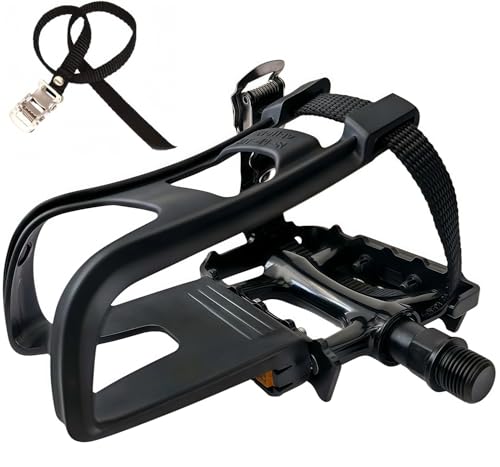
This second YBEKI set is the standard-platform version of the clip-and-strap formula: a pair of resin-and-alloy pedals with toe clips and straps, a 9/16-inch spindle, and a platform listed at a slightly more compact size than the NA008 above. Retailer specifications put its platform at roughly 3.74 by 2.52 inches, which makes it a neat fit for riders with average shoe sizes who find wider cage pedals clumsy in traffic.
In practice, a compact cage has real advantages for road riding in town. It is easier to flip the pedal into position with your toe at a stop, the clip is less likely to strike the ground when you corner with the inside pedal down, and the whole set feels less bulky when you are riding with the straps loose or removed for a short trip. The materials and general construction follow the same pattern as the rest of this class: an engineering resin body for low weight and weather resistance, alloy in the structure, and adjustable nylon straps doing the actual retention work.
Choose this set if you want the simplest possible upgrade from plain flat pedals on a road bike used for commuting and everyday rides, and your shoes are of average width. If you regularly ride longer distances and want the extra adjustment and platform support, step up to the NA008 from the same brand. Either way, confirm on the product page that the version in your basket is the toe clip version, because this brand sells several similar-looking pedal variants, including clipless hybrid models that are a different product entirely.
How to Choose Toe Clip Pedals for a Road Bike
Confirm the thread before anything else
Road bikes almost universally use 9/16-inch pedal threads, and every set in this guide uses that standard, but almost is not always. Some older or unusual cranks differ, and forcing a pedal cross-threaded into a crank arm can ruin the crank. If your bike is non-standard or you are unsure, check the crank maker’s specification first. Remember also that the left pedal is reverse-threaded: both pedals tighten towards the front of the bike.
Match the cage to your shoes, not your ambitions
You will ride these pedals in the shoes you actually wear, so measure the widest part of those shoes and compare it with the cage dimensions in the listing. A cage should admit the shoe smoothly with a wriggle, not a shove, and the strap should cross the foot ahead of the ankle where it can hold without digging in. Riders with wide shoes should start with the BUCKLOS; riders with narrow shoes should avoid oversized cages, because a loose cage delays your exit at a stop.
Understand straps before you tighten them
Begin with the straps loose enough that you can pull your foot straight back out without thinking. Ride that way until entering and exiting the cage is automatic, then take up a little slack at a time. Never ride in traffic with straps pulled fully tight until you have practised releasing them until it is boring. Many experienced riders leave the strap with a small amount of play permanently, which keeps most of the positioning benefit with a much easier exit.
Resin, alloy or aluminium: what the materials mean
Resin-and-alloy pedals are light, weatherproof and inexpensive, and they dominate the complete-set market for good reason. Their weakness is long-term abuse: repeated ground strikes and years of ultraviolet exposure age resin. Aluminium-bodied sets like the BUCKLOS cost and weigh more but shrug off knocks better. For commuting and general road riding, either is serviceable; choose by shoe fit and how roughly the bike is treated, not by chasing a traditional all-metal design that is now mostly sold as separate pedals, clips and straps rather than a complete set.
Fitting and Riding Safely
Fit pedals with the threads lightly greased, start both by hand to be certain they are not cross-threaded, and finish with a proper pedal wrench or the hex fitting if the spindle provides one. Set the clip position, where adjustment exists, so the ball of your foot sits over the spindle with your everyday shoes on. On your first rides, practise on a quiet street: roll up to a stop, pull one foot back and down, and put it on the ground, repeating until the movement needs no thought. Only then ride in busier traffic.
Keep the system maintained like any other pedal. Spin each pedal occasionally to check the bearings still run smoothly, inspect straps for fraying where they pass through the clip, and replace a worn strap before it fails rather than after. A toe clip pedal has no springs or release mechanism to service, which is much of its appeal, but that simplicity depends on the strap, the one part that does wear out.
Frequently Asked Questions
Are toe clip pedals the same as clipless pedals?
No. The names are confusingly similar but the systems are opposites. A toe clip is a cage and strap used with ordinary shoes, and your foot is held by friction and the strap alone. A clipless pedal mechanically locks a cleat on a special cycling shoe to the pedal and releases with a twist. This guide covers only cage-and-strap pedals, as listed above.
Can I ride toe clip pedals with normal trainers?
Yes, that is their main advantage. Any flat-soled shoe works, and a slightly stiffer sole is more comfortable on longer rides because it spreads the pressure of the pedal cage. Avoid very soft, deeply lugged soles, which can hang up on the cage when you try to pull your foot out.
Do toe clips actually make pedalling more efficient?
They keep the foot in the efficient position, stop it sliding forward under effort, and let you pull lightly through the bottom of the stroke and unweight the pedal on the way up. That is a real but modest gain for everyday road riding, and it is also why riders like them on fixed-gear and winter bikes. They do not turn a casual rider into a racer, and any claim beyond positioning and security should be treated with suspicion.
Why are most complete sets resin rather than metal?
Because the modern complete set is built as an affordable, weatherproof everyday product, and resin bodies with alloy reinforcement do that job well. Traditional all-metal quill pedals still exist, but they are usually bought as a pedal, then fitted with separate clips and straps. If you want that classic build, buy the components as a matched system rather than expecting a single boxed set.
How tight should the straps be for commuting?
Loose enough to exit instantly. For stop-start riding, most commuters run the strap merely snug, or even leave it open and rely on the cage alone for positioning. Save firmer straps for uninterrupted riding on quiet roads, and only after exiting the pedals has become automatic.