Our Short List of 3
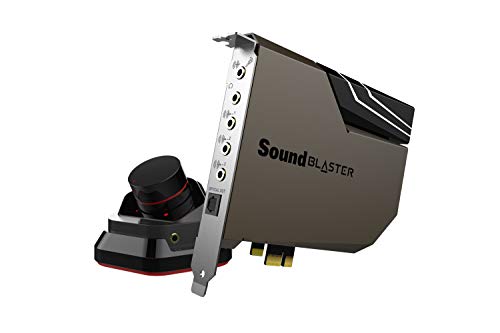
- ESS SABRE-class 9018 DAC with 127 dB DNR and 32-bit/384 kHz playback
- Discrete Xamp headphone bi-amp drives headphones up to 600 ohms
- Discrete 5.1 and virtual 7.1 surround with Dolby Digital Live and DTS encoding
- Desktop Audio Control Module for convenient volume and mic control

- 130 dB DAC with 32-bit/384 kHz playback and Xamp headphone amp
- Scout Mode, Dolby Digital and 7.1 virtual surround for competitive play
- Works with PC, PlayStation, Xbox and Nintendo Switch
- Compact and portable, with sidetone and speaker switching controls
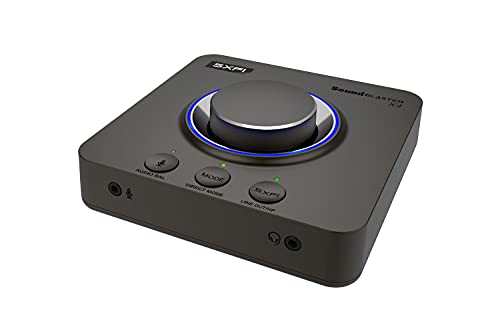
- True 7.1 discrete surround for speakers plus Super X-Fi for headphones
- Seven inputs and outputs, including optical-in and optical-out
- Large volume knob and front-panel controls for fast adjustments
- SmartComms Kit with two-way noise cancellation for voice chat
All 3 Picks at a Glance
| Product | Specs | Action |
|---|---|---|
| Creative Sound Blaster AE-7 |
| Check price on Amazon |
| Creative Sound BlasterX G6 |
| Check price on Amazon |
| Creative Sound Blaster X4 |
| Check price on Amazon |
Key takeaways
- Best creative sound cards for gaming compared in this guide: Sound Blaster AE-7, G6 and X4 DAC specs, surround modes and headphone amp for PC and console play.
Best Creative Sound Cards for Gaming
Finding the best creative sound cards for gaming means looking at one brand above all others: Creative Labs and its Sound Blaster line. For decades, Sound Blaster has been the default name in PC gaming audio, and the current range covers everything from internal PCIe cards that live inside a desktop tower to compact external USB DACs that move between a PC, a PlayStation and a Nintendo Switch. The right choice depends less on the logo on the box and more on how you play, what headphones or speakers you own, and whether you want a permanent install or a portable upgrade.
Onboard motherboard audio has improved over the years, but it still shares space and power with the rest of the board, which is where electrical noise creeps in. A dedicated Sound Blaster card or USB DAC isolates the audio path, adds a stronger headphone amplifier, and unlocks processing features such as Scout Mode, Super X-Fi headphone surround and Dolby Digital Live encoding. Those features are designed to make footsteps, reloads and distant gunfire easier to place in competitive games, and to make single-player worlds sound wider and more detailed.
This guide compares three Creative Sound Blaster models that suit different gaming setups: a high-end internal PCIe card for serious desktop rigs, a portable USB DAC for console and PC players, and a desktop USB hub for gamers who switch between speakers and headphones. Each one is a sound card in the same product family, so every recommendation below is a genuine Creative gaming sound card, not a headset or a speaker.
At a Glance
| Product | Best For | Key Spec |
|---|---|---|
| Creative Sound Blaster AE-7 | Desktop gamers with high-end headphones and speakers | ESS SABRE-class 9018 DAC, 127 dB DNR, 32-bit/384 kHz |
| Creative Sound BlasterX G6 | Console and PC gamers who want a portable DAC | 130 dB DAC, 32-bit/384 kHz, Xamp headphone amp |
| Creative Sound Blaster X4 | Gamers switching between speakers and headphones | 24-bit/192 kHz, 114 dB DAC, Super X-Fi, 7.1 discrete surround |
How to Choose a Creative Sound Card for Gaming
Internal PCIe or external USB. The first decision is physical. An internal PCIe card such as the AE-7 installs inside a desktop tower and connects directly to the motherboard, which keeps the audio path short and leaves the desk clear. It suits a fixed gaming rig with a free PCIe x1 slot. An external USB DAC such as the G6 or X4 sits on the desk, connects over USB, and can move between a PC, a laptop and a console. External units also give easy access to a volume knob and headphone jacks without reaching behind the case. Laptop gamers and console players should focus on USB models, while desktop-only players can choose either form factor.
DAC quality and signal-to-noise ratio. The digital-to-analog converter turns game audio data into the signal your headphones or speakers hear, and its quality sets the ceiling for clarity. Manufacturers quote dynamic range or signal-to-noise ratio in decibels, with higher figures indicating a cleaner signal. A card rated at 116 dB or above is already well beyond typical onboard audio, while flagship models reach 127 dB or 130 dB. Playback resolution matters too: 24-bit/192 kHz covers high-resolution game and music audio comfortably, while 32-bit/384 kHz is the top tier for listeners who want maximum headroom.
Headphone amplifier power. A sound card is only as useful as its ability to drive the headphones plugged into it. Many gaming headsets are easy to drive, but studio-grade and audiophile headphones can present loads of 250 or 600 ohms, which onboard audio and weak USB adapters struggle with. Creative’s Xamp discrete headphone amplifier appears across the range and is designed to drive headphones up to 600 ohms, with a low output impedance that keeps the sound clean. If your headphones are high-impedance models or planar-magnetic designs, put headphone amp power near the top of your checklist.
Surround processing and gaming modes. Stereo headphones cannot reproduce true surround sound on their own, so Sound Blaster cards use processing to simulate it. Scout Mode isolates high-frequency cues such as footsteps, Super X-Fi creates a wider headphone soundstage tuned to the listener, and SBX Pro Studio adds virtual surround, bass enhancement and dialogue clarity. Discrete 5.1 output matters if you run a speaker setup, while Dolby Digital Live and DTS Connect encoding let a card send surround sound to an external receiver over a single optical cable. Choose the processing suite that matches the games you play most.
Connectivity and platform support. Count the ports before buying. A desktop hub such as the X4 offers optical input and output, line-in, mic-in and headset-in, so it can sit between a PC, a console and a speaker system. The G6 is built for cross-platform play with PC, PlayStation and Xbox support, while the AE-7 focuses on a single desktop with its Audio Control Module for quick volume and mic control. Check that the card supports your operating system and console, and that it has the exact inputs your microphone and speakers need.
Software and long-term support. Creative’s Sound Blaster Command software controls equalizer settings, surround profiles, Scout Mode and RGB lighting where fitted. Game-specific EQ presets for popular titles are part of the package on newer models. Because a sound card can outlast several graphics card upgrades, it is worth choosing a model with recent driver support for current versions of Windows, so the card keeps working after system updates.
Creative Sound Blaster AE-7
- ESS SABRE-class 9018 DAC with 127 dB DNR and 32-bit/384 kHz playback
- Discrete Xamp headphone bi-amp drives headphones up to 600 ohms
- Discrete 5.1 and virtual 7.1 surround with Dolby Digital Live and DTS encoding
- Desktop Audio Control Module for convenient volume and mic control
The Sound Blaster AE-7 is the flagship internal PCIe card in this guide and the natural pick for a desktop gamer who wants the strongest DAC in the Creative lineup. At its heart is an ESS SABRE-class 9018 DAC rated at 127 dB DNR, paired with 32-bit/384 kHz PCM playback and DSD64 support. A quad-core audio processor handles the Sound Blaster effects without leaning on the main CPU, and the discrete Xamp headphone bi-amp amplifies each earcup channel individually, which is designed to preserve channel separation and drive studio-grade headphones up to 600 ohms.
Surround support is comprehensive. The card delivers discrete 5.1 audio to speakers and virtual 7.1 surround to headphones, with Dolby Digital Live and DTS encoding for sending surround sound to an external receiver. The included Audio Control Module sits on the desk and puts a large volume knob, headphone and microphone jacks, and mic controls within easy reach, so there is no need to reach around the back of the tower mid-game. The card measures 5.71 by 0.79 by 5.04 inches and needs a free PCIe x1 slot plus a spare drive bay or desk space for the control module.
This card is best for gamers with a permanent desktop setup, demanding headphones, and a speaker system they want to feed with real multichannel audio. Its main limitation is that it is tied to one desktop PC: laptop and console players need a USB model instead. Installation also takes more effort than plugging in a USB DAC, since the case must be opened and the card seated in a slot. Availability can vary, so check the listing for current availability before ordering.
Pros:
Cons:
Creative Sound BlasterX G6
- 130 dB DAC with 32-bit/384 kHz playback and Xamp headphone amp
- Scout Mode, Dolby Digital and 7.1 virtual surround for competitive play
- Works with PC, PlayStation, Xbox and Nintendo Switch
- Compact and portable, with sidetone and speaker switching controls
The Sound BlasterX G6 is a compact external USB DAC and headphone amplifier built for gamers who play across more than one platform. It uses a 130 dB audiophile-class DAC with 32-bit/384 kHz playback, the highest dynamic range figure in this guide, and pairs it with the Xamp discrete headphone amplifier, which drives headphones up to 600 ohms. The result is a small box that can sit beside a keyboard on a PC desk or next to a console, delivering cleaner audio than the built-in headphone output of either device.
Gaming features are the G6’s main strength. Scout Mode highlights subtle audio cues such as enemy footsteps, Dolby Digital decoding handles surround content, and 7.1 virtual surround widens the soundstage on headphones. Sidetone lets players hear their own voice through the headset during chat, and a dedicated speaker control switches output between headphones and speakers without unplugging anything. The unit works with PC, PlayStation 4, Xbox One and Nintendo Switch over USB, which makes it one of the most flexible options in the Creative range for players who split time between systems.
The G6 is best for console and PC gamers who want a portable upgrade they can carry between setups, and for headphone players who value a strong amp in a small footprint. Its limitation is that it is a headphone-focused device rather than a full speaker hub: it offers virtual rather than discrete multichannel output, so a dedicated speaker setup is better served by the AE-7 or the X4. It also has fewer inputs than a desktop hub, with line and optical connections covering the essentials rather than every possible source. Check the listing for current availability before ordering.
Pros:
Cons:
Creative Sound Blaster X4
- True 7.1 discrete surround for speakers plus Super X-Fi for headphones
- Seven inputs and outputs, including optical-in and optical-out
- Large volume knob and front-panel controls for fast adjustments
- SmartComms Kit with two-way noise cancellation for voice chat
The Sound Blaster X4 is a desktop external USB DAC and amp that acts as a full audio hub for a gaming desk. It offers hi-res 24-bit/192 kHz playback through a 114 dB DAC, Super X-Fi headphone holography, and true 7.1 discrete surround output for speaker systems, a combination that covers both headphone and speaker gaming in one device. Seven input and output connectors include optical-in, optical-out, line-in, mic-in and headset-in, so the X4 can connect a PC, a console, a microphone and a speaker set at the same time.
The front panel is designed for quick changes during play. A large volume knob with a blue LED ring sits alongside buttons for audio balance, direct mode and Super X-Fi switching, plus microphone and headphone jacks on the front edge. The SmartComms Kit adds two-way noise cancellation for voice chat, and the unit supports PC, Mac, PlayStation 5, PlayStation 4 and Nintendo Switch. At 129 by 129 by 41 mm and 330 grams, it is a substantial desktop unit rather than a pocket DAC, and it takes up a noticeable amount of desk space.
This card is best for gamers who switch between headphones and a speaker system and want one device to manage both, and for players who value Super X-Fi headphone surround alongside real multichannel speaker output. Its 114 dB DAC rating is lower than the flagship figures of the AE-7 and G6, which matters most to listeners chasing the cleanest possible signal with very revealing headphones. The size is also a trade-off for smaller desks. Check the listing for current availability before ordering.
Pros:
Cons:
Which One Fits You
The three cards split cleanly by setup. Choose the AE-7 if you have a desktop tower with a free PCIe slot, demanding headphones, and a speaker system you want to drive with discrete 5.1 audio. Its 127 dB DAC and Xamp bi-amp make it the strongest pure audio performer here, and the Audio Control Module keeps volume and microphone controls on the desk where they belong.
Choose the G6 if you play on more than one platform or want the most portable option. Its 130 dB DAC is the highest figure in this guide, and its compact USB design moves easily between a PC, a PlayStation and an Xbox. It is the best fit for headphone-first gamers who value Scout Mode and cross-platform support over multichannel speaker output.
Choose the X4 if your desk has both headphones and speakers and you want one hub to manage them. Its seven connectors, optical input and output, and true 7.1 discrete surround make it the most versatile of the three for mixed setups, while Super X-Fi gives headphone gaming a wider soundstage. If your listening is entirely through headphones and you want the cleanest signal possible, the AE-7 or G6 edges ahead on DAC specifications.
Frequently Asked Questions
Do I need a sound card if my motherboard already has audio?
Not everyone does, but a dedicated Sound Blaster card adds a cleaner DAC, a stronger headphone amplifier, and gaming processing such as Scout Mode and Super X-Fi that onboard audio does not offer. The difference is most noticeable with good headphones or a speaker system, and least noticeable with basic earbuds or a cheap headset.
What is the difference between the AE-7 and the G6?
The AE-7 is an internal PCIe card for a single desktop PC, with a 127 dB DAC, discrete 5.1 speaker output and a desktop Audio Control Module. The G6 is an external USB DAC that works with PC and consoles, with a 130 dB DAC and 7.1 virtual surround for headphones. Choose the AE-7 for a fixed desktop with speakers, and the G6 for portability and console play.
Can Creative sound cards work with PlayStation and Xbox?
External USB models such as the G6 and X4 support consoles, with the G6 covering PlayStation 4, Xbox One and Nintendo Switch, and the X4 adding PlayStation 5 support. Internal PCIe cards such as the AE-7 work only in a desktop PC. Always confirm the exact console support on the product listing for the model you choose.
What does Scout Mode do in games?
Scout Mode is a Sound Blaster processing feature that isolates and amplifies high-frequency audio cues such as footsteps, weapon reloads and distant movement. It is aimed at competitive shooters, where hearing an opponent before seeing them can decide a round. It can be toggled on and off in software or from the device controls.
Is Super X-Fi the same as virtual surround sound?
Super X-Fi is Creative’s headphone holography technology, which aims to recreate the sound of a multichannel speaker system in headphones, tuned to the listener’s head and ear shape. Standard virtual surround also simulates direction in headphones, but Super X-Fi adds personalization and a wider sense of space. Both are designed for headphone listening rather than speaker output.
Do Creative sound cards need extra software?
The cards work with standard drivers, but the full feature set, including equalizer settings, surround profiles, Scout Mode and RGB lighting, is controlled through the free Sound Blaster Command software for PC. Downloading the latest version from Creative after installation keeps the card’s features and drivers up to date.
Conclusion
The best creative sound cards for gaming all come from the Sound Blaster family, and the right pick depends on where and how you play. The AE-7 suits a dedicated desktop rig with demanding headphones and a speaker system, the G6 suits players who move between PC and console with a portable DAC, and the X4 suits a mixed desk where headphones and speakers share one hub. All three offer cleaner audio than typical onboard sound, stronger headphone amplification, and gaming-focused processing that helps in competitive play. Match the form factor to your setup first, then weigh DAC quality, headphone power and surround features, and check the listing for current availability before ordering.
Disclosure: As an Amazon Associate, we earn from qualifying purchases.