Our Short List of 3
- Best for: Workshops and garages where some jobs run longer than a single battery pack.
- Capacity: 2 gallons
- Power source: 18V or 20V MAX battery pack, or corded electric
- Filter: HEPA filter
- Included: wide nozzle

- Best for: Tradespeople and mobile workers who already transport tools in PACKOUT cases.
- Capacity: 2.5 gallons
- Battery system: Milwaukee M18, 18 volts
- Wattage: 800 watts
- Storage: PACKOUT modular system compatible

- Best for: Sanding, plaster and renovation cleanup where fine dust control matters most.
- Battery system: Makita 18V LXT lithium-ion
- Motor: brushless
- Capacity: 2 gallons
- Filter: HEPA filter
All 4 Picks at a Glance
| Product | Specs | Action |
|---|---|---|
| DEWALT DCV581H 20V MAX Cordless/Corded Wet/Dry Vacuum |
| Check price on Amazon |
| Milwaukee 0970-20 M18 FUEL PACKOUT 2.5-Gallon Wet/Dry Vacuum |
| Check price on Amazon |
| Makita XCV11Z 18V LXT Brushless Wet/Dry Dust Extractor |
| Check price on Amazon |
 CRAFTSMAN CMCV002B V20 Cordless Wet/Dry Vacuum |
| Check price on Amazon |
Key takeaways
- Five cordless wet/dry vacuums that run on removable tool-platform battery packs, compared by tank size, airflow, filtration and hose reach for cleanup.
Choosing a cordless wet/dry vacuum is really two decisions stacked on top of each other. The first is the vacuum itself: tank size, airflow, filtration. The second, which matters more over the years you own it, is the battery platform. A model with a removable pack turns runtime into a swapping decision instead of a hard limit, because a spent pack clicks off and a charged one clicks on in seconds. It also means the packs already sitting on your charger shelf may have decided the brand for you.
This guide is for homeowners clearing garage and car messes, DIYers who want a shop vacuum that travels from room to room, and tradespeople who already carry one brand of cordless tools. Every pick below runs on a removable slide-on battery pack from a major tool platform, and the picks were chosen from the product names and specifications published on their Amazon pages, including tank capacity, listed airflow, filter type and battery system.
Quick Picks
As an Amazon Associate we earn from qualifying purchases
| Product | Best for | Key spec from title |
|---|---|---|
| Milwaukee 0880-20 M18 2-Gallon Wet/Dry Vacuum | M18 owners who want one vac for the truck and the workshop | 45 CFM airflow, 2-gallon tank |
| DEWALT DCV581H 20V MAX Cordless/Corded Wet/Dry Vacuum | Shops that want battery freedom with a corded fallback | Runs on an 18V/20V MAX pack or a power cord |
| Milwaukee 0970-20 M18 FUEL PACKOUT 2.5-Gallon Wet/Dry Vacuum | PACKOUT users who stack their gear for transport | 2.5-gallon tank, PACKOUT compatible |
| Makita XCV11Z 18V LXT Brushless Wet/Dry Dust Extractor | Fine dust control during sanding and renovation work | Brushless motor, HEPA filter, 2-gallon tank |
| CRAFTSMAN CMCV002B V20 Cordless Wet/Dry Vacuum | V20 owners who need reach around vehicles and benches | 7 ft hose, 35 CFM airflow, 2-gallon tank |
How to Choose
Start with the battery platform you already own
A replaceable battery only saves you money and shelf space if it matches packs you already have. Every vacuum in this guide locks into one maker’s system: Milwaukee M18, DEWALT 18V/20V MAX, Makita 18V LXT or CRAFTSMAN V20, and none of those packs fit a rival brand’s tools. If your drill, impact driver and circular saw already share a charger, buy the vacuum from that same family and the bare tool is the whole purchase. If you are starting from zero, you are really choosing the platform first and the vacuum second, because the first battery and charger kit follows you into every later tool.
Match tank size to the mess, not the shelf
Most removable-pack wet/dry vacuums cluster around 2 gallons, with the PACKOUT Milwaukee stretching to 2.5. A 2-gallon tank is easy to carry one-handed and empties quickly, which suits sawdust piles, car footwells and small spills. It fills fast on flooded corners or drywall debris, though, and every extra emptying trip costs more time than a slightly heavier tank would. Think about your biggest realistic cleanup rather than the average one: frequent small jobs favour the compact toolbox shapes, while renovation work rewards the extra half gallon and a tank you can set down and drag by the hose.
Read the listed airflow before any suction claim
Manufacturers rate these vacuums in CFM, the volume of air moved, and the listings in this guide range from 35 CFM for the CRAFTSMAN to 45 CFM for the Milwaukee 0880-20. Airflow is what carries chips, screws and grit up the hose, so a higher figure generally means fewer clogs on coarse debris. Treat the number as a comparison between listings rather than a promise, because hose diameter and attachments change real-world pickup. If your mess is mostly fine dust, filtration matters more than raw airflow; if it is gravel, offcuts and water, airflow and hose diameter do the heavy lifting.
Check the filter setup before the first wet job
Four of the five picks ship with a HEPA filter, which is what you want for drywall dust, MDF particles and allergen-heavy debris. Wet pickup is where buyers get caught out: many cartridge filters are meant to be removed, or swapped for a foam sleeve, before the vacuum swallows liquid, and running water through a dry-rated paper cartridge shortens its life. Before ordering, read the listing for what the vacuum includes in the box and what the maker says about wet use, and budget for the correct filter or sleeve if your cleanups regularly involve spills.
The 5 Best Options
Milwaukee 0880-20 M18 2-Gallon Wet/Dry Vacuum
The Milwaukee 0880-20 is the default answer for anyone already invested in the M18 platform, and its toolbox shape explains why it shows up in so many work trucks. The listing rates it at 45 CFM, the strongest airflow figure in this guide, and the 2-gallon tank, hose and attachments all store inside the unit’s footprint. It works with every M18 slide-on pack, so runtime scales with whatever batteries you already own, from compact packs for quick jobs to high-capacity packs for a full afternoon of cleanup.
Specs
- Capacity: 2 gallons
- Air flow: 45 CFM
- Filter: HEPA filter, washable
- Hose length: 6 feet
- Battery system: Milwaukee M18 lithium-ion packs; listing cites up to 30 minutes of runtime depending on pack
- Included: flexible hose, crevice tool, utility nozzle and filter
- Weight: 10.1 pounds
- Sold as: bare tool, battery and charger not included
Best for: M18 owners who want one portable vacuum for the vehicle, the bench and the jobsite.
Watch out for: It is a bare tool, so the purchase only makes sense if you already own M18 packs and a charger.
ASIN: B07FB26QRD
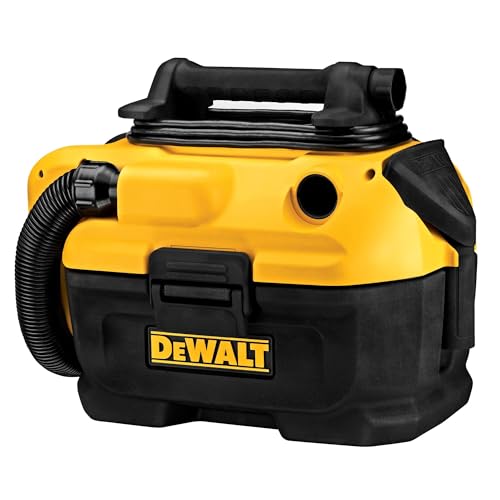
DEWALT DCV581H 20V MAX Cordless/Corded Wet/Dry Vacuum
- Best for: Workshops and garages where some jobs run longer than a single battery pack.
- Capacity: 2 gallons
- Power source: 18V or 20V MAX battery pack, or corded electric
- Filter: HEPA filter
- Included: wide nozzle
Workshops and garages where some jobs run longer than a single battery pack.
Confirm the listing variant is the DCV581H cordless/corded model, since DEWALT sells a similar corded-only version.
The DEWALT DCV581H hedges the one weakness of every battery vacuum: a dead pack halfway through a flooded corner. It runs on an 18V or 20V MAX battery pack for cordless work, then plugs into a wall outlet when the cleanup turns long, so the removable battery is a convenience rather than a single point of failure. The 2-gallon tank and HEPA filter put it in the same class as the other picks here, and the wide nozzle in the box suits flat floors and mats. For DEWALT households it is the flexible middle ground between a pure cordless and a pure corded shop vacuum.
Milwaukee 0970-20 M18 FUEL PACKOUT 2.5-Gallon Wet/Dry Vacuum
- Best for: Tradespeople and mobile workers who already transport tools in PACKOUT cases.
- Capacity: 2.5 gallons
- Battery system: Milwaukee M18, 18 volts
- Wattage: 800 watts
- Storage: PACKOUT modular system compatible
Tradespeople and mobile workers who already transport tools in PACKOUT cases.
The PACKOUT footprint is wider than a toolbox-style vac, so check your shelf or vehicle space before ordering.
The Milwaukee 0970-20 is built for people whose tools already travel in PACKOUT stacks. Its base locks onto Milwaukee’s modular storage system, so the vacuum rides on top of your toolboxes instead of sliding around the truck bed, and the 2.5-gallon tank is the largest in this guide. As part of the FUEL line it uses a brushless motor, and it runs on the same removable M18 packs as the rest of the platform. If your cleanup happens wherever the stack goes, at a rental property, a site cabin or a market stall, that transport integration is the real feature.
Makita XCV11Z 18V LXT Brushless Wet/Dry Dust Extractor
- Best for: Sanding, plaster and renovation cleanup where fine dust control matters most.
- Battery system: Makita 18V LXT lithium-ion
- Motor: brushless
- Capacity: 2 gallons
- Filter: HEPA filter
Sanding, plaster and renovation cleanup where fine dust control matters most.
Availability on Amazon US currently runs through third-party sellers, so check the seller and confirm the model is the XCV11Z, not the Outdoor Adventure variant.
The Makita XCV11Z is positioned less as a shop vacuum and more as a portable dust extractor, which makes it the natural pick when the mess is fine powder rather than chunks. Its brushless motor and HEPA filter, which Makita rates to capture 99.97% of particulates 0.3 microns and larger, target sanding dust, plaster and renovation debris. The 2-gallon unit runs on any removable 18V LXT pack and carries with a shoulder strap, so it follows the work around a room instead of sitting in one corner waiting for the mess to come to it.
CRAFTSMAN CMCV002B V20 Cordless Wet/Dry Vacuum
- Best for: V20 owners cleaning cars, garages and utility rooms where hose reach beats raw airflow.
- Capacity: 2 gallons
- Air flow: 35 CFM
- Hose length: 7 feet
- Filter: HEPA filter
V20 owners cleaning cars, garages and utility rooms where hose reach beats raw airflow.
Some listings bundle this vacuum with a fast charger, so check exactly what the box includes before comparing offers.
The CRAFTSMAN CMCV002B is the reach pick of the group. Its 7 ft hose is the longest listed here, which matters when the vacuum sits on the garage floor while the nozzle works through a car interior or under a bench. The listing states 35 CFM of airflow, lower than the Milwaukee 0880-20, so it suits household debris, pet messes and light workshop dirt better than heavy construction waste. It runs on the same removable V20 packs as CRAFTSMAN’s drills and garden tools, with a HEPA filter for dry pickup, and the bare-tool format keeps it a simple add-on for existing V20 shelves.
Which One Fits Your Situation
You already carry one brand of cordless tools
Buy inside your platform and skip the battery maths entirely. M18 owners choose between the toolbox-style 0880-20 for general work and the PACKOUT 0970-20 if their gear travels in stacks. DEWALT owners get the DCV581H, Makita owners the XCV11Z and CRAFTSMAN owners the CMCV002B. Because every pack you own becomes vacuum runtime, a platform you already charge daily is worth more than a small spec advantage from a rival brand.
Your cleanups sometimes outlast a battery
Pick the DEWALT DCV581H. It is the only model here that runs from a wall outlet as well as a removable pack, so a long wet cleanup never stops at an empty battery. The alternative is discipline: keep two charged packs in rotation for any of the other four vacuums, one in the tool and one on the charger, and swap as needed.
The mess is fine dust, not chunks
Choose the Makita XCV11Z. Its brushless motor, HEPA filtration rated at 99.97% of particulates 0.3 microns and larger, and shoulder-strap portability are all aimed at sanding and renovation dust that drifts everywhere. The Milwaukee 0880-20 also carries a HEPA filter and stronger listed airflow, so it is the fallback if you are on the M18 platform instead of Makita’s.
You clean vehicles and tight corners most
Take the CRAFTSMAN CMCV002B for its 7 ft hose, which reaches across a car interior without dragging the tank behind you, or the Milwaukee 0880-20 if you want the higher 45 CFM airflow for grit and gravel in footwells. Both store compactly, both run on removable packs, and the deciding factor is usually which battery family already lives in your garage.
Common Mistakes
- Buying a bare-tool vacuum without owning the matching battery platform, then discovering the first pack and charger cost as much as the vacuum.
- Assuming removable packs are interchangeable between brands; M18, 20V MAX, 18V LXT and V20 packs each fit only their own family of tools.
- Judging runtime by the vacuum alone instead of the amp-hour rating of the pack you slide into it, since a compact pack and a high-capacity pack behave very differently.
- Running wet pickup through a dry cartridge filter without checking the listing’s guidance, which can ruin the filter and void the easy cleanup you bought the vacuum for.
- Choosing on tank gallons alone while ignoring hose length and storage shape, the two things that decide whether the vacuum actually gets used weekly.
Frequently Asked Questions
Can I use another brand’s battery in these vacuums?
No. Each model accepts only its own platform’s removable packs: Milwaukee M18, DEWALT 18V/20V MAX, Makita 18V LXT or CRAFTSMAN V20. The packs differ in shape, contacts and electronics, and adapter plates sold by third parties are not endorsed by the tool makers. Match the vacuum to the batteries you already own, or budget for a starter kit in that platform.
How long will a cordless wet/dry vacuum run on one pack?
It depends on the pack’s amp-hour rating more than on the vacuum. Milwaukee’s listing for the 0880-20 cites up to 30 minutes of runtime, and larger high-capacity packs stretch that further while compact packs shorten it. For long jobs, either rotate two packs or choose the DEWALT DCV581H, which can switch to corded power when the battery runs out.
Does tool only mean the battery is built in?
It means the opposite. Tool only, or bare tool, listings ship the vacuum without a battery or charger because the battery is a separate removable pack you are expected to own already. Every vacuum in this guide takes a slide-on pack that clicks off for charging or replacement, which is exactly what makes mid-job swaps and eventual battery replacement simple.
Can these vacuums pick up water with the filter fitted?
Usually with a change first. Most cartridge HEPA filters are intended for dry debris, and makers typically direct you to remove the cartridge or fit a foam sleeve before wet pickup. The correct step varies by model, so check the listing and manual for your vacuum before its first spill, and let a filter used near liquid dry fully before dry work.