Our Short List of 3
All 5 Picks at a Glance
| Product | Specs | Action |
|---|---|---|
 1. Renogy 12V 100Ah Deep Cycle AGM Battery | Check price on Amazon | |
 2. Mighty Max ML100-12 SLA AGM Battery | Check price on Amazon | |
 3. LiTime 12V 100Ah Group 31 LiFePO4 Battery | Check price on Amazon | |
 4. LiTime 12V 100Ah Group 24 LiFePO4 Battery | Check price on Amazon | |
 5. ECO-WORTHY 12V 100Ah LiFePO4 Battery with Bluetooth | Check price on Amazon |
Key takeaways
- A guide to how much can you discharge a deep cycle battery: safe limits for AGM and lithium types, plus five 100Ah options for RV, marine, and off-grid use.
Disclosure: As an Amazon Associate, this site may earn from qualifying purchases made through links on this page.
Intro
How much can you discharge a deep cycle battery? The short answer depends on the chemistry inside the case. A lead-acid deep cycle battery, including flooded and AGM types, should give up about half of its rated capacity on a regular cycle. A lithium iron phosphate battery, usually called LiFePO4, can give up four-fifths to the full rated capacity on a regular cycle. That single difference decides how much usable energy you actually carry, and it explains why a 100Ah lithium battery often does the work of a much larger lead-acid battery.
Depth of discharge, shortened to DoD, is the share of a battery rated capacity that you use before recharging. A 100Ah battery drawn down to half holds 50Ah of usable energy at that depth. Draw the same battery down to four-fifths and you use 80Ah. The deeper you go on every cycle, the fewer cycles the battery gives you before its capacity fades. Lead-acid chemistry suffers the most from deep cycling, because the plates sulfate and shed material when they sit at a low charge. Lithium chemistry handles deep cycling far better, because its cells keep their voltage steady across most of the discharge curve and suffer little damage from a full draw.
This guide explains the safe limits for each chemistry, shows how to size a battery bank, and walks through five 100Ah deep cycle batteries sold on Amazon US. Every pick below is a 12V 100Ah deep cycle battery, so the capacity math stays simple and the comparison stays honest. Two are AGM lead-acid, three are LiFePO4, and together they cover the two main ways people answer this question in real life: buy a heavier lead-acid battery and use half of it, or buy a lighter lithium battery and use nearly all of it.
At a Glance
- Flooded lead-acid: use about half of the rated capacity per cycle. Going below that on a regular basis shortens the life of the plates.
- AGM lead-acid: use about half of the rated capacity per cycle, the same as flooded. An occasional deeper draw does not end the battery at once, but it does wear it down sooner.
- Gel lead-acid: use about half of the rated capacity per cycle, the same as the other lead-acid types.
- LiFePO4 lithium: use four-fifths to the full rated capacity per cycle. Maker listings for the lithium picks below describe 4000 or more cycles at a full discharge.
- The five picks: Renogy 12V 100Ah AGM, Mighty Max ML100-12, LiTime 12V 100Ah Group 31, LiTime 12V 100Ah Group 24, and ECO-WORTHY 12V 100Ah with Bluetooth.
- Quick math: a 100Ah AGM battery gives about 50Ah of usable energy per cycle, and a 100Ah LiFePO4 battery gives about 80Ah to 100Ah.
- Recharge promptly: bring a lead-acid battery back to a full charge as soon as you can after each use.
How to Choose
Start with your daily energy need, measured in amp-hours. Add up what your loads draw and for how long they run, then divide by the usable share of the chemistry you plan to buy. If your daily need is 40Ah and you buy AGM, you need a rated capacity of about 80Ah, because only half is usable on a regular cycle. If your daily need is 40Ah and you buy LiFePO4, a 50Ah rated battery covers it at four-fifths usable, and a 100Ah rated battery covers two days. This one calculation keeps you from buying a battery that looks big on paper and runs dry at noon.
Chemistry decides weight, life, and usable energy. A 100Ah AGM battery in this guide weighs about 61 to 64 pounds. A 100Ah LiFePO4 battery in this guide weighs about 21 to 23 pounds, roughly one-third of the AGM weight. Lithium also holds its voltage steady while it discharges, so lights stay bright and motors keep their speed until the battery is nearly empty. Lead-acid voltage sags as it discharges, so the same loads run weaker near the end of a cycle.
Size and group number decide fit. Group 24 cases measure about 10.2 inches long and fit most RV and marine battery boxes built for that group. Group 31 cases measure about 13 inches long and need a larger box. Group 30H sits between them. Measure your box before you buy, and check the terminal style. The Mighty Max pick below uses internal thread terminals, which need bolts or adapters that do not come in the box. The lithium picks below use M8 terminals, which take a ring lug and a nut.
A battery management system, shortened to BMS, is the guard inside a lithium battery. It watches for overcharge, over-discharge, short circuits, and high temperature, and it cuts the current when a limit is crossed. The lithium picks below all carry a BMS, and the LiTime Group 31 pick lists a 100A BMS. Check the BMS current limit against your largest load, because an inverter or a trolling motor that asks for more current than the BMS allows will trip the guard and shut the battery down.
Temperature range matters for outdoor use. The Renogy AGM pick lists discharge from 4 degrees below zero to 140 degrees Fahrenheit, which covers most camping and marine seasons. Lithium batteries charge poorly below freezing, so look for a low-temperature charge guard if you camp in winter. The ECO-WORTHY pick below lists low-temperature protection, and its Bluetooth link lets you watch voltage, current, and remaining capacity from your phone.
Warranty and expansion round out the choice. The LiTime Group 31 pick lists a five-year warranty, and the LiTime Group 24 pick lists a ten-year life with 4000 or more cycles at a full discharge. AGM picks in this guide allow series and parallel connections, and the Renogy pick lists parallel connections up to four batteries. If you plan to grow the bank later, buy a model that is still sold in the same size, so the new battery matches the old one.
The Picks
1. Renogy 12V 100Ah Deep Cycle AGM Battery
The Renogy 12V 100Ah AGM battery is the steady lead-acid pick in this guide, and it suits a buyer who wants a sealed AGM battery with a long record in RV, solar, and marine use. Its listing describes more than 230,000 units sold worldwide across six years, and it lists a maximum discharge current of 1100A, which covers short bursts from inverters and motors without strain. The sealed AGM build needs no watering and spills nothing when the battery tips.
Use half of its 100Ah nameplate capacity on a regular cycle, which gives about 50Ah of usable energy per day. That covers a small RV lighting and fan setup, a fish finder and a livewell pump, or a solar-charged cabin with modest loads. The listing gives a discharge range of 4 degrees below zero to 140 degrees Fahrenheit, so it keeps working through cold mornings and hot afternoons. It supports series connections with no stated limit and parallel connections up to four batteries, so you can grow the bank later by adding an identical unit.
The Renogy suits a buyer who already runs AGM gear and wants a drop-in replacement with no charger change. Lithium batteries often need a charger with a lithium setting, while this AGM battery works with the standard chargers found in most RVs and boats. Its weight is the trade-off: at 63.9 pounds it is about three times the weight of the lithium picks below, so plan the lift and the mounting before you buy.
Renogy 12V 100Ah Deep Cycle AGM Battery
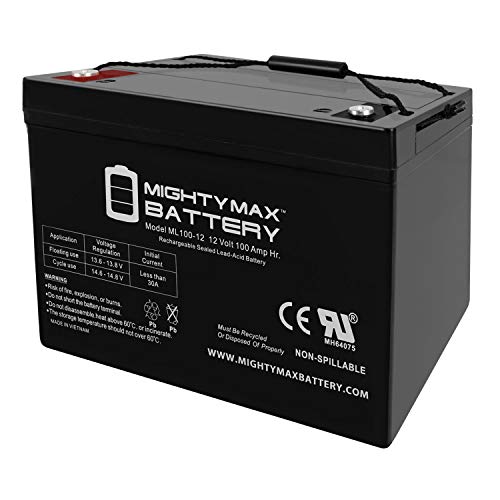
2. Mighty Max ML100-12 SLA AGM Battery
The Mighty Max ML100-12 is a 12V 100Ah sealed lead-acid AGM battery in a Group 30H case, and it is the second lead-acid pick in this guide. It weighs 61 pounds, and its listing carries a UL certification. Like the Renogy, it gives about 50Ah of usable energy on a regular cycle when you hold it to half of its rated capacity.
The detail that needs attention is the terminal style. The ML100-12 uses internal thread terminals, which need bolts or adapters that are not included in the box. Buy the hardware with the battery, and confirm the thread size before you order, because a battery that arrives without a way to connect it is a battery that cannot run anything. Once connected, it serves the same roles as the Renogy: RV house power, marine use, solar storage, and backup power for small off-grid setups.
The Mighty Max suits a buyer who wants a Group 30H case and does not mind sourcing terminal hardware. Its weight and usable energy match the Renogy closely, so the choice between the two comes down to case size, terminal style, and which one fits the box you already own.
Mighty Max ML100-12 SLA AGM Battery
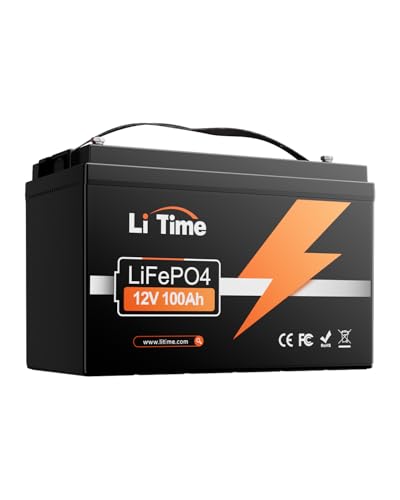
3. LiTime 12V 100Ah Group 31 LiFePO4 Battery
The LiTime 12V 100Ah Group 31 battery is the lithium pick for a buyer who wants the most usable energy from a single 100Ah case. Its listing describes up to 15000 cycles, a ten-year-plus life, and a 100A built-in BMS that guards against overcharge, over-discharge, short circuits, over-voltage, over-current, and over-temperature. It weighs 22.1 pounds, about one-third of the AGM picks above, and it measures 13 inches long by 6.77 inches deep by 8.5 inches high, with M8 terminals.
Use four-fifths to the full rated capacity on a regular cycle, which gives about 80Ah to 100Ah of usable energy per cycle. That is roughly double the usable energy of a 100Ah AGM battery from a case that weighs about 40 pounds less. The listing gives a five-year warranty and 24-hour technical support, and it notes AIG product liability insurance coverage for the product. It also states the battery is not compatible with MerCruiser and Mercury motors, so boat owners with those motors should check fit before buying.
The LiTime Group 31 suits a buyer who is switching from lead-acid to lithium and wants a Group 31 case that drops into the same box.
LiTime 12V 100Ah Group 31 LiFePO4 Battery
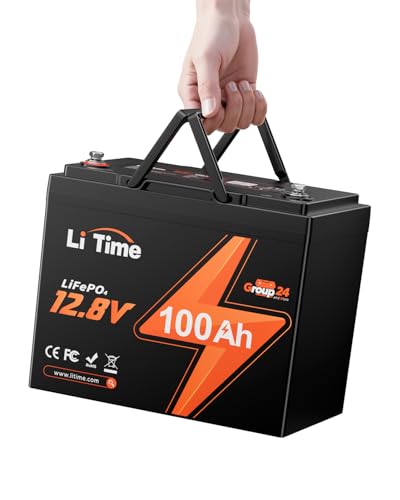
4. LiTime 12V 100Ah Group 24 LiFePO4 Battery
The LiTime 12V 100Ah Group 24 battery is the lithium pick for a smaller box. It measures 10.24 inches long by 6.61 inches deep by 8.27 inches high, and it weighs 21 pounds. Its listing describes 1280 watt-hours of energy with the full rated capacity usable, against a 70Ah AGM battery that gives 504 watt-hours at a three-fifths discharge depth. That comparison shows the core advantage of lithium in one number: the same box size holds far more usable energy.
Its listing describes 4000 or more cycles at a full discharge, with a ten-year life, and automotive-grade LiFePO4 cells with a BMS that guards against overcharge, over-discharge, and overcurrent. It expands from a single 1.28 kilowatt-hour unit up to 20.48 kilowatt-hours with 16 batteries in a four-parallel by four-series layout, so a buyer who starts small can grow into a whole-house backup bank with the same model. It also notes the same MerCruiser and Mercury motor limitation as its Group 31 sibling.
The LiTime Group 24 suits a buyer whose battery box is built for Group 24 and who wants lithium without cutting a larger opening. It is the lowest-weight pick in this guide, and its expansion path makes it the best starting point for a bank that will grow over time.
LiTime 12V 100Ah Group 24 LiFePO4 Battery
5. ECO-WORTHY 12V 100Ah LiFePO4 Battery with Bluetooth
The ECO-WORTHY 12V 100Ah LiFePO4 battery adds phone monitoring to the lithium lineup. It carries Bluetooth 5.1, so you can watch battery voltage, current, and remaining capacity from your phone while the battery runs. Watching the remaining capacity is the simplest way to hold a battery to its safe discharge limit.
It is a Group 24 case, measuring 10.24 inches long by 6.61 inches deep by 8.43 inches high, and it weighs 23.2 pounds. Its listing describes low-temperature protection, which guards the cells when the weather turns cold, and M8 terminals. Like the other lithium picks, it gives four-fifths to the full rated capacity as usable energy, about 80Ah to 100Ah per cycle from a 100Ah nameplate capacity.
The ECO-WORTHY suits a buyer who wants to see the battery state without opening a compartment or adding a separate monitor. The Bluetooth link turns the discharge question into a number on a screen, and that makes it easier to stop drawing power before the battery reaches a depth you did not intend.
ECO-WORTHY 12V 100Ah LiFePO4 Battery with Bluetooth
Comparison Table
| Pick | Chemistry | Rated Capacity | Usable Share per Cycle | Weight | Group Size | ASIN |
|---|---|---|---|---|---|---|
| Renogy 12V 100Ah AGM | AGM lead-acid | 100Ah | About half | 63.9 lb | Group 31 | B075RFXHYK |
| Mighty Max ML100-12 | AGM lead-acid | 100Ah | About half | 61 lb | Group 30H | B00S1QCK94 |
| LiTime Group 31 | LiFePO4 | 100Ah | Four-fifths to full | 22.1 lb | Group 31 | B084DB36KW |
| LiTime Group 24 | LiFePO4 | 100Ah | Four-fifths to full | 21 lb | Group 24 | B0CY2KMXK8 |
| ECO-WORTHY Group 24 | LiFePO4 | 100Ah | Four-fifths to full | 23.2 lb | Group 24 | B09L89LW3P |
Which One Fits Your Situation
If you run an RV or a boat with an existing AGM charger and you want a drop-in replacement, the Renogy or the Mighty Max fits. Both give about 50Ah of usable energy per cycle, both weigh about 61 to 64 pounds, and both work with standard chargers. Pick the Renogy for its 1100A maximum discharge current and its wide temperature range, and pick the Mighty Max when your box is built for Group 30H and you have terminal hardware ready.
If you want the most usable energy from one battery, the LiTime Group 31 fits. Its 100A BMS, its 15000-cycle claim, and its 22.1-pound weight make it the strongest single-battery upgrade in this guide, and it drops into a Group 31 box without modification.
If your battery box is Group 24 and you want lithium, the LiTime Group 24 or the ECO-WORTHY Group 24 fits. Both weigh about 21 to 23 pounds and give four-fifths to the full rated capacity as usable energy. Pick the LiTime Group 24 for its expansion path to a larger bank, and pick the ECO-WORTHY for its Bluetooth monitoring and low-temperature protection.
If you are unsure about chemistry, start from the weight you can lift and the charger you already own. A lithium battery needs a charger with a lithium setting, and an AGM battery needs no change. The usable-energy gap is real, but a battery that does not match your charger is a battery that never reaches a full charge.
FAQ
Can I discharge an AGM battery to zero?
You can, but you should not do it on a regular basis. A lead-acid battery drawn to zero sulfates heavily and loses capacity sooner, and it may not come back to its full capacity even after a long charge. Hold an AGM battery to about half of its rated capacity on a regular cycle.
What happens if I go below half on a lead-acid battery?
The voltage sags, the plates sulfate, and the battery holds less energy on the next cycle. One deep draw does not end a healthy battery at once, but a habit of deep draws shortens its life in a visible way. Recharge promptly after a deep draw, and do not leave the battery sitting at a low charge.
How do I measure depth of discharge?
The simplest way is a battery monitor that counts amp-hours in and out, or a Bluetooth battery like the ECO-WORTHY pick that shows remaining capacity on your phone. Voltage alone is a rough guide, because voltage sags under load and rises when the load stops. A monitor that tracks amp-hours gives a steadier reading.
Can I mix AGM and lithium batteries in one bank?
No. AGM and lithium batteries charge at different voltages, discharge at different curves, and age at different speeds. A mixed bank forces one chemistry to work outside its safe range, and the weaker battery drags the whole bank down. Build a bank from identical batteries of one chemistry, one size, and one age.
How soon should I recharge after a deep discharge?
As soon as you can. A lead-acid battery left at a low charge starts to sulfate within hours, and the longer it sits, the more capacity it loses. A lithium battery tolerates sitting at a partial charge far better. Make the recharge part of the same routine as packing up the boat or the camper.
Final Take
How much can you discharge a deep cycle battery comes down to chemistry: about half of the rated capacity for lead-acid on a regular cycle, and four-fifths to the full rated capacity for LiFePO4. A 100Ah AGM battery gives about 50Ah of usable energy per cycle, while a 100Ah lithium battery gives about 80Ah to 100Ah from a case that weighs one-third as much. The Renogy and Mighty Max picks cover the AGM side with proven cases and standard chargers, and the three lithium picks cover the upgrade side with deep usable shares, light weights, and BMS protection. Measure your box, match your charger, and hold the battery to the limit its chemistry allows.