Key takeaways
- Compare the best weed killer for lawns granules, including weed and feed, pre-emergent, southern lawn and budget picks that kill weeds and feed turf.
Granular weed killers suit lawns because they do two jobs with familiar equipment. You load a bag into a broadcast or drop spreader, walk the yard at a steady pace, and let the granules settle onto the grass and soil. There is no mixing, no hose to drag around beds, and no spray drift drifting toward flowers on a breezy day.
The catch is that granules are not one single kind of product. Some bags only kill weeds that are already growing. Some only prevent new weeds from sprouting. The most useful bags for many lawns combine jobs, clearing visible broadleaf weeds, blocking crabgrass before it appears, or feeding the turf so it thickens and leaves less open soil for the next round of weeds. This guide compares five granular options by job, grass type, coverage, and timing.
As an Amazon Associate, we earn from qualifying purchases.
Quick answer
For most established lawns, Scotts Turf Builder Triple Action1 is the top pick because one granular application kills listed broadleaf weeds, prevents crabgrass for months, and feeds the grass in the same pass. Choose a plain weed and feed for visible weeds only, a pre-emergent for prevention, and a southern formula for warm-season turf types.
Scotts Turf Builder Triple Action1 — Best overall

Scotts Turf Builder Triple Action1 earns the top spot because it covers the three tasks most lawn owners want handled in a single spring pass. The granules kill listed broadleaf weeds that are already up, including dandelion and clover. They also carry a pre-emergent side that prevents crabgrass for up to four months. At the same time, the fertilizer portion feeds the lawn so it can build thicker growth, and thicker turf is itself a form of weed control because it shades the soil where weed seeds would otherwise sprout.
That combination matters for timing. A homeowner with dandelions showing now and a history of crabgrass every summer would otherwise need two products applied weeks apart. Triple Action1 folds those jobs into one bag. The 4,000 square foot size suits a typical suburban yard, and larger sizes in the same line suit bigger properties.
Application follows the usual weed and feed pattern. Granules need to land on damp grass so the weed-killing portion can cling to weed leaves, so apply when dew is present or after a light watering, then hold off watering for a day or two. Use the spreader setting printed for your model, walk at an even pace, and sweep stray granules off driveways back onto the grass.
The limits are worth naming. This is for established lawns, not a yard you plan to seed at the same time, because the pre-emergent side cannot tell crabgrass seed from grass seed. It also works on listed weeds only. Within its intended job, though, it is the most complete single bag here.
- Form: Granules for broadcast or drop spreader use
- Coverage: Up to 4,000 square feet for this bag size
- Bag weight: 11.31 pounds
- Jobs in one bag: Kills listed broadleaf weeds, prevents crabgrass, and feeds the lawn
- Prevention window: Crabgrass prevention for up to four months
- Key weeds named: Dandelion, clover, and other listed broadleaf weeds
- Best timing: Spring, when weeds are actively growing and before crabgrass germinates
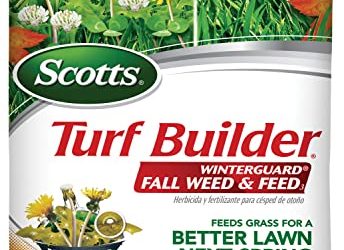
Scotts Turf Builder Weed and Feed5 — Best weed and feed

Scotts Turf Builder Weed and Feed5 is the pick when the lawn already shows weeds and the main goal is simple: clear the dandelions and clover that are visible now, and feed the grass so it recovers and fills in behind them. It does not carry the crabgrass prevention job of the Triple Action1 bag above. That narrower focus is a strength for mid-season use, because you can apply it when prevention is no longer the point, for example in late spring or early summer when broadleaf weeds are the obvious problem.
Scotts builds this line around its WeedGrip approach, where granules grip onto weed leaves so the active ingredients can work. Application conditions matter more than quantity: apply to a damp lawn, then give the product time before rain or irrigation washes granules off the leaves. Extra product beyond the label rate does not improve control and can stress the grass.
The size listed here is the larger bag, covering up to 12,000 square feet, which suits bigger yards. Smaller bags in the same line cover 4,000 square feet. The feeding side greens and thickens the turf, helping it crowd out future weeds once the current ones die back.
Choose this bag if crabgrass has not been your recurring problem, or if you already handled prevention earlier in the season with a separate product and now need post-emergent control plus food. Skip it if you need prevention in the same pass, and keep it away from newly seeded areas until the new grass is established and has been mowed the number of times the label requires.
- Form: Granules for broadcast or drop spreader use
- Coverage: Up to 12,000 square feet for this bag size
- Bag weight: 33.95 pounds
- Jobs in one bag: Kills listed broadleaf weeds and feeds the lawn
- Key weeds named: Dandelion and clover, plus other listed broadleaf weeds
- Feeding role: Fertilizer portion greens and thickens turf to crowd out weeds
- Best timing: When broadleaf weeds are actively growing on an established lawn
The Andersons Barricade Granular Pre-Emergent — Best pre-emergent

The Andersons Barricade is a different tool from the two bags above. It does not kill weeds that are already growing, and it does not feed the lawn. It is a professional-grade granular pre-emergent built around prodiamine, an active ingredient widely used by lawn care operators to form a barrier in the upper soil layer. When weed seeds germinate and their young shoots reach that barrier, growth stops. Applied before crabgrass and other listed annual weeds sprout, one pass can protect the lawn through the main germination window.
This prevention-only focus is why it wins its class. Homeowners who feed on a separate schedule get a single-purpose product with no extra nitrogen pushing growth at the wrong moment. The granules use a dispersing carrier designed to break down with water and distribute the active ingredient evenly, reducing striped misses.
Timing decides everything with a pre-emergent. Apply before soil temperatures climb into the range where crabgrass germinates, then water the product in. A fall application targets winter annuals such as annual bluegrass. Because the barrier also blocks grass seed, plan seeding for a season when you have not applied it.
The 18 pound bag covers up to 5,800 square feet. Larger bags suit bigger properties or a spring plus fall program. If your yard already shows weeds, pair this with a post-emergent plan rather than expecting Barricade to clean up growing weeds.
- Form: Granular pre-emergent for spreader application
- Coverage: Up to 5,800 square feet for this bag size
- Bag weight: 18 pounds
- Active ingredient: Prodiamine
- Jobs in one bag: Pre-emergent prevention only, with no fertilizer
- Targets: Crabgrass and other listed grassy and broadleaf weeds before emergence
- Best timing: Early spring before germination, with an optional fall pass for winter annuals
BioAdvanced Season Long Lawn Weed Killer and Preventer for Southern Lawns — Best for southern lawns

Southern lawns play by different rules. Warm-season grasses such as St. Augustinegrass, including Floratam, Bermudagrass, centipedegrass, and zoysia can be damaged by weed killers that are perfectly safe on northern bluegrass or fescue. BioAdvanced Season Long Lawn Weed Killer and Preventer for Southern Lawns is formulated for those grasses, and its label names the southern turf types it is cleared for, which is the first thing a southern homeowner should check on any bag.
The formula works on both sides of the weed problem. It kills listed broadleaf weeds that are already present, including dollarweed, dandelion, clover, chickweed, and henbit, and a residual herbicide portion keeps listed weeds from coming back for up to six months. It also prevents crabgrass in warm-season turf. That long residual window suits southern growing seasons, which run longer and give weeds more months to sprout than a northern lawn faces.
One application of the 10 pound bag treats up to 4,000 square feet. Apply with a spreader when weeds are actively growing, then water lightly within a day to move the residual portion into the soil. Avoid mowing briefly after application, and follow the label on repeat timing.
The boundary is firm: this product is for southern lawns only. Northern homeowners should pick another bag here. Southern homeowners should confirm their grass type against the label list before buying. For the right lawn, the six-month window means fewer spreader passes across a long season.
- Form: Granules for rotary or drop spreader use
- Coverage: Up to 4,000 square feet for this bag size
- Bag weight: 10 pounds
- Jobs in one bag: Kills listed broadleaf weeds and prevents listed weeds and crabgrass
- Control window: Kill plus prevention for up to six months
- Grass types named: St. Augustinegrass including Floratam, Bermudagrass, centipedegrass, and zoysia, as listed on the label
- Key weeds named: Dollarweed, dandelion, clover, chickweed, and henbit
Scotts Turf Builder Halts Crabgrass Preventer with Lawn Food — Best budget

Scotts Turf Builder Halts Crabgrass Preventer with Lawn Food is the value entry point into granular prevention. It pairs the Halts pre-emergent approach, which stops crabgrass before it invades and protects through the season, with a lawn food portion aimed at a fast green-up after winter and stronger, deeper roots. For a homeowner who wants prevention and feeding in one modest bag, without paying for the broader weed-killing package of the top pick, this is the sensible spend.
The 5,000 square foot bag is sized for an average yard, and its job is clearest in early spring. You apply it as the lawn wakes up, the preventer portion settles into the soil to block crabgrass germination, and the fertilizer portion pushes the grass to green up and thicken. A thicker lawn then does quiet work all season, shading the soil and reducing the space available for weeds that the preventer did not cover.
Be clear about what it does not do. It prevents listed weeds rather than killing mature weeds already growing. If dandelions are already flowering, you need a post-emergent product as well. It also shares the seeding limit of every pre-emergent: do not apply where you plan to seed until the label interval passes.
As a budget pick, its appeal is focus: the two spring jobs most lawns need, prevention and food, in one pass, with spreader settings printed for common models. If you later need post-emergent control, you can add it without having overbought a premium all-in-one bag.
- Form: Granules for broadcast or drop spreader use
- Coverage: Up to 5,000 square feet for this bag size
- Bag weight: 13.35 pounds
- Jobs in one bag: Pre-emergent crabgrass prevention plus lawn food
- Feeding role: Promotes a fast green-up after winter and builds strong, deep roots
- Key target: Crabgrass prevented before germination, with season-long protection as labeled
- Best timing: Early spring, as the lawn greens up and before crabgrass sprouts
How to choose
Begin with the job, not the brand. Look at your lawn and name the problem honestly. If weeds are already up and visible, you need a post-emergent product that kills growing weeds, which means a weed and feed or the southern formula here. If the lawn looks clean now but crabgrass arrives every summer, you need a pre-emergent applied before germination. If both problems sound familiar, an all-in-one bag such as the top pick, or a planned pairing of a preventer plus a later weed and feed, covers both.
Next, match the bag to your grass type. Northern cool-season grasses such as Kentucky bluegrass, fescue, and perennial ryegrass accept most mainstream formulas. Southern warm-season grasses are pickier, and St. Augustinegrass in particular rules out several northern products. The label list of approved grasses is not fine print to skim; it is the difference between a cleaner lawn and a damaged one. If you do not know your grass type, identify it before buying, because every other choice depends on it.
Then check coverage against your actual lawn size. Measure turf area, not the whole lot, since driveways, beds, and the house need no product. A bag far larger than the lawn invites over-application or poor storage; too small leaves untreated strips. Pick the size closest above your measured area.
Finally, plan around seeding. Every pre-emergent here will also block grass seed, so prevention and seeding cannot share the same weeks. Apply post-emergent granules to damp grass, pre-emergent granules to a dry lawn and water them in, and set the spreader to the printed rate for your model.
Who should skip
Skip granular weed killers altogether if your weed problem is small enough to hand-pull or spot-treat. A full-lawn granular application puts herbicide on every square foot, including clean areas that needed nothing, and a targeted approach is the better tool for a dozen scattered weeds. Also skip these products if you are about to seed or overseed, since the pre-emergent options will block your new grass and even plain weed and feed labels restrict use on young, tender turf.
Homeowners with Dichondra or bentgrass lawns should be careful, because several formulas exclude those grasses. If your lawn borders vegetable beds or water features, read the setback directions, keep granules out of beds, and sweep strays off hard surfaces. If you cannot confirm your grass type or target weeds on the label, identify both first.
Frequently Asked Questions
When is the best time to apply granular weed killer?
It depends on the job. Pre-emergent granules go down before weed seeds germinate, which for crabgrass means early spring before soil warms, with an optional fall pass for winter annuals. Post-emergent weed and feed granules go down when weeds are actively growing and the grass is damp, so the product can cling to weed leaves.
Can I apply a weed and feed and seed my lawn in the same season?
Not at the same time. Pre-emergent ingredients block grass seed along with weed seed, and weed and feed labels also require new grass to be established and mowed several times before application. Pick one priority for the season, or separate the jobs by the full interval the product label states.
Do granular weed killers need watering after application?
Pre-emergent granules generally need watering in so the active ingredient settles into the soil and forms its barrier. Post-emergent weed and feed granules follow the opposite pattern at first: they need to sit on damp weed leaves for a day or two before rain or irrigation. The bag label gives the exact sequence for each product, so follow that rather than a general rule.
How long before children and pets can use the lawn again?
Labels for granular lawn products typically direct you to keep people and pets off the treated area until the granules have been watered in and the lawn has dried, or for the specific period printed on the bag. Read the re-entry directions on your product, water as directed, and let the grass dry fully before normal use resumes.
Final verdict
For most homeowners, Scotts Turf Builder Triple Action1 is the buy: it kills visible broadleaf weeds, prevents crabgrass for months, and feeds in one granular pass. If your weeds are already up and prevention is handled, Scotts Turf Builder Weed and Feed5 is the focused weed and feed choice. For pure prevention on a separate feeding schedule, The Andersons Barricade brings a professional-grade prodiamine barrier. Southern lawns should go straight to the BioAdvanced Season Long formula built for warm-season grasses, with its six-month window. And if the goal is spring prevention plus food in a modest bag, Scotts Turf Builder Halts Crabgrass Preventer with Lawn Food is the budget-friendly route. Match the bag to your grass type and your timing, set the spreader by the label, and one product can carry the lawn through the season.
Product and ASIN Reference
| Product | ASIN |
|---|---|
| Scotts Turf Builder Triple Action1 | B09JVFT7N5 |
| Scotts Turf Builder Weed and Feed5 | B0BBN6RHBY |
| The Andersons Barricade Granular Pre-Emergent | B07NZ2BMMK |
| BioAdvanced Season Long Lawn Weed Killer and Preventer for Southern Lawns | B0BPVJ7BWZ |
| Scotts Turf Builder Halts Crabgrass Preventer with Lawn Food | B000I1M5NG |