Key takeaways
- Compare five table saw miter gauges by angle stops, fence support, and miter slot fit, and find the gauge that holds its setting through repeated crosscuts.
A stock miter gauge often leaves a small amount of side play in the slot, and that play shows up as a gap at the end of a mitred corner. The real decision is not which gauge looks strongest on a bench, but which one locks at the angle you need, stays square to the blade, and repeats the same cut on the next board without a fresh setup. A gauge with clear stops, a bar that can be tuned to the slot, and a fence long enough to hold the workpiece steady changes crosscutting from guesswork into a repeatable step.
This guide is for hobby woodworkers replacing a loose stock gauge, furniture makers cutting repeated mitres, and shop owners who crosscut long boards and want the same length every time. Each gauge below was chosen from its name and its listing details on Amazon, with attention to angle stops, fence design, miter bar fit, and the parts included in the box.
Quick Picks
As an Amazon Associate we earn from qualifying purchases.
| Product | Best for | Key spec from title |
|---|---|---|
| INCRA MITER1000SE Miter Gauge Special Edition | Repeat mitres with a telescoping fence | Telescoping fence and dual flip shop stop |
| INCRA Miter1000/HD Miter Gauge | Fine angle work with a vernier scale | 180 stops with 1/10-degree vernier adjustment |
| POWERTEC 71391 Table Saw Precision Miter Gauge System | A complete fence and flip stop setup | 24-inch multi T-track fence with flip stop |
| WEN WA1401 Steel and Brass Premium Miter Gauge | A steel and brass gauge for everyday crosscuts | 27 angle stops for table saws and router tables |
| POWERTEC 71142 Universal Table Saw Miter Gauge | A compact gauge for standard miter slots | 27 angle stops in a universal assembly |
How to Choose
Miter Slot Fit and Bar Adjustment
Most contractor table saws use a miter slot that measures 3/4 inch wide by 3/8 inch deep, and a gauge built for that size should slide without rocking from side to side. Before ordering, measure the slot at the table surface with calipers, because a narrow slot on a compact saw will not accept a standard bar. Look for a bar with adjustable expansion discs, nylon screws, or a similar tuning method, since those parts take up the slack between the bar and the slot walls. A bar that fits loosely will drift during a cut, while a bar tuned too tight will bind halfway through the stroke.
Angle Stops and Fine Adjustment
Positive stops are small detents that lock the head at common angles, and they matter most when a project needs the same angle again and again. A gauge with stops at 0, 22.5, 30, and 45 degrees covers picture frames, boxes, and common joinery without constant checking against a square. Count the stops and note their spacing, because a gauge with stops every 5 degrees is easier to set than one with only a few widely spaced detents. A vernier scale adds a further layer of control for angles that fall between stops, letting the head move in fractions of a degree.
Fence Length and Repeat Stops
The fence is the flat face that the workpiece rests against, and its length decides how much support a long board gets before it reaches the blade. A short fence works for small parts, yet a long board can pivot on a short face and leave a cut that is square at one end and off at the other. A telescoping fence extends for long stock and shortens for small parts, which keeps the setup compact when bench space is tight. A flip stop on the fence sets a fixed length, so a run of identical parts can be cut without measuring each piece.
Head, Materials, and Locking Feel
The protractor head carries the angle scale and the locking mechanism, so its construction shapes how the gauge feels in use. A steel head resists flex when the lock is tightened, while an aluminum head keeps the gauge lighter for frequent handling. Brass knobs and steel plates tend to hold up under repeated adjustment, and a laser-etched scale stays readable longer than a printed one that can wear away. Turn the lock through its full range before buying into a design, and note whether the handle falls naturally under the hand during a push.
The 5 Best Options
INCRA MITER1000SE Miter Gauge Special Edition With Telescoping Fence and Dual Flip Shop Stop
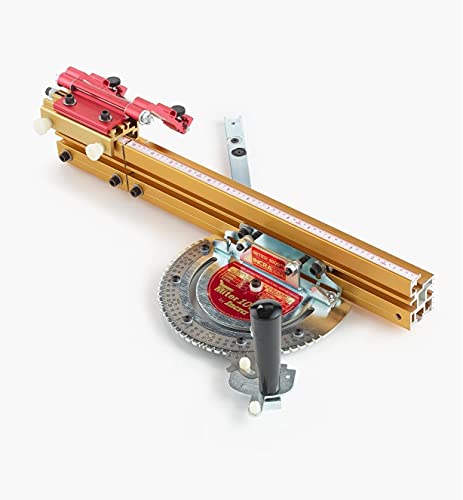
The MITER1000SE suits woodworkers who cut the same mitre angles across many parts and want the setup to return to the same setting without fuss. Its 41 positive stops give a fine spread of preset angles, so common settings such as 45 degrees for frames and 22.5 degrees for octagonal work engage with a clear click rather than a visual guess. The telescoping fence extends to support longer boards, and the dual flip stop helps repeat a length across a batch. The GlideLOCK bar system adjusts to the slot, which keeps the gauge tracking straight instead of wandering as it moves toward the blade.
Specs
- 41 positive angle stops
- Telescoping fence included
- Dual flip shop stop included
- GlideLOCK miter bar expansion system
- Special Edition miter gauge for table saws
Best for: Woodworkers cutting repeated mitres who want many preset angles and a fence that extends for longer boards.
Watch out for: The adjustment for the bar uses small parts that need care during setup, so follow the included instructions and check the fit in the slot before the first cut.
INCRA Miter1000/HD Miter Gauge

The Miter1000/HD is built for work where a fraction of a degree changes how a joint closes, such as segmented turning blanks and fine casework. Its head offers positive stops at every degree across 180 stops, and the vernier scale allows adjustment to 1/10 of a degree for angles that sit between whole numbers. The telescoping fence extends to 31 inches, which supports long boards while they are pushed past the blade, and the fence scale reads to 1/32 inch for setting a length.
Specs
- 180 positive stops, one at every degree
- Vernier scale for adjustment to 1/10 of a degree
- Telescoping fence extends to 31 inches
- Fence scale with 1/32 inch graduations
- Miter gauge for table saws
Best for: Fine joinery and segmented work where small angle changes and a long supporting fence matter.
Watch out for: The fine adjustment rewards a careful setup, so square the head to the blade with a reliable square before relying on the vernier for a critical cut.
POWERTEC 71391 Table Saw Precision Miter Gauge System

The POWERTEC 71391 is a complete system for woodworkers who want the gauge, fence, and stop to arrive together rather than assembled from separate parts. Its head carries 27 angle stops, and the T-slotted miter bar fits a standard 3/4-inch by 3/8-inch slot, with a removable T-slot plate for slots without a T shape. The included fence measures 24 inches by 3 inches and carries a multi T-track with a scale, while the T-track flip stop sets a repeat length for batches of parts. Because the fence, stop, and gauge are designed as one system, the parts align without hunting for a compatible fence from another maker.
Specs
- 27 angle stops
- 3/4-inch by 3/8-inch T-slotted miter bar with removable T-slot plate
- 24-inch by 3-inch multi T-track fence with scale included
- T-track flip stop included
- Precision miter gauge system for table saws
Best for: Woodworkers who want a ready-to-use gauge, fence, and flip stop in one system for repeated crosscuts.
Watch out for: Confirm the slot on the saw accepts a T-slotted bar and the removable plate, and check that the fence clears the blade guard and any nearby jig before cutting.
WEN WA1401 Steel and Brass Premium Miter Gauge

The WEN WA1401 suits a shop that wants a durable gauge for everyday crosscuts without a long fence to store. Its steel miter plate gives the head a rigid base, and the brass components on the lock knobs provide a solid feel when the angle is tightened. The head carries 27 positive stops, so common angles engage quickly, and expansion discs on the miter bar take up play in a standard 3/4-inch by 3/8-inch slot. The listing describes use on table saws, router tables, and band saws, which makes it a flexible addition to a small shop where one gauge moves between machines.
Specs
- Steel miter plate with brass lock knob components
- 27 positive angle stops
- Expansion discs for the miter bar
- Fits standard 3/4-inch by 3/8-inch miter slots
- For table saws, router tables, and band saws
Best for: Everyday crosscuts in a small shop where a steel and brass gauge moves between machines.
Watch out for: No fence ships with this gauge, so plan a separate fence or a shop-made support when cutting long boards that need more than the head alone.
POWERTEC 71142 Universal Table Saw Miter Gauge Assembly
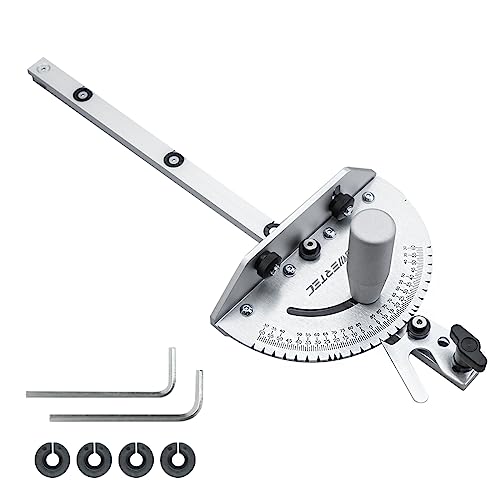
The POWERTEC 71142 is a compact starting point for a woodworker replacing a stock gauge and learning how a tuned bar changes a cut. Its laser-cut aluminum head carries 27 locking stops in 5-degree increments across a 180-degree range, with a plus or minus 60-degree range for acute mitre cuts. The miter bar measures 3/4 inch wide by 17 3/4 inches long by 3/8 inch deep, and four adjustable nylon discs tune the bar to the slot without scratching the slot walls. A removal plate lets the gauge work in T-slotted and non-T-slotted slots, and a universal fence mounting bracket is included for adding a fence later.
Specs
- 27 locking stops in 5-degree increments over a 180-degree range
- Plus or minus 60-degree range for acute mitre cuts
- Laser-cut aluminum head
- Miter bar 3/4 inch wide by 17 3/4 inches long by 3/8 inch deep
- Four adjustable nylon discs on the miter bar
- Universal fence mounting bracket included; no fence ships in the standard bundle
Best for: A first upgrade from a stock gauge on a standard-slot saw, especially for general crosscuts and acute mitres.
Watch out for: No fence ships in the standard bundle, so long boards will need a separate fence or a shop-made support, and the gauge will not fit saws with a 5/8-inch miter slot.
Which One Fits Your Situation
Repeated Picture-Frame Angles
For frames and boxes where 45-degree corners must close without a gap, choose the INCRA MITER1000SE. Its 41 positive stops make the common frame angles easy to find, and the dual flip stop keeps each side at the same length across a set. The telescoping fence supports the moulding while it is pushed through the cut, which reduces the chance of the piece shifting at the end of the stroke.
Long Boards and Repeated Crosscuts
For long boards cut to the same length again and again, choose the POWERTEC 71391. The 24-inch fence gives the board a long reference face, and the T-track flip stop holds the length setting between cuts. The 27 stops cover the usual crosscut angles, and the T-slotted bar keeps the system tracking straight through the full travel of the slot.
Fine Joinery With Small Angle Changes
For segmented work and fine casework where a whole degree is too coarse, choose the INCRA Miter1000/HD. Its stops at every degree and the vernier scale for 1/10-degree adjustment let the angle move in small steps, and the fence extends to 31 inches for longer pieces. Square the head carefully first, then use the fine adjustment for the final setting.
A First Upgrade From a Stock Gauge
For a first upgrade on a standard-slot saw, choose the POWERTEC 71142 or the WEN WA1401. The POWERTEC gives 27 stops and a tunable bar in a compact head, while the WEN adds a steel plate and brass lock parts for everyday use. Either one improves on a loose stock gauge, and a separate fence can be added later when long boards become a regular part of the work.
Common Mistakes
- Buying a gauge without measuring the miter slot, then finding a standard 3/4-inch bar will not fit a narrow slot.
- Trusting the angle scale without squaring the head to the blade before the first cut.
- Cutting long boards against a short fence, which lets the piece pivot and leaves a cut that is off at one end.
- Leaving the bar loose in the slot, so the gauge drifts sideways during the push and the mitre does not close.
- Setting a flip stop once and assuming it stays put, instead of checking the length on a scrap piece after each adjustment.
Frequently Asked Questions
Will an aftermarket miter gauge fit my table saw?
Most aftermarket gauges are built for the standard 3/4-inch wide by 3/8-inch deep miter slot found on contractor saws, and the gauges in this guide list that size. Measure the slot with calipers before ordering, because compact and benchtop saws sometimes use a narrower 5/8-inch slot that will not accept a standard bar. A bar with expansion discs or adjustable screws can take up small differences in a standard slot.
What is the difference between a miter gauge and a miter saw?
A miter gauge slides in the table saw slot and guides the workpiece past the blade for crosscuts and mitres, while a miter saw is a separate machine with its own blade and pivoting head. The gauge is an accessory that upgrades the table saw, and it works best for crosscuts, repeated lengths, and mitres on boards that fit on the table.
Do I need a fence on a miter gauge?
A fence is not required for short parts, because the head alone can guide a small piece past the blade. For long boards, a fence gives the workpiece a longer reference face and keeps it from pivoting during the cut, which improves the squareness of the result.
How do I keep a miter gauge accurate over time?
Square the head to the blade with a reliable square, then lock the head and check the setting on a scrap piece before cutting project parts. Clean sawdust from the slot and the bar, and re-check the bar fit after moving the gauge between machines, since a loose bar is a common source of drift.