Key takeaways
- Compare the best track saws for plywood, MDF and doors — Makita, DEWALT, Milwaukee, Festool and WEN plunge saws compared by depth, bevel, rail and dust control.
Breaking down a full sheet of plywood on a table saw is awkward, and guiding a regular circular saw along a clamped straightedge rarely gives a clean, factory edge. A track saw solves both problems: it plunges into the work while riding in a groove on an aluminium guide rail, so the rail — not your hand — decides where the cut goes. The result is a long, straight cut with far less splintering on melamine, veneered plywood, MDF and laminate, plus the ability to trim a door in place or cut an opening in the middle of a panel.
This guide compares five genuine plunge-cut track saws that run on a guide rail — not standard circular saws with an aftermarket edge guide. They cover a corded kit with its rail included, two cordless saws for major battery platforms, a premium cordless system, and a lower-cost corded option. Check the rail length and what is actually included before you buy, because some listings are tool-only.
As an Amazon Associate, I earn from qualifying purchases.
Quick Picks
- Best corded kit with rail included: Makita SP6000J1 — A 6-1/2-inch plunge saw supplied as a kit with a 55-inch guide rail and a stackable case, with variable speed for different sheet materials.
- Best cordless for site power: DEWALT DCS520B 60V MAX TrackSaw — A brushless 60V MAX plunge saw with anti-kickback features and a dual-edged track design, sold as tool only.
- Best for Milwaukee M18 owners: Milwaukee M18 FUEL 2831-20 — A brushless 6-1/2-inch plunge track saw that runs on M18 batteries, with fine depth adjustment and strong dust collection when paired with a vacuum.
- Best premium cordless system: Festool TSC 55 KEBI-F-Plus — A cordless plunge-cut track saw with a kickback stop, splinter guard system and Systainer storage, aimed at finish work where edge quality matters most.
- Best budget corded option: WEN CT1065 — A 10-amp, 6.5-inch plunge-cut sidewinder track saw for straight rips and crosscuts in sheet stock, with the WEN track system sold around it.
1. Makita SP6000J1 6-1/2-Inch Plunge Circular Saw Kit with 55-Inch Guide Rail

The Makita SP6000J1 is the most straightforward starting point for many buyers because the listing is a kit: the plunge saw, a 55-inch guide rail and a stackable tool case are included together. That matters. A track saw without a rail is only half a system, and buying the saw and rail in one box removes the guesswork about compatibility for your first cuts.
The saw uses a 12-amp motor with variable speed from 2,000 to 5,200 RPM and electronic speed control to help maintain speed under load. Lower speeds suit melamine and plastics where heat and chipping are a concern, while higher speeds suit plywood and solid wood. Maximum cutting depth is 2-3/16 inches at 90 degrees and 1-9/16 inches at 45 degrees, which covers common sheet thicknesses and many door-trimming jobs. The bevel range and close-to-wall cutting capability also make it useful for flooring and fitted work where a table saw cannot go.
On the rail, a splinter guard helps produce a clean edge on veneered panels. The plunge action lets you start a cut in the middle of a sheet for sink cut-outs, rather than only entering from an edge, and soft-start reduces the jolt at switch-on.
Specifications
- Type: Corded plunge-cut track saw
- Blade diameter: 6-1/2 inches
- Motor: 12 amp
- No-load speed: 2,000–5,200 RPM, variable
- Max depth at 90 degrees: 2-3/16 inches
- Max depth at 45 degrees: 1-9/16 inches
- Included in this kit listing: 55-inch guide rail and stackable case
Pros
- Rail and case are included in the kit, so it can cut straight out of the box
- Variable speed with electronic control for a wider range of materials
- Plunge action allows mid-panel cut-outs as well as edge rips
- Soft start and a well-balanced body help with long, controlled cuts
Cons
- Corded design needs mains power and cable management along the rail
- A single 55-inch rail is short for ripping a full 8-foot sheet lengthwise without repositioning or joining a second rail
- Dust extraction works best with a vacuum connected, which is not part of the saw kit
View the Makita SP6000J1 on Amazon
2. DEWALT DCS520B 60V MAX 6-1/2-Inch Cordless TrackSaw
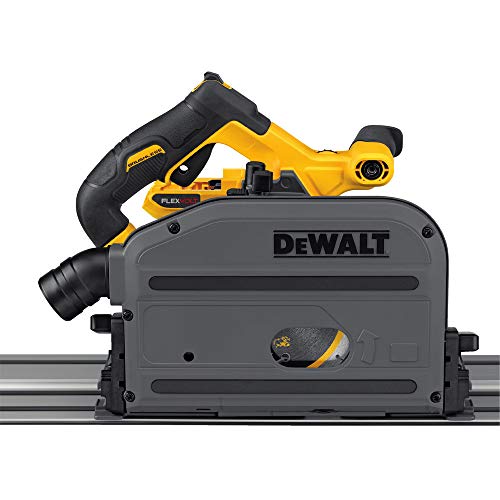
The DEWALT DCS520B is built for site carpenters and remodelers who want track-saw accuracy without dragging a cord across sheet goods. It runs on the DEWALT 60V MAX FLEXVOLT platform and uses a brushless motor with variable speed from 1,750 to 4,000 RPM. Maximum depth is 2-1/8 inches at 90 degrees and 1-5/8 inches at 45 degrees from a 6-1/2-inch blade, enough for most plywood, MDF and door work.
DEWALT’s track system is designed so the saw can run on either edge of the track, which speeds up set-up when you need to cut from the other side of a sheet. The saw includes an anti-kickback mechanism that engages with the track, a riving knife, and a low-profile guard that helps when working close to a wall or in a confined space. A dust port is provided for connection to an extractor, which is important on MDF and in occupied homes.
This listing is tool only: battery, charger and guide track are separate items to confirm on the listing. The DCS520B makes most sense if you already own FLEXVOLT batteries. If you are starting from zero, add those items to your comparison before judging it against a corded kit that includes a rail.
Specifications
- Type: Cordless plunge-cut TrackSaw, tool only
- Blade diameter: 6-1/2 inches
- Power source: DEWALT 60V MAX FLEXVOLT battery platform
- Motor: Brushless
- No-load speed: 1,750–4,000 RPM, variable
- Max depth at 90 degrees: 2-1/8 inches
- Max depth at 45 degrees: 1-5/8 inches
Pros
- Cordless freedom for breaking down sheets on site or outdoors
- Anti-kickback engagement with the track and a riving knife
- Dual-edged track design allows cutting from either side
- Variable speed helps match the blade to the material
Cons
- Tool-only listing: battery, charger and track are not included
- Needs the higher-voltage FLEXVOLT platform rather than standard 20V MAX batteries
- Heavier in use once a large FLEXVOLT battery is fitted
View the DEWALT DCS520B on Amazon
3. Milwaukee M18 FUEL 6-1/2-Inch Plunge Track Saw 2831-20

Milwaukee was late to the track saw category, and the M18 FUEL 2831-20 is aimed squarely at finish carpenters and cabinet installers who already run M18 tools. It is a brushless, cordless plunge track saw with a 6-1/2-inch blade, designed to rip solid hardwood as well as sheet goods while delivering portable precision on Milwaukee’s guide rail system.
Useful details include an adjustable cam system to tune the saw’s fit on the rail, a smooth plunge mechanism, and a micro-adjust depth knob — helpful when you want to score a veneer first or stop just short of the surface below. Positive bevel stops at common angles, including 22.5 and 45 degrees, with capacity to 48 degrees, speed up repeat angled cuts. Milwaukee states over 90 percent dust collection when the saw is used with a vacuum, so hose fit matters.
As with the DEWALT above, this is a bare-tool listing: battery, charger and guide rail are separate. For an existing M18 user, though, adding a bare tool is far simpler than adopting a second battery platform.
Specifications
- Type: Cordless plunge-cut track saw, bare tool
- Blade diameter: 6-1/2 inches
- Power source: Milwaukee M18 battery platform
- Motor: POWERSTATE brushless
- Bevel capacity: Up to 48 degrees, with positive stops at common angles
- Depth control: Plunge with micro-adjust depth knob
- Dust port: Designed for connection to a vacuum hose
Pros
- Runs on the widely used M18 platform, ideal for existing Milwaukee owners
- Micro-adjust depth control suits scoring cuts and precise through-cuts
- Adjustable cams let you dial out play between saw and rail
- Strong dust collection when paired with a suitable vacuum
Cons
- Bare tool: battery, charger and rail are separate purchases
- Best results depend on using Milwaukee’s own rail system
- Cordless runtime on thick hardwood depends heavily on battery size
View the Milwaukee 2831-20 on Amazon
4. Festool TSC 55 KEBI-F-Plus Cordless Plunge-Cut Track Saw

Festool is the brand most closely associated with the modern track saw, and the TSC 55 is its cordless plunge-cut model. It is aimed at kitchen fitters, cabinetmakers and finish carpenters for whom a chipped edge on a laminated panel is not acceptable. The system is built around the Festool guide rail, splinter guards on both sides of the cut, and dust extraction as a core part of the design rather than an accessory.
A headline feature is the kickback stop, which is designed to stop the saw quickly if it begins to lift or bind on the rail, reducing the risk of the saw jumping back toward the user. The saw uses a 160 mm blade, gives a cutting depth of up to about 55 mm at 90 degrees as its model designation reflects, and bevels for angled cuts in worktops and panels. This KEBI-F-Plus version is supplied with batteries and in a Systainer case according to its listing configuration, but Festool sells several closely named variants, so read the exact listing contents carefully before ordering — some Festool listings are for the saw only, without a rail.
The Festool ecosystem is the other reason to choose it: rails, clamps, extractors and Systainers all interlock. That is a genuine advantage if you plan to build a system, but blades and rails are Festool-specific, so you are committing to that ecosystem.
Specifications
- Type: Cordless plunge-cut track saw
- Blade diameter: 160 mm (about 6-1/4 inches)
- Power source: Festool 18V battery system, twin-battery configuration
- Cutting depth at 90 degrees: Up to 55 mm
- Key feature: Kickback stop
- Storage: Systainer case in Plus configuration — confirm exact contents on the listing
- Rail system: Festool FS guide rail, compatibility to confirm on the listing
Pros
- Excellent splinter control for laminated and veneered panels
- Kickback stop adds a layer of protection rare in this category
- Dust extraction is central to the system design
- Systainer storage integrates with other Festool cases
Cons
- Premium system cost, including rails and accessories
- Several similar variant names make it easy to order the wrong configuration
- Blade and rail fit are Festool-specific, limiting cross-brand mixing
View the Festool TSC 55 on Amazon
5. WEN CT1065 10-Amp 6.5-Inch Plunge Cut Sidewinder Circular Track Saw
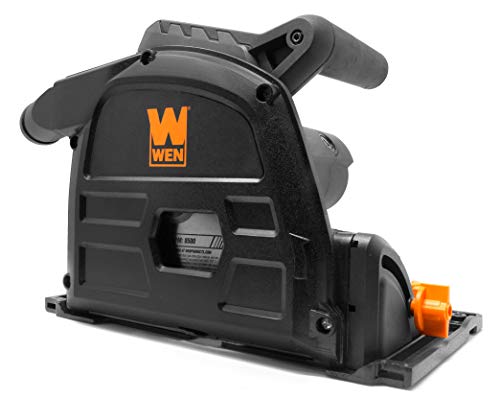
The WEN CT1065 is the entry point in this list: a corded, 10-amp plunge-cut track saw with a 6.5-inch blade for buyers who need straight sheet cuts occasionally — breaking down plywood for a workshop project, trimming doors, or cutting shelving — without moving to a pro cordless platform. It rips material up to 2-1/8 inches thick at 90 degrees and bevels to 45 degrees for cuts up to 1-5/8 inches thick, and it is supplied with a 24-tooth carbide-tipped blade in the standard listing.
The saw runs on WEN’s track system, so check whether the listing is for the saw alone or a bundle with track and clamps — WEN sells several configurations, and a saw-only box cannot cut until a rail arrives. A dust port is included for shop vacuum connection.
Expect a simpler fit and finish than the Makita, Milwaukee or Festool. For occasional sheet work that trade-off can be reasonable, provided you set the saw on its rail carefully and make a first pass to set the splinter strip.
Specifications
- Type: Corded plunge-cut track saw
- Blade diameter: 6.5 inches
- Motor: 10 amp
- Blade included: 24-tooth carbide-tipped blade in the standard listing
- Max depth at 90 degrees: 2-1/8 inches
- Max depth at 45 degrees: 1-5/8 inches
- Track system: WEN track saw track and adapters — confirm bundle contents on the listing
Pros
- Lowest-cost route into genuine plunge track saw cutting in this group
- Corded power means no batteries or chargers to buy or manage
- Handles common sheet thicknesses for rips and crosscuts
- Plunge action allows cut-outs a regular circular saw handles poorly
Cons
- Bundle contents vary, so the track may not be in the box
- Rail fit and adjustment are less refined than the premium brands
- The included general-purpose blade is not the final word for melamine
How to Choose a Track Saw
Start with the rail, not the saw. A 55-inch rail crosscuts a 4×8 sheet across its width, but ripping the full 8-foot length needs a longer rail or two rails joined accurately. Confirm whether a rail is included, and whether clamps are needed — many rails grip sheet goods well but benefit from clamps on narrow stock.
Corded or cordless. Corded models such as the Makita and WEN give consistent power and a lower starting cost, and they suit a fixed workshop. Cordless models from DEWALT, Milwaukee and Festool are easier on site and around large sheets, but the real cost includes batteries, a charger and the rail. If you already own a battery platform, staying on it is usually the deciding factor.
Depth and bevel. Most 6-1/2-inch track saws cut a little over 2 inches at 90 degrees, which covers sheet goods and most doors. If you regularly cut thick worktops or stacked sheets, check the exact depth figure. For bevels, look at the maximum angle and whether there are positive stops at 45 degrees.
Blade and edge quality. A fine-tooth blade and a properly trimmed splinter guard do more for a clean edge on melamine than motor power does. Check blade bore and diameter before assuming blades swap between brands — they often do not.
Dust extraction. Track sawing creates fine dust, especially from MDF. A dust port that fits your vacuum hose makes a visible difference indoors; in clients’ homes, treat extraction as a requirement.
What is in the box. Saw only, saw with case, and saw with rail and case are three different purchases wearing similar titles. List what you need — saw, rail, clamps, battery, charger, blade — and match it line by line against the listing.
FAQs
Is a track saw the same as a circular saw?
No. A track saw is a plunge saw: the blade starts retracted, plunges to a set depth, and the body locks onto and slides along its guide rail. That rail connection is what delivers repeatable straight cuts.
Can a track saw replace a table saw?
For breaking down sheet goods and long straight rips, often yes, and it is easier for one person with full sheets. It does not replace a table saw for narrow rips, small parts, dadoes or joinery. Many shops break sheets down with a track saw, then finish pieces on the table saw.
Do I need clamps for the guide rail?
Not always. Most rails grip sheet material well for straight cuts. Clamps help on bevel cuts, narrow pieces, vertical work such as trimming a hung door, and any cut where the rail could shift. If in doubt, clamp it.
Why does my first cut on a new rail matter?
The first pass trims the rail’s splinter guard exactly to your saw and blade, so the guard edge then shows precisely where the blade will cut. A different blade kerf changes that alignment.
Can I use another brand’s rail with my saw?
Sometimes, but it is not guaranteed. Rail groove dimensions and saw base profiles differ between brands, and a loose or tight fit affects accuracy and safety. Unless the saw maker states compatibility, assume you need the same brand’s rail system.
What blade should I use for melamine and laminate?
Use a fine-tooth blade intended for sheet and laminate work, set the depth so the blade just clears the underside, and consider a shallow scoring pass first on the most chip-prone material. A sharp, clean blade and a trimmed splinter guard matter more than pushing the saw quickly.
Conclusion
For most buyers, the decision is about the system around the saw: The Makita SP6000J1 kit is the simplest complete start because the rail is in the box. The DEWALT DCS520B suits site work on the FLEXVOLT platform, the Milwaukee 2831-20 is the natural pick for M18 owners, the Festool TSC 55 is the premium choice where edge quality and kickback protection come first, and the WEN CT1065 keeps the cost of entry down for occasional sheet work — provided you confirm the track is included or order it at the same time. Choose the rail length for the sheets you actually cut, confirm what each listing includes, and any of these five will cut straighter and cleaner than a standard circular saw guided freehand.