
Key takeaways
- Stay safe on the roadside. If possible, pull far off the road, turn on hazard lights, and stay away from traffic. Place the triangle only when it is safe to do so.
- Know your cables. Follow the manual of both vehicles for the correct connection order, and avoid jump-starting a damaged or frozen battery.
- Jump starter storage. Follow the maker’s temperature limits; do not leave lithium units in extreme heat or cold longer than advised.
- Secure the load. Keep the kit in the trunk or secured in the cabin so it doesn’t become a projectile in a sudden stop.
- Check the kit twice a year. Replace batteries, expired first aid items, food and water, and recharge the jump starter.
- Call for help. If you are on a highway, in unsafe weather or unsure, call roadside assistance or emergency services rather than attempting repairs.
For most drivers, a ready-made roadside bag such as the Lifeline AAA Excursion Road Kit, paired with a separate portable jump starter, covers the common breakdowns for under 150 dollars, while a bag-only kit leaves you dependent on another driver for a dead battery. The pairing matters because the most frequent roadside problems are a flat battery and a flat tire, and kit contents differ sharply in how they handle each one. This guide explains what is in the popular kits, what is missing, and how to fill the gaps.
Our top picks


As an Amazon Associate we earn from qualifying purchases at no extra cost to you.
At a glance
| Option | Best for | Key stated specs | Limits |
|---|---|---|---|
| Lifeline AAA Excursion Road Kit (76-piece, model 4388AAA) | All-round roadside basics with a tire inflator | Lifeline lists a fabric dual-compartment bag, warning triangle, air compressor with gauge, 10 ft 8-gauge booster cables, 9-LED flashlight, gloves, screwdrivers, pliers, duct tape, poncho, whistle and a 45-piece first aid section | Booster cables need a second vehicle; Lifeline lists a fabric bag, but one AAA shop page also lists a hard-shell case, so listings differ |
| Lifeline AAA 66-piece Severe Weather kit | Drivers in winter-weather regions | Lifeline lists a 45-piece first aid section, folding shovel, fleece cap, gloves and scarf, ice scraper, LED strobe, hand warmers and a survival blanket in a hard-shell foam case or bag depending on the listing | No jump starter and no booster cables in Lifeline’s contents list; case type varies by listing |
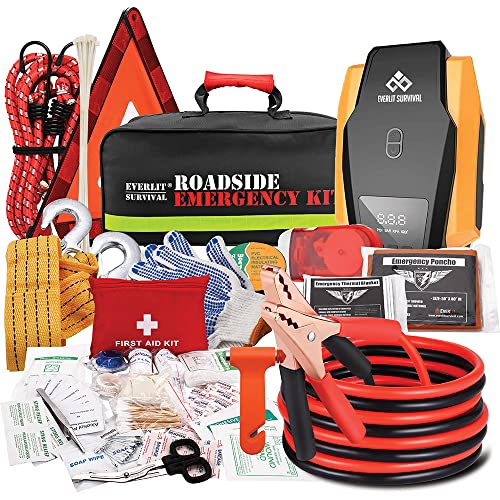
| Larger bag kits (Everlit Road Guardian and generic 100-plus piece kits) | Buyers who want a tire inflator, cables and a tow strap in one bag | Everlit lists a digital tire inflator, 12 ft jumper cables, tow strap, reflective triangle, glass breaker with seatbelt cutter, first aid kit and hand-crank flashlight | Piece counts can pad with minor items; contents differ by version and seller; still needs a second vehicle for cables |
| Portable jump starter (NOCO Boost GB40, GOOLOO A3) | Dead battery without a second car | NOCO lists the GB40 for gasoline engines up to 6.0L and diesel up to 3.0L; GOOLOO lists the A3 at 3000A peak, for engines up to 9.0L gas and 6.5L diesel, with a built-in tire inflator up to 150 PSI | Sold separately; needs periodic recharging; engine-size limits apply |
What the Lifeline Excursion kit contains
Lifeline’s own product page for the 76-piece AAA Excursion Road Kit lists an accident forms and guidelines set, an emergency warning triangle, an air compressor with a gauge, a 9-LED aluminum flashlight, cotton gloves, Phillips and flat screwdrivers, vinyl-grip pliers, two shop cloths, a bungee cord, ten cable ties and 10-foot 8-gauge booster cables. Survival supplies include three AAA batteries, a whistle, a poncho, a roll of duct tape and a utility knife. The first aid portion lists a guide, a sting relief pad, six antiseptic towelettes, fifteen small and twenty larger bandages, a gauze pad and adhesive tape. One shop page describes a dual-compartment fabric bag while the feature list says hard-shell foam case, so listings differ on the carrying case.
The air compressor handles slow leaks and low pressure but does not repair a puncture or replace a spare. Booster cables work only with a donor vehicle, and a donor driver may not be nearby at night or on an empty road. A kit with no jump starter leaves a dead battery dependent on flagging a driver or calling roadside service.
What to add to a basic kit
A portable jump starter
This is the biggest upgrade. The NOCO Boost Plus GB40 and the GOOLOO A3, which also has a tire inflator, are two examples, and both makers list engine-size limits. Match the jump starter to your engine size using the maker’s guidance, store it within its stated temperature range, and recharge it periodically as the manual specifies, since lithium units self-discharge and may not be ready if forgotten for months.
Tire-change essentials
Your car should already have a jack, wrench and spare or sealant kit. Confirm they are present and that you know how to use them, and check your owner’s manual for jacking points. A kit’s compressor does not replace these.
Visibility and signalling
A reflective triangle and a flashlight are part of the Lifeline kit. Add a reflective vest if you may walk near traffic, and consider spare flashlight batteries.
Comfort and weather
A blanket, water and non-perishable snacks help when waiting for help. Rotate food and water on a schedule and avoid leaving drinks that can freeze and burst.
First aid
Included first aid sections are basic. If anyone in your car has a medical condition or takes regular medication, carry what they need and follow their clinician’s advice. In an emergency call local emergency services; a kit is for minor cuts and scrapes only.
Picks by buyer type
Commuter in mild weather
The Excursion kit and a compact jump starter cover the usual issues, and the whole bundle fits in a trunk well.
Winter or snow-region driver
The Lifeline 66-piece severe weather kit lists a folding shovel, ice scraper, fleece set and survival blanket, but no booster cables, so add a jump starter, a warm blanket and traction aids yourself.
Road-tripper
Carry a larger bag kit, a jump starter with a tire inflator, and navigation backups such as a paper map or offline maps.
New driver or gift buyer
A bag kit with clear organization and a printed guide is useful, but teach the recipient how the cables, compressor and jump starter work before they need them.
Decision table: pick this if
| Pick this if | Choose | Why |
|---|---|---|
| You want the basics in one bag | Lifeline AAA Excursion kit | Lifeline-listed compressor, cables, triangle and flashlight |
| You have no donor car access | Add a portable jump starter | Booster cables need a second vehicle |
| You drive in winter conditions | Severe-weather kit plus cold-weather extras | Basic road kits omit shovels, scrapers and blankets |
| You want the highest piece count | A 100-plus piece bag kit | More items, though many are minor |
| You want tire inflation and jump starting from one device | A jump starter with a built-in inflator | Offered on some models, such as the GOOLOO A3 |
Safety and storage notes
- Stay safe on the roadside. If possible, pull far off the road, turn on hazard lights, and stay away from traffic. Place the triangle only when it is safe to do so.
- Know your cables. Follow the manual of both vehicles for the correct connection order, and avoid jump-starting a damaged or frozen battery.
- Jump starter storage. Follow the maker’s temperature limits; do not leave lithium units in extreme heat or cold longer than advised.
- Secure the load. Keep the kit in the trunk or secured in the cabin so it doesn’t become a projectile in a sudden stop.
- Check the kit twice a year. Replace batteries, expired first aid items, food and water, and recharge the jump starter.
- Call for help. If you are on a highway, in unsafe weather or unsure, call roadside assistance or emergency services rather than attempting repairs.
Alternatives
- Assemble your own kit. Buy a jump starter, a tire inflator, a reflective triangle, gloves and a flashlight separately for more control over quality.
- Roadside assistance membership. Complements a kit by covering towing and lockouts.
- Premium all-in-one kits. The Uncharted Supply Co. Overlander is built on a YETI GoBox and includes a portable power bank and jump starter, but it sits far above this cap.
Tiers compared
| Tier | What to expect | Trade-off |
|---|---|---|
| Budget | Basic bag with cables, triangle and flashlight | No jump starter; basic first aid |
| Mid-range | Excursion-style kit plus a separate jump starter | Covers battery and tire basics; two purchases |
| Premium | Integrated kits with a jump starter and tools | Most complete; usually above this cap |
Building a kit around your own driving
The best kit is the one matched to your trips. A city commuter rarely waits long for help and may only need a jump starter, a flashlight and a reflective triangle. A rural or highway driver may wait far longer, and benefits from water, snacks, a blanket, a phone power bank and a paper map. Families should add items for children and any regular medication, and pet owners should carry water and a leash. Think about the worst realistic delay on your usual route and pack for that window, not for a short wait.
Keep a short checklist in the glovebox: roadside assistance number, your insurance details, a pen and the accident forms that come with some kits. Practice once in the driveway: open the compressor, connect the jump starter according to its manual, and find the jack points in your owner’s manual. Knowing where everything is, and how it works, matters more than the number of pieces in the bag.
Frequently Asked Questions
Do I need a jump starter if the kit has jumper cables?
Cables require a second running vehicle. A portable jump starter lets you restart the car alone, which is why pairing one with a bag kit is advised.
What is the most important item in a car emergency kit?
For most drivers, a way to restart a dead battery and a way to signal or be seen. Everything else, from tools to first aid, supports waiting safely for help.
How often should I check my kit?
At least twice a year, such as when the clocks change. Replace expired first aid items, rotate food and water, and recharge any jump starter.
Is the included first aid kit enough?
It is intended for minor injuries only. Add any medication or supplies your passengers need, and call emergency services for anything serious.
Can the air compressor replace a spare tire?
No. It can top up a slow leak, but a damaged tire still needs a proper repair or replacement. Know where your spare or sealant kit is and how to use it.
Should I keep the kit in the trunk or the cabin?
The trunk is usual, but make sure it is secured. In very hot or cold climates, follow the maker’s temperature guidance for electronics and keep water from freezing.


