
Key takeaways
- Measure the interior. Compare the interior dimensions, not the exterior, against your folded documents. A passport and a few envelopes fit the 1200, while legal-size folders need more room.
- Do not overstuff. Fire-resistant walls can be thicker than they look, and stuffing reduces protection and makes closing difficult.
- Keep the key separate. Store the key outside the chest and not in an obvious place. Record the key code or number if the maker provides one.
- Location. Place the chest in a lower-risk area, such as a ground-floor closet, rather than near a heat source. A chest falling through a burning floor can be exposed to more than its rating assumes.
- Do not store firearms or cash exclusively in a paper chest. If you store firearms, follow local law and use a product designed and rated for that purpose.
- Replace after a fire. Chests that have been in a fire should be replaced; follow the maker’s warranty and instructions.
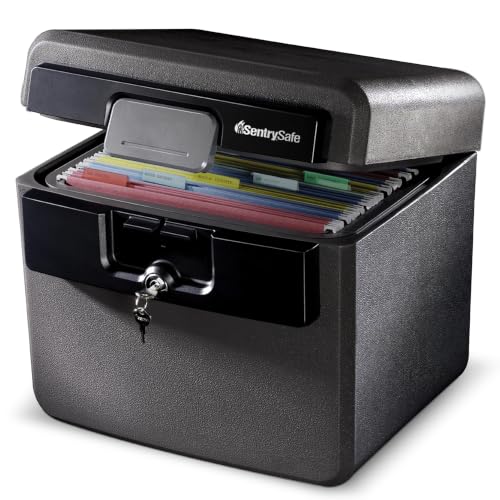
For basic protection of passports, deeds and paperwork at home, a small fire chest such as the SentrySafe 1200 is the model that fits under 100 dollars, while buyers who want water protection or a longer fire rating should expect to step up to a higher tier. The important point is that the budget tier gives you a short fire rating, a simple key lock and a portable box, not a burglar-resistant vault. Read the rating labels carefully, because a fire rating, a water rating and a theft rating are three different things.
Our top picks



As an Amazon Associate we earn from qualifying purchases at no extra cost to you.
At a glance
| Model | Best for | Key stated specs | Limits |
|---|---|---|---|
| SentrySafe 1200 Small Fire Chest | Passports, a few important papers, USB drive, on a tight budget | The maker lists UL Classified for up to 30 minutes at 1550°F, exterior 14.3 x 11.2 x 6.1 in, interior 3.5 x 12 x 7.5 in, 0.18 cu ft, keyed lock, 13.32 lb, ETL Verified for CDs, DVDs and USB drives, 1-year warranty | No water protection listed; short fire rating; not a burglary safe |
| SentrySafe CHW30220 fire and water chest | More paper capacity with water resistance | SentrySafe’s store lists UL Classified for up to 30 minutes at 1550°F, ETL Verified for 72 hours of water submersion, 0.36 cu ft, 7.6 x 16.5 x 14.8 in exterior, about 24 lb, keyed lock | Fire rating is the same 30 minutes as the 1200; one SentrySafe page and one retailer list different fire figures, so listings differ; price may sit near or above this cap |
| SentrySafe CFW20201 fire and water chest | Home files with flood concerns | SentrySafe’s page lists UL Classified for 1 hour at up to 1700°F, ETL Verified water protection for up to 72 hours, 0.28 cu ft, 6.6 x 15.4 x 14.3 in exterior, keyed lock | Higher tier than the 1200; one reseller lists a lower fire rating, so listings differ |
| Honeywell 1114 fire and security chest | Buyers wanting stated fire and submersion protection | Honeywell lists ETL Certified 60-minute fire protection up to 1700°F, certified 100-hour waterproof protection up to 1 meter, 0.39 cu ft, 41.9 lb; older listings state 24 hours of water protection | Heavy; ETL certified rather than UL Classified; usually above this cap; check which water rating applies to your unit |
What the ratings mean
Fire rating
Fire ratings describe how long the interior stays below a temperature at which paper chars, under a specific test. The SentrySafe 1200 is UL Classified for up to 30 minutes at 1550°F according to the maker. Several of the larger models are listed at one hour. A longer rating gives more margin if a fire is slow to be controlled, but a rating is not a promise for every real-world fire, since fires differ in duration and temperature and the safe may fall from a floor above. The Honeywell 1114 is described by its maker as ETL Certified for 60 minutes up to 1700°F, which is a different certifying body from UL; both are recognized, but the labels are not interchangeable and the test details differ.
Paper versus digital media
Paper chars at a higher temperature than electronic media is damaged, so a chest rated for paper may not protect a drive. The SentrySafe 1200 page says it is ETL Verified to protect CDs, DVDs and USB drives from fire damage. Do not assume other chests protect media unless the maker says so, and consider keeping backups off-site as well.
Water rating
Fire fighting leaves water behind, so water resistance can matter as much as heat resistance. The 1200’s maker lists security and fire only, with no water protection. The CFW20201 and the CHW30220 are each listed with ETL Verified water protection for up to 72 hours, and the Honeywell 1114 with certified 100-hour protection at 1 meter on its maker page, while older Honeywell listings say 24 hours. Because the test conditions differ by model, read the exact wording on each maker’s page and not only the headline.
Security
Under this budget, the lock is a basic key lock. These chests are intended to protect against fire and casual access, and they are light enough to carry away. The 1200 weighs about 13 pounds. If theft is the main worry, consider bolting a safe down or a bank deposit box, and understand that a small fire chest is a privacy and fire tool, not a burglary tool.
Picks by buyer type
Renter or student: SentrySafe 1200
This chest is small, with a built-in handle and a maker-listed interior of 3.5 by 12 by 7.5 inches, which fits a passport, a folded set of key papers and a USB drive but not a thick binder. It has a lower fire rating than heavier one-hour chests. It is a handy grab-and-go container if you evacuate, though you should never delay leaving to retrieve it.
Homeowner with deeds, titles and tax records
A one-hour rated, water-resistant chest, such as SentrySafe’s CFW20201 or the Honeywell 1114, has more capacity and a longer fire rating, while the CHW30220 adds water protection and capacity but lists only 30 minutes of fire protection. These typically exceed the under-100 budget, so the honest answer is that a homeowner with a lot of papers should plan for a higher tier or limit what is stored at home and keep copies elsewhere.
Flood-prone area
Prioritize a model whose maker states a water rating and a duration, such as the CFW20201’s 72-hour water protection or the Honeywell’s 100-hour submersion rating on its maker page, and store the chest above likely water lines.
Buyer who needs to protect digital backups
Look for a maker statement on media protection, as on the SentrySafe 1200 listing, and keep a second copy off-site.
Decision table: pick this if
| Pick this if | Choose | Why |
|---|---|---|
| You have a few papers and a tight budget | SentrySafe 1200 | Low-cost UL Classified option, portable, keyed |
| You have a binder of files | A larger one-hour chest | More interior volume and longer rating |
| You live where flooding is possible | A chest with a stated water rating | The 1200 lists no water protection |
| You store a USB backup | 1200 or another chest with a media statement | Maker states media protection for the 1200 |
| You worry about theft | A bolted-down safe or bank box | Fire chests are portable and use basic locks |
Fit and use notes
- Measure the interior. Compare the interior dimensions, not the exterior, against your folded documents. A passport and a few envelopes fit the 1200, while legal-size folders need more room.
- Do not overstuff. Fire-resistant walls can be thicker than they look, and stuffing reduces protection and makes closing difficult.
- Keep the key separate. Store the key outside the chest and not in an obvious place. Record the key code or number if the maker provides one.
- Location. Place the chest in a lower-risk area, such as a ground-floor closet, rather than near a heat source. A chest falling through a burning floor can be exposed to more than its rating assumes.
- Do not store firearms or cash exclusively in a paper chest. If you store firearms, follow local law and use a product designed and rated for that purpose.
- Replace after a fire. Chests that have been in a fire should be replaced; follow the maker’s warranty and instructions.
Alternatives
- Bank safe deposit box. Better for originals you rarely need, such as deeds and wills.
- Digital copies in two locations. Scan important papers and store encrypted copies in separate places.
- Heavier fire and water safes. If you need an anchored, higher-rated safe, plan for a higher budget tier, and read the rating labels carefully.
Tiers compared
| Tier | What to expect | Trade-off |
|---|---|---|
| Budget | 30-minute rated key-lock chest like the SentrySafe 1200 | Short rating; no water protection listed |
| Mid-range | One-hour fire and water chests | Larger and heavier; usually above this cap |
| Premium | Anchored safes with digital locks and longer ratings | Best protection; much higher spend |
What to put in and what to leave out
Good candidates for a small fire chest are documents that are hard to replace and small enough to lie flat: passports, birth and marriage certificates, vehicle titles, property deeds, insurance policy summaries, a list of account numbers and a spare USB drive holding scans. Leave out anything bulky or low in value, since a crowded chest fits less and protects less. Original wills and similar papers are often better lodged with a lawyer or a bank deposit box, and some institutions require specific storage, so ask the issuing office.
Photograph or scan each document and store the images in at least two separate places, including one outside your home. A chest protects the original from a fire, while digital copies protect you if the chest is lost, stolen or forgotten. Revisit the contents each year, discarding what you no longer need and adding new records, and note where the key is kept so a trusted family member can find it in an emergency.
Frequently Asked Questions
Is a 30-minute fire rating enough?
It depends on your risk and what you store. A 30-minute rating covers short or well-contained fires, while a longer rating adds margin. For irreplaceable originals, a bank deposit box or a longer-rated, water-resistant chest is a safer plan.
Does fireproof mean waterproof?
No. The maker of the SentrySafe 1200 lists fire and security only, with no water protection. Water-resistant models are labeled separately and describe a specific test, such as 72 hours of submersion or 100 hours at 1 meter.
What is the difference between UL Classified and ETL Certified?
They are different testing and certifying bodies. SentrySafe describes the 1200 as UL Classified, while Honeywell describes the 1114 as ETL Certified. Both are recognized, but ratings come from different test procedures, so compare the stated temperature, duration and drop conditions.
Will a fire chest stop a burglar?
Not reliably. Small chests use basic key locks and can be carried away, so they are designed mainly for fire and privacy. For theft concerns, look at anchored safes or off-site storage.
What should I keep in a home document safe?
Passports, birth certificates, property papers and insurance details are common choices. Keep copies of important papers somewhere else too, and avoid storing items the maker does not list as protected.
Can I store a laptop or hard drive inside?
Only if the maker states electronics protection and the dimensions fit. Most small chests protect paper, and the SentrySafe 1200 is specifically described as ETL Verified for CDs, DVDs and USB drives, not for laptops.


