Key takeaways
- Compare the best table saws, from compact jobsite models to a full cabinet saw, and pick the blade size, fence and rip capacity your own workshop needs.
A table saw is the centre of most woodworking shops, because it rips boards to width, crosscuts panels and cuts joinery with a repeatability no hand tool can match. The right saw depends on your space and your work: a compact jobsite saw fits a small garage and travels to the job, while a cabinet saw stays put and powers through thick hardwood all day. Buying the wrong class means fighting the tool on every cut, so the choice deserves care.
This guide is for woodworkers, remodelers and serious DIYers who need a table saw that matches their shop and their projects. It covers compact jobsite saws, a mid-size saw with a rolling stand, and a full cabinet saw, and it suits small garages, shared workshops and permanent shops alike. The saws below were chosen from the names and specifications on their Amazon pages, with blade size, motor, fence and rip capacity checked for each model.
Quick Picks
As an Amazon Associate we earn from qualifying purchases
| Product | Best for | Key spec from title |
|---|---|---|
| DEWALT DWE7491RS | Jobsite work with a rolling stand | 32-1/2 in rip capacity |
| DEWALT DWE7485 | Small shops and tight storage | 8-1/4 in compact blade |
| SKIL TS6307-00 | Full 10-inch cuts with a folding stand | 25-1/2 in rip capacity |
| SawStop PCS31230-TGP236 | Permanent shops and maximum safety | 3 HP cabinet saw |
How to Choose
Start with blade size and depth of cut
Blade size decides how deep the saw can cut, and that limit shows up on the first thick board you rip. A 10-inch blade cuts about 3 inches deep at 90 degrees, which covers dimensional lumber, sheet goods and most joinery, while an 8-1/4 inch blade cuts shallower and suits trim, flooring and sheet goods. If you regularly cut thick hardwood or four-by-four posts, the 10-inch saw is the honest choice even though it is heavier. Match the blade to the thickest stock you cut, not the thinnest.
Judge the fence before anything else
The fence is the part of a table saw that decides whether your cuts stay square, so judge it before the motor. A rack-and-pinion fence moves both ends together and locks parallel to the blade with one adjustment, which is why it dominates the jobsite class. A basic rip fence works fine but rewards a quick check with a tape at both ends before each cut. Whatever fence your saw has, test it for play and deflection, because a fence that drifts will ruin every cut that follows it.
Match the motor to your material
Motor power decides whether the saw bogs down in dense hardwood or powers through without slowing. A 15 amp motor is the standard for jobsite saws and handles sheet goods, softwood and most hardwood ripping, while a 3 horsepower cabinet saw motor on a 230-volt circuit cuts thick hardwood all day. Check your shop wiring before buying a cabinet saw, because it needs a 230-volt supply that a normal garage outlet cannot provide. Buy the motor your material demands, not the one your budget prefers.
Treat the safety system as a feature
A table saw spins a sharp blade at thousands of revolutions per minute, so the safety system is a real buying feature rather than an afterthought. Look for a riving knife that follows the blade, a blade guard that covers the cut, and anti-kickback pawls that catch a board before it throws back. SawStop adds a brake that stops the blade on skin contact in under five milliseconds, which changes how you work around the blade. Keep the guard on, use a push stick, and never reach over a spinning blade.
The 4 Best Options
DEWALT DWE7491RS
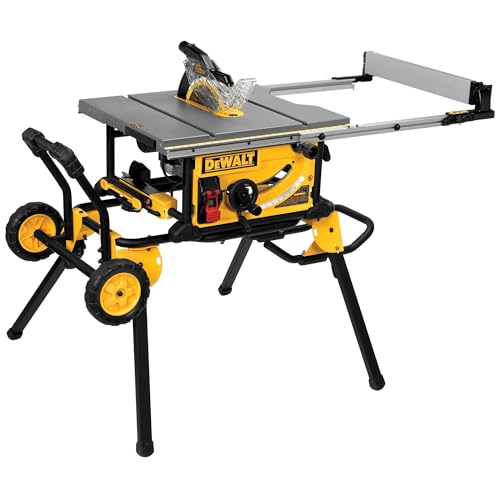
The DWE7491RS is the jobsite standard in this guide, pairing a 10-inch blade with a rolling stand that folds away for transport. Its 15 amp motor spins at 4,800 RPM and rips 32-1/2 inches to the right of the blade, which is enough to halve a sheet of plywood in one pass. The rack-and-pinion telescoping fence adjusts fast and holds parallel, and the rolling stand lets one person move the saw from truck to jobsite without help. It is the saw to buy when the work moves.
Specs
- Blade: 10 in.
- Motor: 15 amp, 4,800 RPM
- Rip capacity: 32-1/2 in. to the right of the blade
- Fence: rack-and-pinion telescoping fence system
- Stand: foldable rolling stand included
Best for: contractors and remodelers who move their saw between jobsites.
Watch out for: the rolling stand adds weight and bulk, so check your vehicle and storage before ordering.
DEWALT DWE7485

The DWE7485 is the compact pick in this guide, built for woodworkers who need a real table saw in a small shop. Its 8-1/4 inch blade spins at 5,800 RPM behind a 15 amp motor, and the 24-1/2 inch rip capacity handles sheet goods and trim work without a second tool. The rack-and-pinion fence is the same system as the larger DEWALT, so cuts stay square even in a saw that fits on a bench. At 46 pounds by the maker figure, one person can carry it from shelf to bench and start cutting.
Specs
- Blade: 8-1/4 in.
- Motor: 15 amp, 5,800 RPM
- Rip capacity: 24-1/2 in. to the right of the blade
- Fence: rack-and-pinion telescoping fence system
- Weight: 46 lb (maker figure for the saw)
Best for: small shops, shared garages and anyone who stores the saw between uses.
Watch out for: the 8-1/4 inch blade cuts shallower than a 10-inch saw, so thick stock at a bevel will stop it.
SKIL TS6307-00
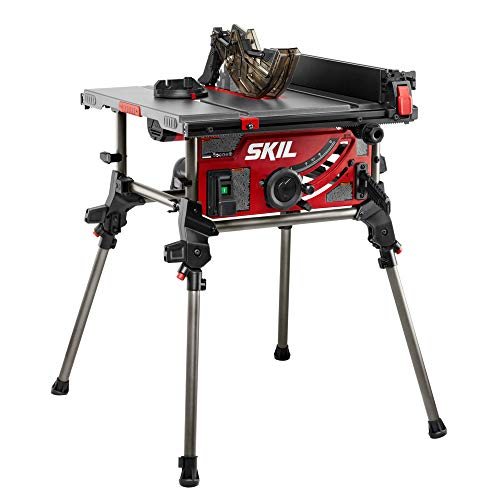
The TS6307-00 is the capacity pick of the compact class, giving you a full 10-inch blade and a folding stand in one box. Its 15 amp motor runs at 4,600 RPM, the 25-1/2 inch rip capacity covers sheet goods, and the rack-and-pinion fence adjusts from one knob. The integrated folding legs turn it into a complete workstation on site, and the bevel range from minus 2 to 47 degrees covers angled cuts without a second setup. It suits buyers who want full cutting depth and a stand without stepping up to a cabinet saw.
Specs
- Blade: 10 in., 24T carbide blade included
- Motor: 15 amp, 4,600 RPM
- Rip capacity: 25-1/2 in. to the right of the blade
- Fence: rack-and-pinion
- Bevel range: minus 2 to 47 degrees
- Stand: integrated folding legs included
Best for: DIYers who need genuine 10-inch cutting depth and a stand in the box.
Watch out for: dado work needs a separate dado insert plate, which is not in the box.
SawStop PCS31230-TGP236
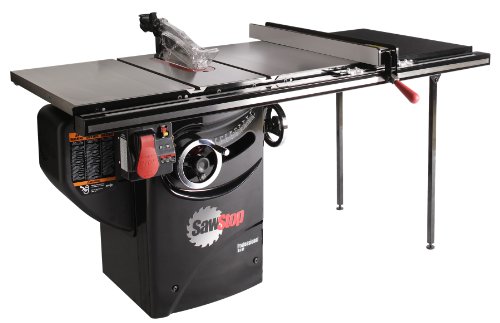
The PCS31230-TGP236 is the premium cabinet saw in this guide, built for a permanent shop where power, stability and accuracy matter most. Its 3 horsepower motor runs on a 230-volt circuit and drives a 10-inch blade through thick hardwood, while the 36-inch T-Glide fence locks parallel with one action. The safety system stops the blade on skin contact in under five milliseconds, and the enclosed cabinet base keeps dust contained. It is heavy, it needs a dedicated circuit, and it is the saw serious woodworkers keep for decades.
Specs
- Blade: 10 in., 40-tooth blade included
- Motor: 3 HP, 230 volt, 13 amp
- Fence: 36-inch Professional T-Glide fence system
- Depth of cut: 3-1/8 in. at 90 degrees, 2-1/4 in. at 45 degrees
- Safety system: blade-contact detection that stops the blade in under 5 milliseconds
- Base: enclosed cabinet base
Best for: permanent shops where safety, power and accuracy matter most.
Watch out for: this saw needs a 230-volt supply and a large floor area, so it is not a portable purchase.
Which One Fits Your Situation
You move the saw between jobs
Pick the DEWALT DWE7491RS, because the rolling stand and the 32-1/2 inch rip capacity cover jobsite work in one package. One person can roll it from the truck to the work, set it up, and rip sheet goods without a second tool. The rack-and-pinion fence holds its setting through the move, which matters when the saw travels every day.
Your shop is a small garage
Pick the DEWALT DWE7485, because it is the lightest real table saw in this guide and it stores on a shelf. The 8-1/4 inch blade and 24-1/2 inch rip capacity cover trim, flooring and sheet goods, and the 46 pound weight means one person can carry it. It is the saw for woodworkers who share their garage with a car.
You want full depth and a stand
Pick the SKIL TS6307-00, because it gives you a 10-inch blade, a 15 amp motor and an integrated folding stand in one box. The 25-1/2 inch rip capacity and the bevel range cover most workshop jobs, and the folding legs mean the saw arrives as a complete workstation rather than a benchtop unit.
You are building a permanent shop
Pick the SawStop PCS31230-TGP236, because the 3 horsepower motor, the cast iron table and the T-Glide fence are built for decades of daily use. The blade-contact brake changes how you work around the saw, and the enclosed base keeps the shop cleaner. Plan the 230-volt circuit and the floor space first.
Common Mistakes
- Buying a compact 8-1/4 inch saw when your work is mostly thick hardwood at a bevel.
- Judging a saw by its motor alone and ignoring a fence that drifts out of parallel.
- Ordering a cabinet saw without checking that your shop has a 230-volt circuit.
- Removing the blade guard for convenience and working without kickback protection.
- Comparing maker tool weights with packaged listing weights, which describe the box rather than the saw.
Frequently Asked Questions
What size table saw do I need?
A 10-inch saw suits most workshops, because it cuts about 3 inches deep and handles dimensional lumber, sheet goods and joinery. An 8-1/4 inch saw suits trim, flooring and small shops where storage matters more than depth. If you cut thick hardwood or four-by-four posts regularly, buy the 10-inch saw and accept the extra weight.
Is a rack-and-pinion fence worth it?
Yes, a rack-and-pinion fence moves both ends together and locks parallel to the blade with one adjustment, which keeps cuts square without constant checking. A basic fence can work well, but it needs a tape check at both ends before each cut. For a saw that moves often, the rack-and-pinion fence holds its setting better through transport.
Can a table saw cut dadoes?
Some table saws can cut dadoes with a dado blade set and a matching throat plate, but not every saw accepts one. Check the manual for your model before buying a dado set, because some compact saws need a separate insert plate that is not in the box. Never run a dado stack without the correct throat plate and guard setup.
How do I keep a table saw accurate?
Check the fence for parallel with a tape at both ends, square the blade to the miter slot, and keep the table clean so boards slide freely. A sharp blade cuts straighter than a dull one, so replace the blade when cuts start to burn or wander. Recheck the settings after moving the saw, because transport knocks fences out of alignment.