
Key takeaways
- Location. Keep an extinguisher near an exit so you can fight a small fire with your back to the way out. A common spot is in the kitchen near the door, but not right beside the stove where you could not reach it during a fire.
- Mount it. Use the bracket supplied. A loose unit can roll or be hard to find in smoke. Mount it according to the maker’s instructions.
- Check the gauge. Look at the pressure gauge every month, and look for corrosion, a damaged hose or a missing pin. Replace the unit if the gauge is outside the operating range.
- Service life. Follow the maker’s replacement or service interval stated on the label and manual. Do not use a unit past that.
- Using it. The common method is pull the pin, aim low at the base of the fire, squeeze the handle and sweep side to side. Read the label instructions on your own unit before you ever need it.
- When not to fight. Leave and call the emergency number if the fire is spreading, filling the room with smoke, blocking your exit or you are not sure what is burning. Never fight a fire that involves a gas leak, and do not use water on a grease fire.
- After discharge. Even a partial discharge means the unit must be replaced or serviced, and the area should be ventilated since the powder is irritating to breathe.
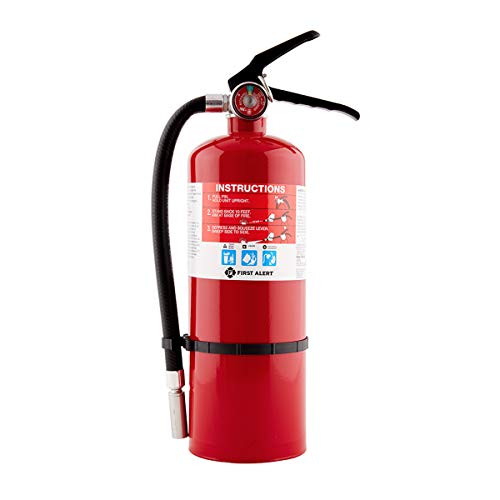
For most households, a compact multipurpose dry chemical extinguisher rated 1-A:10-B:C, such as the Kidde Basic 110 (FA110G) or the First Alert HOME1, is the sensible choice within a best fire extinguisher under $100 budget, and buyers who want rechargeable metal construction or a bigger rating should compare the step-up models listed below. An extinguisher is a first-response tool for a small fire when everyone can leave safely; it does not replace working smoke alarms, an escape plan or a call to the fire department. When in doubt, leave the building and call the fire department.
Our top picks



As an Amazon Associate we earn from qualifying purchases at no extra cost to you.
At a Glance
| Model | Best for | Key stated specs | Limits |
|---|---|---|---|
| Kidde Basic 110 (FA110G) | Kitchens, garages and multi-room coverage on a budget | The maker lists a UL rating of 1-A:10-B:C, aluminum construction, a 12-year service-free design and a strap bracket; listings state 2.5 lb of agent | Disposable, so it is replaced after use; small capacity |
| First Alert HOME1 | Buyers who want a rechargeable, all-metal unit | The maker lists a UL 1-A:10-B:C rating, a metal head, a rechargeable design and a 10-year limited warranty; total weight is listed as 5.4 lb on the maker’s page, while some listings show less | Heavier than the Kidde; recharge must be done by a certified professional |
| Kidde Living Area | Larger rooms needing more Class A capacity | Listings show a 2-A:10-B:C rating and 4 lb of agent | Bulkier; may sit near the cap |
| First Alert HOME2PRO | Step-up rating | Listings show a 2-A:10-B:C rating, a metal valve and a rechargeable design | Larger and much heavier, listed around 9.6 lb |
| Kidde Full Home | Whole-home coverage with the largest rating in this group | Listings show a 3-A:40-B:C rating and about 5.5 lb of agent | Heavy; listings differ on whether it fits the cap |
How to Read the Rating
The rating on the label tells you what size of fire the unit has been certified to handle. The number before the A refers to Class A fires of ordinary materials such as wood, paper and cloth, and a higher number means a larger test fire. The number before the B refers to flammable liquids such as cooking oil spills in a garage or a small fuel fire, and C only means the agent does not conduct electricity, which matters for energized equipment. The maker of the Basic 110 describes its unit as UL rated 1-A:10-B:C. A UL-listed ABC unit is the common standard for homes, and 1-A:10-B:C is the smallest rating most household models carry.
Class K is separate. It covers cooking oils and fats in commercial-style fryers. A standard ABC unit can be used on many kitchen fires, but if you deep-fry often, read the manual and consider a unit designed for kitchen cooking oils.
Budget Tier: Compact Dry Chemical Units
Kidde Basic 110 (FA110G)
This is the one reviewers most often name as best budget or best value. The maker describes aluminum construction, a UL rating of 1-A:10-B:C, a 12-year service-free design that needs no internal examination, and a QR code for registration. It ships with a strap bracket. Listings describe the contents as 2.5 lb of dry chemical, and it is a disposable extinguisher, meaning it is replaced after use rather than recharged; total weight is commonly listed near 3.9 lb, though listings differ. Multi-packs with brackets are popular for covering kitchen, garage, laundry and bedroom hallways.
The compact size helps people with limited grip strength, since a lighter unit is easier to hold steady. The trade-off is a short discharge: listings for compact units of this size describe a range of only several feet and a discharge lasting around ten seconds, so there is little margin. Use it only on a fire that is still small, and leave and call the fire department if it is not out quickly.
First Alert HOME1
Reviewers often name the First Alert HOME1 as a leading pick. The maker lists a UL rating of 1-A:10-B:C, a metal head, and a rechargeable design that a certified professional can service, with a 10-year limited warranty. The trade-off is weight: the maker’s page lists about 5.4 lb in total, heavier than the aluminum Kidde, although some retailer listings show a lower figure.
Step-Up Tier
If a single extinguisher has to protect a larger open space, a bigger rating adds margin. Listings show the Kidde Living Area at 2-A:10-B:C with 4 lb of agent, the First Alert HOME2PRO at 2-A:10-B:C, and the Kidde Full Home at 3-A:40-B:C. These are heavier and bulkier, so make sure the person who would actually use it can lift and aim it. Pricing varies by listing; some of these land near the cap and some above it.
Disposable Versus Rechargeable
Disposable units are cheaper and need no servicing, but the whole unit is replaced after any use, even a short burst, and at the end of its service life. Rechargeable metal units cost more up front and can be refilled by a qualified service company after use. The cost of a refill, and the effort of finding a service provider, means many households simply replace a budget unit. What matters more than the choice is that the gauge reads in the operating range, the pin and hose are intact and the label is readable.
Pick X If You Need Y
| If you need | Pick | Why |
|---|---|---|
| Lowest cost to cover several rooms | Kidde Basic 110 multi-pack | Light, compact, with brackets |
| Metal construction and rechargeability | First Alert HOME1 | Professional recharge supported |
| A vehicle or boat unit | A unit whose label states it is suited to vehicles or marine use | Check the label and manual for the intended use |
| Larger rooms | Living Area, HOME2PRO or Full Home | Higher Class A rating |
| Frequent deep frying | A Class K unit | Designed for cooking oils |
Placement, Care and Safety
- Location. Keep an extinguisher near an exit so you can fight a small fire with your back to the way out. A common spot is in the kitchen near the door, but not right beside the stove where you could not reach it during a fire.
- Mount it. Use the bracket supplied. A loose unit can roll or be hard to find in smoke. Mount it according to the maker’s instructions.
- Check the gauge. Look at the pressure gauge every month, and look for corrosion, a damaged hose or a missing pin. Replace the unit if the gauge is outside the operating range.
- Service life. Follow the maker’s replacement or service interval stated on the label and manual. Do not use a unit past that.
- Using it. The common method is pull the pin, aim low at the base of the fire, squeeze the handle and sweep side to side. Read the label instructions on your own unit before you ever need it.
- When not to fight. Leave and call the emergency number if the fire is spreading, filling the room with smoke, blocking your exit or you are not sure what is burning. Never fight a fire that involves a gas leak, and do not use water on a grease fire.
- After discharge. Even a partial discharge means the unit must be replaced or serviced, and the area should be ventilated since the powder is irritating to breathe.
Alternatives
- Fire blankets. Useful for small kitchen pan fires and clothing fires when used per the maker’s instructions.
- Aerosol fire suppressants. Convenient, but their ratings differ from UL extinguisher classes, so compare the labels carefully.
- Commercial-grade units. Steel commercial-style units from the same brands are typically rechargeable, though they are aimed at workplaces and are heavier.
Frequently Asked Questions
What rating should a home extinguisher have?
A UL-rated ABC unit with at least 1-A:10-B:C is the usual starting point for homes. Larger homes or open floor plans benefit from a bigger rating or more than one unit.
How many do I need?
A common approach is one near the kitchen, one in the garage or workshop, and one on each floor near the bedrooms or the way out. Place them where you can reach an exit behind you.
Do extinguishers expire?
Yes. Each maker states a service life or inspection interval on the label or in the manual, and the gauge should be checked regularly. The Kidde Basic 110 is described by the maker as a 12-year service-free design, but follow the paperwork supplied with your unit.
Can I use it on an electrical fire?
The C in the rating means the agent is not conductive. If it is safe to do so, cut power at the breaker first. If you are unsure, or the fire is anything more than small, leave and call the fire department.
Is a disposable unit safe after a short spray?
No. Once used, even briefly, it may not hold enough pressure. Replace it or have a rechargeable unit serviced by a qualified provider.
Is an extinguisher enough for fire safety?
No. Working smoke and carbon monoxide alarms, a practiced escape plan and prompt calls to the fire department are the priority. Fire services generally advise that you get out first.


