Key takeaways
- Compare five proven camping tents for families, couples, and rough weather. Dome, instant cabin, and SUV options with rainflies included for car camping.
A good camping tent gives a family room to move, a couple a dry place to wait out a storm, and a solo camper a shelter that goes up fast after a long drive.
The five tents below cover the most common camping plans: a budget dome for couples, a fast-pitching instant cabin for families, a value dome with a wide door, a weather-ready dome with two vestibules, and a tent that joins onto an SUV tailgate. Each one includes a rainfly.
As an Amazon Associate, we earn from qualifying purchases.
Quick Answer
The Coleman Sundome 4-Person is the pick for most campers, pairing a low-effort dome design with a full rainfly, a 9 by 7 foot floor, and a setup of about 10 minutes. Families who want standing room should look at the CORE 9 Person Instant Cabin instead, and campers who expect real rain should look at the Kelty Wireless.
How to Choose
Capacity labels assume people lying shoulder to shoulder with no gear inside, so size up by one person for any trip longer than a single night. A 4-person tent sleeps two adults and their bags in comfort, a 6-person tent suits a family of four, and a 9-person cabin suits a family that wants chairs, cots, and room to stand.
Setup speed matters more than most buyers expect. Dome tents with two or three poles take 10 to 20 minutes for one person. Instant tents with pre-attached poles cut that to about two minutes, which is a real advantage when rain is already falling or when you arrive at camp after dark.
Weather protection comes down to three things: a rainfly that covers the whole tent, a bathtub floor that rises up the sides, and sealed seams. A fly that covers only the roof leaves the walls exposed in wind-driven rain.
Ventilation prevents condensation, the most common complaint about budget tents. Look for mesh panels, a ground vent, and a fly that leaves a gap for air to move, because a tent with no airflow drips inside on a cool night even when no rain falls.
Weight and packed size matter only if you carry the tent far from the car. Car campers can ignore weight and choose space instead, while hikers should look for a tent under 6 pounds, which none of the family tents on this list offers.
Finally, check the door layout. Two doors let two people leave without climbing over each other, and a vestibule gives muddy boots and packs a dry place outside the sleeping area.
Coleman Sundome 4-Person Camping Tent with Rainfly

The Sundome has been the default first tent for car campers for years, and the current PFAS-free version keeps that formula. It is a freestanding dome with a 9 by 7 foot floor, 63 square feet of space, and a peak height of 61 inches. Two adults fit with a queen-size air bed and room left for bags along the wall.
Setup takes about 10 minutes for one person. Two poles cross in sleeves and clip to the body, and the rainfly drapes over the top with a simple buckle attachment. The frame is rated by the maker to handle winds over 35 miles per hour when the tent is staked and guyed out.
The rainfly covers the roof and upper walls, and the tent includes a ground vent, large mesh windows, and an E-port for an electrical cord. Two interior pockets hold a phone, keys, and a headlamp. The shelter weighs 9.1 pounds and packs to 23 by 6 by 6 inches.
The limits are honest ones. The peak height of 4 feet 11 inches means no adult stands upright inside, and four adults fit only if they sleep without gear inside, so treat this as a roomy tent for two or three people. The rainfly does not reach the ground, so heavy wind-driven rain can wet the lower walls.
CORE 9 Person Instant Cabin Tent
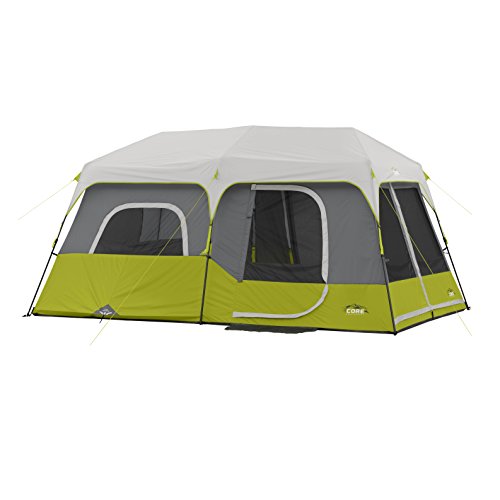
The CORE 9 Person Instant Cabin is the pick for families who want a tent that feels like a small room. The floor measures 14 by 9 feet, and the center height of 78 inches lets most adults stand upright inside. Nine people is the rated capacity, and the practical use is a family of four or five with cots, chairs, and gear inside.
The headline feature is setup speed: the poles come pre-attached, so the frame unfolds and locks in about two minutes, which matters on arrival day when a family wants shelter before unpacking. The cabin shape uses near-vertical walls, which keeps the usable space close to the full floor area instead of shrinking toward the peak like a dome.
H2O Block technology with a fully taped rainfly and taped seams handles weather, while mesh windows and a ground-level vent move air on warm nights.
The trade-off is bulk. A 14 by 9 foot cabin with pre-attached poles packs large and heavy, so this tent belongs in a car trunk, not on a hiking trail. It also needs a flat, open pitch, because the wide footprint finds every slope and root on uneven ground.
Coleman Skydome Camping Tent

The Skydome is Coleman’s answer to the slow setup of a classic dome. It pitches in about 5 minutes thanks to color-coded poles and a hub design, and the listing covers sizes from 2 to 8 people.
The wide door opens almost the full width of one wall, which makes it easy to carry an air bed inside and step in and out at night. The rainfly uses the maker WeatherTec system with welded floors and inverted seams, and the tent is built as a 3-season shelter for spring, summer, and fall.
Inside, the layout stays simple: a rectangular floor, mesh panels, and pockets for small gear.
The Skydome gives up some headroom to the cabin tents, and its peak height suits sitting and kneeling rather than standing. It is also a fair-weather shelter at heart, with a rainfly that covers the roof rather than reaching the ground.
Kelty Wireless Tent

The Kelty Wireless is the pick for campers who expect rain and wind and want a tent that handles both without a premium price. Kelty sells the Wireless in 4, 6, and 8 person sizes, and the figures here describe the 6-person version. Match the size at checkout.
The 6-person version offers 86.5 square feet of floor, a 74-inch peak height, and two vestibules for covered storage outside the doors. Two doors mean two people can leave without crossing each other, and the vestibules keep boots and packs dry. The full-coverage rainfly uses 68-denier polyester with a 1,200 mm water column and a durable water repellent finish, and the floor uses the same 68-denier polyester.
Setup uses a simple pole structure with Quick Corners that guide the poles into place, and one person can pitch the tent in about 10 minutes. The tent weighs close to 19 pounds packed, so it is strictly a car-camping shelter.
The floor is the known weakness. At 68 denier it is thinner than the floors on premium tents, and moisture can come through the bottom in wet conditions if the tent sits without a ground layer. A footprint or a simple ground cloth solves that. The internal pocket layout is also sparse, with small mesh pockets near the floor rather than large organizers.
Timber Ridge SUV Tent

The Timber Ridge SUV Tent connects to the tailgate of an SUV or minivan and turns the vehicle and the tent into one sleeping space. That design suits road trips, festival weekends, and emergency shelter plans.
The tent attaches to the open tailgate and seals around the rear of the vehicle, so sleepers can use the cargo area as part of the tent. It also works as a standalone tent when detached. The combined space gives more room than a tent alone, and the vehicle roof adds a hard, dry layer above part of the sleeping area.
Setup takes longer than a dome tent, because the tent must align with the vehicle and seal around the tailgate. Measure the vehicle before buying, because tailgate height and width vary and the tent fits a range of SUVs and minivans rather than every vehicle on the road. The tent includes a rainfly, and the connection sleeve is the part to check most carefully in wet weather, since a poor seal lets rain run down the vehicle and into the tent.
This pick is the most specialized shelter in this guide. It is not the lightest, the fastest, or the roomiest tent here, but it is the only one that turns a vehicle into part of the shelter.
Who Should Skip It
Skip this guide if you plan to hike miles to a backcountry site. Every tent here is built for car camping, and the lightest weighs more than 9 pounds, while backpacking tents pack under 6 pounds.
Skip the family cabin tents if your campsite is small or sloped. A 14 by 9 foot cabin needs a flat, open pitch, and many tent pads at state parks are sized for dome tents.
Skip the SUV tent if you drive a sedan or a hatchback with a low roof. The connection sleeve is built for SUVs and minivans, and a poor fit leaves a gap that rain and insects find.
Finally, skip any tent on this list if you need a 4-season shelter. These are all 3-season tents built for spring, summer, and fall.
FAQ
How many people should a 4-person tent really hold?
Two adults with gear, or three people sleeping close together. Capacity labels count people lying flat with no bags inside, so size up by one person for trips longer than a single night.
Do I need a footprint or ground cloth under my tent?
Yes, for any tent with a thin floor, and especially for the Kelty Wireless. A footprint protects the floor from abrasion and adds a layer against ground moisture. It should sit slightly smaller than the tent floor so rain does not pool between the layers.
How long does it take to set up an instant tent?
About two minutes for the CORE 9 Person Instant Cabin, because the poles come pre-attached and the frame unfolds and locks. Dome tents take 5 to 10 minutes for one person, and the Kelty Wireless takes about 10 minutes with its Quick Corner pole system.
Can I use these tents in heavy rain?
The Kelty Wireless handles heavy rain best, thanks to its full-coverage rainfly and two vestibules. The Sundome and Skydome handle ordinary rain well but have rainflies that cover the roof rather than reaching the ground, so wind-driven rain can wet the lower walls.
Final Verdict
Most campers should buy the Coleman Sundome 4-Person. It is the simplest, most proven shelter in this guide, it sets up in about 10 minutes, and its 9 by 7 foot floor fits two adults with gear. Families who want to stand up inside should step up to the CORE 9 Person Instant Cabin, trading packed size for a 78-inch peak and a two-minute setup. Campers who expect real rain should choose the Kelty Wireless, whose full-coverage fly and two vestibules earn their keep on the first wet night. The Skydome suits anyone who wants the fastest dome setup with a wide door, and the Timber Ridge SUV Tent suits road trippers who want their vehicle to be part of the shelter.
Product and ASIN Reference
| Product | ASIN |
|---|---|
| Coleman Sundome 4-Person Camping Tent with Rainfly | B0D7QHY574 |
| CORE 9 Person Instant Cabin Tent | B00VFH1RQS |
| Coleman Skydome Camping Tent | B0D7QL1LHC |
| Kelty Wireless Tent | B082P5CM94 |
| Timber Ridge SUV Tent | B0CGX2XLXW |