Key takeaways
- Find the best hiking watches for GPS navigation, solar charging, and long battery life. Compare rugged Garmin, Casio, and Suunto picks for every trail.
A good hiking watch does three jobs at once: it keeps you on route, it tells you how high you have climbed, and it keeps working when the trip runs long. A phone can do the first two, but a phone battery fades fast in cold weather and a phone screen is hard to read in bright sun. A trail watch is built for those conditions, with a battery measured in days and a case that shrugs off rain, dust, and knocks against rock.
As an Amazon Associate, we earn from qualifying purchases.
Quick Answer
For most hikers, the Garmin Instinct 3 Solar is the best hiking watch. It pairs multi-band GPS with a barometric altimeter and compass, adds a flashlight for camp, and runs for days on a charge, with solar charging stretching GPS time far beyond a normal smartwatch. Hikers who need topo maps on the wrist should step up to the Garmin fenix 8 Solar instead.
How to Choose
Start with navigation. Some watches store full topographic maps on the wrist, showing trails, contour lines, and water sources without a phone signal. Others show only a breadcrumb trail of where you have walked, enough for marked trails but thin for off-trail route finding. Decide which kind of hiking you do most before you pay for maps you may never open.
Battery life is the second decision. Makers quote battery in several modes, so compare the GPS number, not the smartwatch number. A watch that lasts a month as a timepiece may last only a day or two with GPS running. Solar charging extends battery rather than replacing it, and it works best in open sun rather than under forest cover.
Weight and fit come next. A heavy watch drags on a long climb, and a wide case catches on pack straps. Smaller wrists suit the 45 mm class, while larger wrists suit the 50 mm class. A soft silicone or nylon band stays comfortable when wet, while a stiff band chafes on a sweaty climb.
A 10 ATM watch handles rain, river crossings, and submersion without worry, while a 5 ATM watch covers rain and splashes but deserves more care around deep water. The altimeter, barometer, and compass, often called the ABC sensors, matter for weather awareness and direction when the trail fades. Finally, think about charging: a solar watch that never needs a cable suits multi-day trips, while a rechargeable GPS watch needs a power bank for anything longer than a weekend.
Best Overall
Garmin Instinct 3 Solar 50mm

The Instinct 3 Solar is the hiking watch for most people: it covers the essentials and keeps going. Multi-band GPS locks onto satellites quickly, even under tree cover, and the barometric altimeter and compass give altitude and direction without a phone. The monochrome Power Glass display stays readable in harsh sunlight, and the fiber-reinforced polymer case is rated to 10 ATM.
Battery is the headline here. Garmin rates the 50 mm model at 60 hours of GPS, stretching to 260 hours with solar in strong sun, and 150 hours in max-battery mode. That is a week on the trail without thinking about a charger. A built-in LED flashlight helps around camp, and breadcrumb navigation shows the route back to the trailhead. It also comes in a 45 mm size for smaller wrists, so match the size to your wrist before ordering.
The trade is maps. There are no preloaded topo maps here, so off-trail navigation means carrying a paper map or a phone as a backup. For marked trails, day hikes, and multi-day trips on established routes, that trade is easy to accept. Button-only controls work with gloves, which matters on cold mornings, and the 52-gram weight disappears on the wrist after the first mile.
Best for Maps
Garmin fenix 8 Solar 47mm Sapphire

Hikers who leave marked trails need maps on the wrist, and the fenix 8 Solar delivers them. Preloaded topographic maps show trails, contour lines, and points of interest on a color display, guarded by a sapphire lens and titanium bezel. Multi-band GPS keeps the position fix steady in canyons and dense forest, and the built-in flashlight covers camp chores after dark.
Solar charging stretches GPS time to 92 hours, with 67 hours without solar, so a long weekend off trail is well within reach. The case is rated to 10 ATM, and the altimeter, barometer, and compass round out the navigation set. Route planning works on the watch itself, with turn prompts on the trail, which beats unfolding a paper map in wind and rain.
This is the heaviest and most capable watch in this guide, and the cost reflects that. Hikers who stay on marked trails will not use the maps enough to justify it, and the color display draws more power than the monochrome Instinct screen. But for off-trail travel, peak bagging, and route finding in unfamiliar terrain, having the map on your wrist changes how confidently you move.
Best for Thru-Hikes
Garmin Enduro 3

A thru-hike is a battery problem before it is anything else, and the Enduro 3 is built to solve it. Garmin rates it at 320 GPS hours with solar, in a package that weighs only 63 grams with its nylon band. Full topo maps and multi-band GPS are included, so the watch navigates as well as it endures, and the Power Sapphire lens guards the screen through weeks of brush and rock.
The light weight matters more than it sounds. On a twenty-mile day, every gram counts, and the Enduro 3 is lighter than most watches with half its battery. The nylon band dries fast after river crossings and stays comfortable when wet, and the case is rated to 10 ATM. The altimeter, barometer, and compass are all present, and the watch tracks long climbs without needing a mid-trip charge.
The single size is the main drawback. The Enduro 3 comes in one large case, so smaller wrists may find it oversized. It is also a specialist tool: the long battery and maps come at a cost that day hikers will not need. For anyone walking for weeks at a time, it removes battery worry from the packing list entirely.
Best No-Charge Solar
Casio Pro Trek PRW-61

Not every hiker wants a GPS watch. The Pro Trek PRW-61 suits those who navigate with a paper map and want the watch to simply work. Tough Solar charging means the watch never needs a cable or a battery change, and Multi Band 6 radio time keeps it accurate without any setup. The Triple Sensor set covers altitude, barometric pressure, and compass direction, which is the classic trail toolkit.
At 62 grams, the PRW-61 is light on the wrist, and the resin case handles knocks and scrapes without complaint. The watch is rated to 10 ATM, so rain and stream crossings are no worry. There is no screen to charge, no app to update, and no cable to pack, which makes it the simplest watch in this guide, with almost nothing to go wrong.
The trade is clear: there is no GPS and no map. This watch cannot show where you are or guide you back, so it suits hikers who already carry a map and compass and want a rugged timepiece with altitude and weather awareness. For that hiker, the PRW-61 is a watch that can be worn for years without a second thought.
Best Budget
Garmin Instinct E 45mm
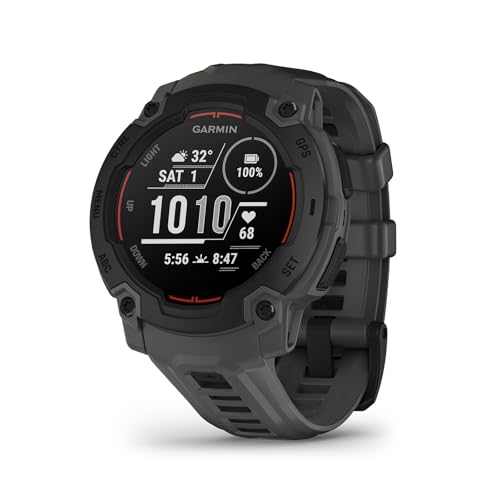
The Instinct E brings the rugged Instinct case to a lower cost by leaving solar charging out. You still get multi-band GPS, a barometric altimeter and compass, breadcrumb navigation, and a 10 ATM case, all in a 45 mm size that suits smaller wrists and lighter packs. Garmin rates GPS time at 24 hours, which covers a full weekend of day hikes on a single charge.
The monochrome display is readable in direct sun, and the button controls work with gloves. The watch tracks routes, altitude, and distance, and it pairs with a phone for notifications when you are back in range. For hikers who want a real GPS watch without paying for solar or maps, this is the honest entry point.
The limits are the battery and the lack of solar. A multi-day trip needs a power bank, and there are no topo maps, so off-trail navigation still needs a paper map. For marked trails, weekend trips, and hikers building their first trail kit, the Instinct E covers the essentials at a cost that leaves room for boots and a pack.
Who Should Skip It
A hiking watch is the wrong buy for some people. If your walks are short, flat, and close to town, a phone and a paper map already cover you. If you need a watch mainly for calls, messages, and apps, a general smartwatch with a bright screen serves you better than a trail watch with a monochrome display and limited apps.
Hikers with very small wrists should try the 45 mm models before buying a 50 mm case, since a watch that slides around gives poor heart data and chafes on long climbs. And if you never leave marked trails, skip the map models and save the money: breadcrumb navigation and a paper map are enough, and the lighter solar watches will serve you better.
FAQ
Do I need topo maps on my watch?
It depends on where you hike. Marked trails with clear signs need only breadcrumb navigation, which shows your path and guides you back. Off-trail travel, cross-country routes, and unfamiliar mountains benefit from topo maps, which show terrain and water on the wrist. If you mostly hike established trails, maps are a luxury rather than a need.
How long does a hiking watch battery really last?
Compare the GPS number, not the smartwatch number. A watch rated for a month as a timepiece may last only a day or two with GPS running. Solar charging extends GPS time in open sun but helps less under forest cover. For multi-day trips, carry a power bank unless your watch is solar powered and you expect open sky.
Are solar hiking watches worth it?
Solar charging is worth it for multi-day and thru-hikes, where it can stretch GPS time from days to weeks. For day hikes and weekends, a rechargeable watch topped up at home is enough. The Casio Pro Trek is different: its solar cell means it never needs charging at all.
Can a hiking watch replace a paper map and compass?
No. A watch is a navigation aid, not a replacement for a map and compass. Batteries die, screens crack, and GPS signals fade in deep canyons. Carry a paper map and a compass on any trip where getting lost would matter, and know how to use them before you need them.
Final Verdict
The Garmin Instinct 3 Solar is the best hiking watch for most hikers, pairing long solar-assisted battery with GPS, altitude, and compass in a light, rugged case. Hikers who roam off trail should choose the Garmin fenix 8 Solar for its topo maps, and thru-hikers should choose the Garmin Enduro 3 for battery life that spans weeks. The Casio Pro Trek PRW-61 suits map-and-compass hikers who want a watch that never needs charging, and the Garmin Instinct E is the budget pick for marked trails and weekend trips. Match the watch to the trails you actually walk, and it will earn its place on your wrist.
Product and ASIN Reference
| Product | ASIN |
|---|---|
| Garmin Instinct 3 Solar 50mm | B0DSC47H9Z |
| Garmin fenix 8 Solar 47mm Sapphire | B0DD622CGH |
| Garmin Enduro 3 | B0DD5N9G17 |
| Casio Pro Trek PRW-61 | B0BQHJ51LQ |
| Garmin Instinct E 45mm | B0DSC72873 |