Key takeaways
- Compare five safety earplugs for workshops, job sites, and loud machinery, from bulk foam plugs to reusable filtered and custom molded pairs.
Loud work damages hearing slowly, and the damage does not heal. A circular saw, a grinder, a mower, or a single afternoon near a compressor can leave ears ringing for hours, and repeated exposure adds up over years. Earplugs are the smallest, cheapest protection you can carry, and they work under a hard hat, under a hood, and alongside safety glasses without breaking any seal.
This guide covers plugs only: five genuinely different earplugs for adult work use, from bulk foam plugs to a reusable filtered pair and a custom molded pair. Every pick here is a plug you push into the ear canal, not a cup you wear over the ear.
As an Amazon Associate, we earn from qualifying purchases.
Quick Answer
For most people, the Howard Leight MAX-1 is the pick to buy first. Its bell-shaped foam seals the ear canal with an NRR of 33, the highest figure among disposable foam plugs here, and the 200-pair box costs little per pair, so you can stash plugs in a truck, a toolbox, and a jacket pocket. If you want one reusable pair for all-day wear, step up to the Alpine WorkSafe.
How to Choose
Begin with the NRR, the Noise Reduction figure in decibels that describes how much sound a protector blocks when fitted correctly. A higher number means more protection, but the number is a lab result, not a promise. Real-world protection runs lower, because a perfect seal is hard to hold, and a foam plug only works when rolled thin, inserted deep, and left to expand.
For most home workshop jobs, an NRR in the high 20s or low 30s is enough. Grinding, demolition, and indoor range sessions are louder, so aim for an NRR of 30 or higher there, or double up with plugs under muffs.
Foam versus reusable is the next decision. Foam plugs are cheap, hygienic, and easy to hand out to a crew, but they are disposable and depend entirely on correct insertion. Reusable plugs cost more up front, wash clean, and last for months, but they need the right size and regular cleaning. Filtered reusable plugs add a third option: they cut harmful noise while letting speech and warning signals through, which matters when you work in a team.
Fit decides everything else. A foam plug needs to be rolled thin, pushed past the ear canal opening with the opposite hand pulling the top of the ear up and back, and held while it expands. If the plug backs out, feels loose, or lets voices through clearly, the fit is wrong. Try a smaller plug, a different shape, or a flanged stem instead of foam.
Corded versus uncorded is a practical choice. A cord keeps plugs around your neck between tasks and stops them from getting lost, but it can snag on machinery and dangle into a work area. Uncorded plugs suit shared boxes and dispensers, where each pair stays sealed until use. Match the choice to the job, not to habit.
Products
Howard Leight MAX-1 Disposable Foam Earplugs, 200 Pair
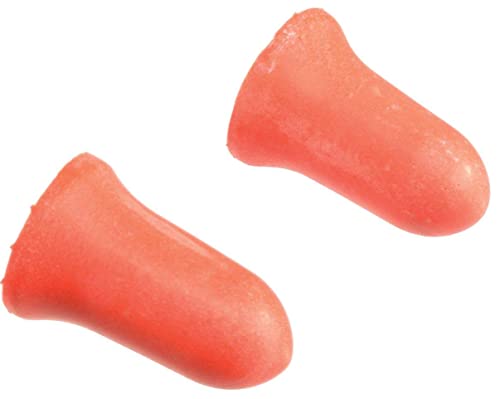
The Howard Leight MAX-1 is the foam plug most crews should buy first. Its bell-shaped polyurethane foam tapers to a narrow tip, so it slides in easily, then expands to fill the ear canal and resists backing out while you work. The NRR of 33 is the highest figure among disposable foam plugs in this guide, which covers sawing, grinding, mowing, and outdoor range sessions.
Each pair comes sealed in its own poly bag, so plugs stay clean until use, and the per-pair cost is low enough to treat foam plugs as the consumables they are.
Match the MAX-1 by its part number, because the MAX family is large. The MAX-30 is the corded version, the MAX-1S is a smaller plug for narrow ear canals, and the MAX-1-D is a dispenser refill. Pick the MAX-1 when you want maximum foam protection in a bulk box.
Honeywell Laser Lite LL-1 High Visibility Disposable Foam Earplugs, 200 Pair

The Honeywell Laser Lite LL-1 is the high-visibility foam plug in this guide, and its case rests on color and comfort. The pink and yellow plugs are easy to spot across a job site, which helps a supervisor confirm at a glance that a crew is protected, and helps you find a dropped plug on a bench. The low-pressure polyurethane foam expands gently, so it presses less against the ear canal than stiffer foam during long wear.
The NRR of 32 sits just below the MAX-1, which covers the same range of workshop and outdoor jobs. The 200-pair box matches the MAX-1 on quantity, with each pair sealed in its own poly bag.
Match the LL-1 by its part number 3301105, because Honeywell sells Laser Lite in several pack sizes and corded versions under similar names. The R-01204 listing is a different pack, so match by ASIN. Pick the Laser Lite when bright color and gentle foam matter as much as the number on the box.
3M E-A-R Classic 310-1001 Uncorded Disposable Foam Earplugs, 200 Pair

The 3M E-A-R Classic 310-1001 is the oldest foam plug design still in wide use, and its case rests on slow-recovery foam that holds its shape in heat and humidity. The cylindrical yellow plug compresses slowly, which gives you time to insert it properly, then expands to a firm seal that stays put through a long shift. The NRR of 29 is lower than the two plugs above, but the Classic earns its place on comfort and consistency, not on the highest number.
The foam resists moisture, so it suits humid shops, outdoor summer work, and anyone who sweats through a shift. Each pair comes in a pillow pack, and the 200-pair box is the standard bulk format for a workplace dispenser.
Match the 310-1001 by its part number, because 3M sells the Classic in several pack formats. The 312-1201 is the poly-bag version, and the VP312-1201 is a small five-pair pack. Pick the Classic when you want a proven, slow-recovery foam plug that behaves the same in heat and humidity.
Alpine WorkSafe Reusable Earplugs for Work

The Alpine WorkSafe is the reusable plug in this guide, and it solves the problem foam plugs cannot: hearing the world while still cutting the worst noise. The plugs use acoustic filters that cut harmful noise by 23 dB while letting speech, alarms, and warning signals through, so you can hear a coworker or a backup alarm without pulling a plug out. The ThermoShape material softens with body heat and takes on the shape of the ear canal, which keeps the seal comfortable through a full shift.
The plugs arrive with a safety cord and a storage case, and they wash clean, so one pair lasts for months of daily use. The filter design also means the WorkSafe is not the pick for the loudest jobs, where a high-NRR foam plug or a muff blocks more sound.
Match the WorkSafe by name, because Alpine sells several similar plugs. The MusicSafe Pro is built for musicians with different filter sets, and the SleepSoft is built for sleep. Pick the WorkSafe when you need to hear your team while cutting machine noise.
Decibullz Custom Molded Earplugs

The Decibullz Custom Molded Earplugs are the custom-fit plug in this guide, and they solve the problem every universal plug shares: no two ear canals are the same shape. The thermoplastic molds heat in hot water, then press into the ear and set to the exact shape of your ear canal and outer ear. If the fit is wrong, you reheat and remold, so the process is forgiving.
The NRR of 31 with the foam tips puts the Decibullz close to the best foam plugs here, with a seal that stays consistent because the plug matches your ear. The plugs are reusable and remoldable, so one pair can last for years of regular use.
The trade-off is the molding step itself, which takes a few minutes and a pot of hot water, and the plugs are not for people who dislike putting objects deep into their ears. Match the standard Decibullz by ASIN, because the PRO kit is a different package. Pick the Decibullz when universal plugs never quite fit and you want a seal shaped to your own ears.
Who Should Skip It
Skip foam plugs if you have trouble inserting them correctly, because a poorly fitted plug protects less than a muff with a visible seal. Skip the MAX-1 and the Laser Lite if you need to hear speech clearly all day, because high-NRR foam blocks voices along with machine noise, and a filtered plug like the WorkSafe suits team work better. Skip the E-A-R Classic if you work at an indoor range or with a grinder all day, because its NRR of 29 is the lowest here, and a higher-NRR plug or a muff is the safer choice. Skip the WorkSafe if your job is the loudest kind, because its 23 dB reduction is a filter, not a wall. Skip the Decibullz if you want protection straight out of the box, because the molding step takes time and hot water.
FAQ
How far should a foam earplug go into the ear?
Roll the plug into a thin crease-free cylinder, pull the top of the ear up and back with the opposite hand, and push the plug past the ear canal opening until only a small edge stays outside. Hold it in place while the foam expands, usually for about half a minute.
Can foam earplugs be washed and reused?
No. Foam plugs are single-use. They pick up dirt and earwax, lose their spring after a few insertions, and expand more slowly each time. Replace them when they feel stiff, look dirty, or stop expanding fully. Reusable plugs like the WorkSafe and the Decibullz wash clean with mild soap and water, and those are the ones to choose if you dislike throwing plugs away.
Do earplugs work with safety glasses and a hard hat?
Yes, and that is one of their main strengths. Plugs sit inside the ear canal, so glasses arms and hard hat suspensions never break the seal the way they can with muffs. For the loudest jobs, wear plugs under muffs, which adds protection and keeps the muff seal honest.
How do I know if my earplugs fit correctly?
Your own voice should sound muffled and hollow, background noise should drop clearly, and the plug should stay in place when you move your jaw. If voices sound normal, the plug backs out, or one ear feels different from the other, the fit is wrong. Try a different size or shape, or switch from foam to a flanged or molded plug.
Final Verdict
Buy the Howard Leight MAX-1 first if you want the strongest foam protection in a bulk box that a whole crew can share. Choose the Honeywell Laser Lite if bright color and gentle foam matter for long shifts. Choose the 3M E-A-R Classic if slow-recovery foam and humid conditions are your daily reality. Choose the Alpine WorkSafe if you need to hear your team while cutting machine noise. Choose the Decibullz if universal plugs never fit and you want a seal shaped to your own ears. Whichever you pick, wear it every time the noise begins, because the best plug is the one that stays in.
Product and ASIN Reference
| Product | ASIN |
|---|---|
| Howard Leight MAX-1 Disposable Foam Earplugs, 200 Pair | B0013A0C0Y |
| Honeywell Laser Lite LL-1 High Visibility Disposable Foam Earplugs, 200 Pair | B0007XJOLG |
| 3M E-A-R Classic 310-1001 Uncorded Disposable Foam Earplugs, 200 Pair | B008MCU2M4 |
| Alpine WorkSafe Reusable Earplugs for Work | B00REAQTF4 |
| Decibullz Custom Molded Earplugs | B01N129AQ8 |