Our Short List of 3

- Blade: 12 inches, dual-bevel sliding head on rails
- Motor: 15 amp, 3,800 rpm
- Crosscut capacity: up to 2 by 16 at 90 degrees with special setup, 2 by 12 at 45 degrees
- Cut-line system: XPS LED shadow line, adjustment free

- Blade: 12 inches, dual-bevel head on Axial-Glide arm
- Motor: 15 amp, 3,800 rpm
- Slide benefit: saves about 12 inches of rear workspace versus rail sliders
- Controls: upfront metal bevel controls, SquareLock quick-release fences

- Blade: 10 inches, dual-bevel head on two-steel-rail slide system
- Motor: 15 amp direct drive, 3,200 rpm, electric brake
- Miter range: 0 to 60 degrees left and right with positive stops
- Capacity: 6-5/8 inches nested crown, 5-1/4 inches vertical baseboard, 12-inch crosscut at 90 degrees
All 5 Picks at a Glance
| Product | Specs | Action |
|---|---|---|
| DEWALT DWS780 12-Inch Sliding Compound Miter Saw — best overall |
| Check price on Amazon |
| Bosch GCM12SD 12-Inch Dual-Bevel Glide Miter Saw — best for tight benches |
| Check price on Amazon |
| Makita LS1019L 10-Inch Dual-Bevel Sliding Compound Miter Saw — best 10-inch precision |
| Check price on Amazon |
 Metabo HPT C12RSH3 12-Inch Dual-Bevel Sliding Miter Saw — best 12-inch value with a shadow line |
| Check price on Amazon |
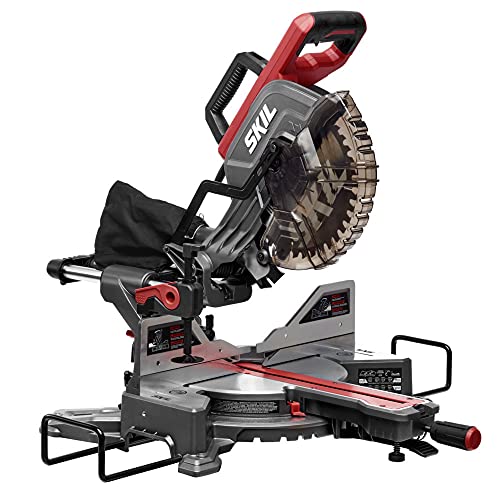 SKIL MS6305-00 10-Inch Dual-Bevel Sliding Compound Miter Saw — best budget slider |
| Check price on Amazon |
Key takeaways
- Compare the best sliding miter saws for wide crosscuts, crown and trim, with dual-bevel range, glide and rail designs, and shadow cut lines compared.
A sliding miter saw earns its bench space when a fixed chop saw falls short: the head travels forward on rails or a glide arm, so a 10-inch or 12-inch blade can crosscut wide shelving, deck boards, and laminate flooring in a single pass instead of forcing you to flip the stock and blend two cuts. That travel is the whole point of this guide. Every pick below genuinely slides, whether on twin steel rails, a forward-rail layout, or a hinged glide arm, and every pick bevels and miters for compound work on crown, baseboard, and stair parts.
This roundup is narrower than a general miter saw guide on purpose. Fixed compound-only models were excluded, because they cannot match the crosscut width a slider delivers from the same blade size. The five saws run from the strongest all-round 12-inch machine down to a lighter 10-inch value pick, compared on slide mechanism, crosscut capacity, bevel range, cut-line system, and weight.
As an Amazon Associate, we earn from qualifying purchases.
Quick answer
For most buyers, the DEWALT DWS780 is the best sliding miter saw here, with a 12-inch dual-bevel head, wide crosscut capacity for 2 by 16 stock, and an LED shadow line that needs no calibration. Choose the Bosch glide model for tight benches, the Makita for 10-inch precision, and the SKIL for lower-cost trim work.
DEWALT DWS780 12-Inch Sliding Compound Miter Saw — best overall
- Blade: 12 inches, dual-bevel sliding head on rails
- Motor: 15 amp, 3,800 rpm
- Crosscut capacity: up to 2 by 16 at 90 degrees with special setup, 2 by 12 at 45 degrees
- Cut-line system: XPS LED shadow line, adjustment free
The DWS780 is the reference point for 12-inch sliders, and it holds the top spot here because it pairs the widest useful capacity in this group with a cut-line system that stays accurate without adjustment. Its head rides on rails for a crosscut capacity that covers 2 by 16 dimensional lumber at 90 degrees with the maker’s special setup, and 2 by 12 at a 45-degree miter, which is enough for deck framing, wide shelving boards, and most flooring planks without a second pass.
The XPS crosscut positioning system casts a shadow of the blade onto the work, showing exactly where the cut will land on either side of the kerf. Because the shadow comes from the blade itself, there is no laser to knock out of alignment and no line offset to learn. Tall sliding fences support crown molding nested against the fence, and the back fence design is what allows the deeper vertical capacity for baseboard stood upright.
A stainless steel miter detent plate with positive stops, a cam lock handle, and an override for fine angles make repeat work fast, while the 15-amp motor turns at 3,800 rpm for framing lumber and hardwoods alike. At roughly 56 pounds it is a saw you move with intent rather than carry daily, and the rails need clear space behind the bench through the full stroke.
Key specs
Choose this saw if you want one machine that covers framing, decking, trim, and flooring without a capacity compromise. Skip it if your bench sits tight against a wall, because the rail stroke needs rear clearance the glide and forward-rail designs below do not.
Bosch GCM12SD 12-Inch Dual-Bevel Glide Miter Saw — best for tight benches
- Blade: 12 inches, dual-bevel head on Axial-Glide arm
- Motor: 15 amp, 3,800 rpm
- Slide benefit: saves about 12 inches of rear workspace versus rail sliders
- Controls: upfront metal bevel controls, SquareLock quick-release fences
The GCM12SD solves the slider’s biggest layout problem. Instead of rails that sweep backward, Bosch uses a patented Axial-Glide arm: a hinged, sealed-bearing linkage that folds the head forward in a smooth arc. The maker positions this as saving about 12 inches of workspace behind the saw, so the machine can sit nearly flush to a wall while still delivering a full sliding crosscut. For a fixed bench in a garage or basement shop, that footprint change is the reason to buy this saw over a rail model.
Capacity stays in full 12-inch territory. The glide system allows wider crosscuts than a non-sliding 12-inch saw, with horizontal capacity around 14 inches, vertical capacity for tall baseboard, and nested crown capacity suited to common profiles. The bevel and miter ranges are generous, with miter angles reaching beyond 50 degrees on one side and bevel controls placed up front in metal, so adjustments happen from the front of the saw rather than by reaching around the back.
SquareLock fences align quickly and hold position, the detent plate covers the common crown and trim angles, and an ambidextrous trigger handle with a soft grip suits long trim sessions. Trade-offs are weight and complexity: at about 65 pounds this is the heaviest saw in the guide, and the glide arm has more moving parts than simple rails, so it rewards careful setup out of the box.
Key specs
Choose this saw if your bench depth is fixed and you still need 12-inch sliding capacity. Skip it if you haul a saw between sites often, because the weight and arm design favor a permanent station.
Makita LS1019L 10-Inch Dual-Bevel Sliding Compound Miter Saw — best 10-inch precision
- Blade: 10 inches, dual-bevel head on two-steel-rail slide system
- Motor: 15 amp direct drive, 3,200 rpm, electric brake
- Miter range: 0 to 60 degrees left and right with positive stops
- Capacity: 6-5/8 inches nested crown, 5-1/4 inches vertical baseboard, 12-inch crosscut at 90 degrees
The LS1019L shows how far a 10-inch slider can stretch. Its two-steel-rail system uses a single slide-glide operation with linear ball bearings, and the rails are arranged so the saw can operate flush against a wall, much like the Bosch glide concept but in a smaller, lighter frame. The direct-drive gearbox and guard design free up vertical room, giving this 10-inch saw a nested crown capacity of 6-5/8 inches, the figure usually associated with 12-inch machines, plus 5-1/4 inches of vertical baseboard capacity.
The miter range is the widest in this guide at 60 degrees left and right, with positive stops at the common angles including 31.6 degrees for crown work. That extra swing matters for octagonal frames, stair returns, and odd room corners where a 52-degree limit forces awkward workarounds. A laser guide marks the cut line, the 15-amp direct-drive motor runs at 3,200 rpm with a soft ramp-up and an electric brake, and the see-through guard keeps the blade and line in view through the cut.
Crosscut capacity reaches 12 inches at 90 degrees, enough for 2 by 12 stock and most shelving, while the smaller blade costs less to replace and leaves a narrower kerf for finish work. At 57.9 pounds it is the most compact full-featured slider here and the easiest of the three premium picks to mount on a portable stand.
Key specs
Choose this saw if finish accuracy, wall-flush placement, and a wide miter swing matter more than raw 12-inch depth of cut. Skip it if you routinely cut thick framing stock in one pass, where the larger blades above hold an edge.
Metabo HPT C12RSH3 12-Inch Dual-Bevel Sliding Miter Saw — best 12-inch value with a shadow line
- Blade: 12 inches, dual-bevel sliding head
- Speed: 4,000 rpm no-load
- Miter range: 45 degrees left to 57 degrees right, nine detent stops
- Bevel range: 45 degrees left and right
The C12RSH3 is the current-generation Metabo HPT 12-inch slider, and its appeal is getting the core pro feature set, dual bevel, sliding rails, and a shadow cut line, in a lighter and simpler package than the premium pair at the top. The Xact Cut shadow line uses an LED to project the blade profile onto the stock, the same adjustment-free principle as the DEWALT system, so the line you see is the line the blade will follow.
The head slides for wide crosscuts, miters from 45 degrees left to 57 degrees right, and bevels 45 degrees in both directions, with nine detent stops covering the angles used most in trim and framing. The motor delivers a 4,000 rpm no-load speed, a touch quicker than the other 12-inch picks, and one-touch locks for miter and bevel settings speed up angle changes between cuts. A tall fence supports crown and baseboard stood against it, and side holders help steady longer stock at bench level.
At 53.6 pounds it is the lightest 12-inch slider in this guide, which makes it the easiest of the three to pair with a folding stand for site work. The included blade is a 32-tooth general purpose blade suited to framing and rough trim; finish carpenters will want to budget for a finer blade for painted molding. The maker’s five-year warranty coverage is the longest stated in this group, which suits buyers who keep tools for a long service life.
Key specs
Choose this saw if you want 12-inch sliding capacity and a shadow line while keeping weight and complexity down. Skip it if you need the very widest crosscut for oversize planks, where the DEWALT back fence setup still leads.
SKIL MS6305-00 10-Inch Dual-Bevel Sliding Compound Miter Saw — best budget slider
- Blade: 10 inches, dual-bevel sliding head
- Motor: 15 amp, 4,800 rpm
- Crosscut capacity: 2 by 12 at 90 degrees, 2 by 8 at 45 degrees
- Bevel stops: 48 and 45 degrees left, 0 degrees, 45 degrees right
The MS6305-00 brings the defining slider features, rail travel, dual bevel, and a shadow line, down to the most accessible tier in this guide, and it does so without shrinking to a toy size. The 10-inch head slides to crosscut 2 by 12 lumber at 90 degrees and 2 by 8 at a 45-degree miter, which covers deck boards, shelving, stair treads, and most trim stock a homeowner or remodeler handles week to week.
Dual bevel is the feature that separates this saw from cheaper single-bevel sliders: the head tilts both ways, with positive stops at 48 and 45 degrees left, zero, and 45 degrees right, so mirrored crown and return cuts happen without flipping long, fragile molding end for end. The LED shadow line marks the blade path clearly and never needs the recalibration a laser can demand after transport. Miter capacity runs to 50 degrees left and right with 11 positive stops.
The 15-amp motor spins at 4,800 rpm, the highest blade speed here, which helps the included blade leave clean edges in pine and primed stock. At 39.4 pounds with a carry handle, this is the only saw in the guide that one person can comfortably move between a garage bench, a driveway, and a folding stand on a regular basis. Extension rods, a clamp, and a dust bag are included. The compromises are the expected ones at this tier: fence and detent feel are less refined than the premium saws, and dust collection is the weakest of the five.
Key specs
Choose this saw if you want genuine sliding capacity and dual bevel for home projects without paying for pro-tier mass and refinement. Skip it if your work is daily production trim, where the heavier saws above hold settings better under constant use.
How to choose
Begin with the widest stock you cut in a normal month, not the widest you can imagine. If that is 2 by 12 shelving and deck boards, a good 10-inch slider such as the Makita or SKIL covers you, and you gain a smaller footprint and lower blade cost. If you regularly cut 2 by 14 or wider planks, deep crown, or tall baseboard stood upright, step up to a 12-inch slider and check the nested crown and vertical figures, not just the headline crosscut number.
Next, measure the space behind your bench. Traditional rail sliders need roughly the full stroke length in clear space behind the saw at full extension. If your bench backs onto a wall, the Bosch Axial-Glide arm and the Makita forward rail layout exist precisely for that problem, and choosing one of them can matter more than any capacity figure. For a saw that lives on a stand and travels, weight and a carry handle move to the top of the list.
Then weigh the cut-line system. Shadow lines from an LED show both edges of the actual blade and never drift out of calibration, which is why three of the five picks use them. Lasers are bright and precise but can need occasional realignment. Finally, confirm the bevel arrangement: dual bevel saves real time on crown and long molding because the stock stays put while the head tilts either way.
Who should skip
Skip sliding miter saws entirely if nearly all your cuts are in 2 by 6 or narrower stock. A lighter fixed compound saw handles that work, costs less to buy and maintain, and has no slide mechanism to keep clean and true. The general miter saw guide on this site is the better read for that kind of work.
Skip the premium 12-inch models if the saw will live in a small shop corner and only come out for occasional shelving. The SKIL or a 10-inch class saw will do the same cuts with far less storage pain. Skip the budget pick, in turn, if you cut hardwood trim all day for a living: detent wear, fence refinement, and dust control are exactly what the extra money above buys. And skip every corded model here if your work is mostly on sites without reliable power runs; a cordless slider is a different category with different trade-offs in runtime and weight.
Frequently Asked Questions
What does the sliding feature actually add over a fixed miter saw?
Travel. A fixed head can only cut as wide as the blade diameter allows in a straight chop, while a sliding head pulls through the stock, extending crosscut width well beyond the blade size. That is how a 10-inch slider crosscuts a 2 by 12 and how a 12-inch slider handles boards that would otherwise need a flip and a second, less accurate cut.
Is a 10-inch sliding saw enough, or do I need 12 inches?
For trim, flooring, shelving, and deck boards, a 10-inch slider is usually enough, and models like the Makita even match 12-inch nested crown capacity. Move to 12 inches when you cut thick stock, tall baseboard stood upright, or very wide planks often, and when you want the deeper vertical cut a larger blade provides in a single pass.
Which slide design is best for a bench against a wall?
Look for a glide arm or a forward-rail design rather than rear-extending rails. The Bosch Axial-Glide linkage folds forward and saves about 12 inches of rear space, and the Makita two-rail layout is built to run flush against a wall. Both keep full sliding capacity without demanding an empty gap behind the bench.
How do I keep a sliding saw cutting accurately over time?
Keep the rails or glide path clean, since packed dust is the main cause of rough travel and drift. Check fence squareness and detent accuracy with a known square after any move, tighten the slide lock before transport, and use a sharp blade suited to the material. A shadow line system removes one whole category of drift, because the projected line always comes from the blade itself.
Final verdict
For a single recommendation, the DEWALT DWS780 remains the safest buy in this category: the widest practical capacity, a shadow line that never needs calibration, and fences built for crown and tall baseboard. The Bosch GCM12SD is the smarter pick when bench depth is non-negotiable, and the Makita LS1019L is the precision choice for finish work in a compact, wall-flush frame. The Metabo HPT C12RSH3 delivers 12-inch sliding and a shadow line in the lightest full-size package here, while the SKIL MS6305-00 makes genuine dual-bevel sliding capacity reachable for home shops. Pick by your widest regular board and your bench layout, and any of the five will cut wider and cleaner than the fixed saw it replaces.
Product and ASIN Reference
| Product | ASIN |
|---|---|
| DEWALT DWS780 12-Inch Double Bevel Sliding Compound Miter Saw | B00540JS7C |
| Bosch GCM12SD 12-Inch Dual-Bevel Glide Miter Saw | B004323NNC |
| Makita LS1019L 10-Inch Dual-Bevel Sliding Compound Miter Saw with Laser | B073K99HWJ |
| Metabo HPT C12RSH3 12-Inch Dual-Bevel Sliding Miter Saw | B0CY6R4MHX |
| SKIL MS6305-00 10-Inch Dual-Bevel Sliding Compound Miter Saw | B08J7N3VYW |