Key takeaways
- Compare the best miter saws for trim, framing, and fine woodworking, from compact 10-inch compound saws to full-size 12-inch sliding models.
The best miter saw for most workshops is the DEWALT DWS780, a 12-inch double-bevel sliding compound saw that handles wide boards, tall baseboards, and nested crown molding. If your bench sits against a wall, the Bosch GCM12SD glides on articulated arms instead of rear rails, so it needs almost no clearance behind it. For a lighter 10-inch slider with the same crown capacity, the Makita LS1019L stands out. The DEWALT DWS715 is the best non-sliding 12-inch option, and the Metabo HPT C10FCGS is the budget pick for accurate crosscuts without the sliding mechanism.
As an Amazon Associate, we earn from qualifying purchases.
Table of Contents
- How to Choose a Miter Saw
- DEWALT DWS780 12-Inch Double Bevel Sliding Compound Miter Saw
- Bosch GCM12SD 12-Inch Dual-Bevel Glide Miter Saw
- Makita LS1019L 10-Inch Dual-Bevel Sliding Compound Miter Saw with Laser
- DEWALT DWS715 12-Inch Single Bevel Compound Miter Saw
- Metabo HPT C10FCGS 10-Inch Compound Miter Saw
- Frequently Asked Questions
- Conclusion
- Product and ASIN Reference
How to Choose a Miter Saw
A miter saw earns its place by making fast, repeatable angled cuts that would take far longer with a circular saw and a guide. The first decision is blade size: a 12-inch saw cuts wider boards in one pass and handles taller baseboards and crown molding, while a 10-inch saw is lighter, easier to carry, and usually costs less. The second decision is sliding versus non-sliding. A sliding saw pulls the head forward and back, so it crosscuts boards much wider than the blade. A non-sliding saw is simpler, lighter, and cheaper, but its crosscut width is limited to roughly the blade diameter.
Bevel type matters for compound cuts. A single-bevel saw tilts to one side, so you flip the workpiece to cut the mirror angle. A double-bevel saw tilts both ways, which saves time on crown molding and trim runs. Miter range is worth checking too: most saws miter at least 50 degrees each way, and a few reach 60 degrees, which matters for hexagonal and octagonal frames.
Cut guides are another real difference. DEWALT uses an XPS shadow line that projects the blade edge onto the board, while Makita fits a laser line on its slider. A shadow line shows both edges of the kerf, and a laser shows only one side and can drift with heat. Weight is the last practical factor: a 12-inch slider can weigh well over 50 pounds, so it lives on a stand, while a 10-inch compound saw under 25 pounds can be carried to the job and back. Finally, confirm the exact model number on the listing before ordering, since several of these saws have near-identical siblings.
DEWALT DWS780 12-Inch Double Bevel Sliding Compound Miter Saw

The DWS780 is the default 12-inch sliding compound saw. It is the current model in DEWALT’s line, it carries the XPS LED shadow line that projects the blade edge onto the workpiece, and it cuts 2 by 14 dimensional lumber at 90 degrees and 2 by 12 at 45 degrees. The tall sliding fences support base molding up to 6-3/4 inches vertical and crown molding up to 7-1/2 inches nested, which covers nearly every trim job.
It miters 60 degrees to the right and 50 degrees to the left, and the detent plate has 10 positive stops. The dual bevel tilts from 0 to 49 degrees in both directions. A 15-amp motor spins the 12-inch blade at 3,800 RPM, and the included 80-tooth carbide blade leaves a clean edge on trim. The trade-off is size and weight: at nearly 55 pounds, this saw belongs on a stand, and the sliding rails need clearance behind the saw. It is the premium pick here for framing, decking, and fine trim.
Specs
- Blade size: 12 inches
- Motor: 15 amp, 3,800 RPM
- Bevel: dual bevel, 0 to 49 degrees left and right
- Miter range: 60 degrees right, 50 degrees left
- Crosscut capacity: 2 by 14 at 90 degrees, 2 by 12 at 45 degrees
- Cut guide: XPS LED shadow line
- Included: 80-tooth carbide blade, blade wrench, vertical material clamp, dust bag
- Weight: 54.7 pounds
- Warranty: 3-year limited
Bosch GCM12SD 12-Inch Dual-Bevel Glide Miter Saw

The Bosch GCM12SD solves a workshop problem rail sliders cannot: space behind the saw. Instead of rails that poke out the back, it rides on Bosch’s Axial-Glide system, articulated arms that fold as the head moves. The saw can sit almost flush against a wall and still make its full cut, which makes it the best choice for a small shop.
Under the arm is a serious 12-inch saw: the 15-amp motor drives a 60-tooth carbide blade, the dual bevel tilts 47 degrees to each side, and the miter range runs 52 degrees left and 60 degrees right. Crosscut capacity is 3-1/2 by 13-1/2 inches, enough for 4 by 14 dimensional lumber, with 6-1/2 inches of vertical capacity. The bevel and miter controls sit up front, and base extensions add material support. An electric brake stops the blade quickly after the cut. The main drawbacks are weight and warranty: at 65 pounds it is the heaviest saw here, and the one-year limited warranty is the shortest cover in this roundup. There is no laser or shadow line, so you line up cuts by eye. For a tight shop, the glide arm is worth those trade-offs.
Specs
- Blade size: 12 inches
- Motor: 15 amp
- Bevel: dual bevel, 0 to 47 degrees left and right
- Miter range: 52 degrees left, 60 degrees right
- Crosscut capacity: 3-1/2 by 13-1/2 inches
- Cut guide: none
- Included: 60-tooth carbide blade, dust bag
- Weight: 65 pounds
- Warranty: 1-year limited
Makita LS1019L 10-Inch Dual-Bevel Sliding Compound Miter Saw with Laser

The Makita LS1019L proves that a 10-inch saw can cut like a 12-inch saw. Its direct-drive gearbox and redesigned guard free up vertical room, so it cuts crown molding up to 6-5/8 inches nested, the same capacity a 12-inch saw advertises, with 5-1/4 inches of vertical capacity and a 12-inch crosscut. The two-steel-rail system lets it sit flush against a wall like the Bosch, and the head runs on ball bearings for a smooth slide.
It miters a full 60 degrees left and right, useful for hexagonal and octagonal frames. The dual bevel tilts 48 degrees to each side, and a built-in laser marks the cut line. The 15-amp direct-drive motor runs at 3,200 RPM with soft start, so start-ups are smooth and there are no belts to replace. At about 58 pounds it is the lightest full slider here. Some owners report the slide can drift out of parallel on some units, so check the saw against a square when it arrives and use a retailer with straightforward returns. The laser also needs occasional adjustment. For finish carpentry in a tight shop, 10-inch portability with 12-inch crown capacity is hard to beat.
Specs
- Blade size: 10 inches
- Motor: 15 amp direct drive, 3,200 RPM
- Bevel: dual bevel, 0 to 48 degrees left and right
- Miter range: 60 degrees left, 60 degrees right
- Crosscut capacity: 12 inches
- Cut guide: laser
- Included: 60-tooth carbide blade, vertical vise, dust bag, wrench
- Weight: 57.9 pounds
- Warranty: limited
DEWALT DWS715 12-Inch Single Bevel Compound Miter Saw

The DWS715 is the best non-sliding 12-inch saw for trim and framing. It skips the sliding rails, which keeps it simpler, lighter, and less expensive than the DWS780, while keeping the same 12-inch blade and 15-amp motor. The motor spins at 4,000 RPM, and the saw crosscuts 2 by 8 dimensional lumber at 90 degrees and 2 by 6 at 45 degrees, which covers most trim and framing work.
The detent plate has 14 positive stops, and the cam miter lock holds angles repeatably. The single bevel tilts 0 to 48 degrees to the left, so mirror bevels mean flipping the workpiece, but that is a fair trade at this tier. Tall sliding fences support 5-1/2 inch base molding and crown molding nested. There is no factory cut-line indicator, so you align by eye, and the stock blade is a common first upgrade for finish work. It carries DEWALT’s 3-year limited warranty with one year of free service. If you do not need to crosscut wide boards in one pass, the DWS715 gives you 12-inch capacity without the weight, bulk, or cost of a slider.
Specs
- Blade size: 12 inches
- Motor: 15 amp, 4,000 RPM
- Bevel: single bevel, 0 to 48 degrees left
- Miter range: 50 degrees left, 50 degrees right
- Crosscut capacity: 2 by 8 at 90 degrees, 2 by 6 at 45 degrees
- Cut guide: none
- Included: 12-inch carbide blade, blade wrench, dust bag, vertical clamp
- Weight: 42.8 pounds
- Warranty: 3-year limited
Metabo HPT C10FCGS 10-Inch Compound Miter Saw
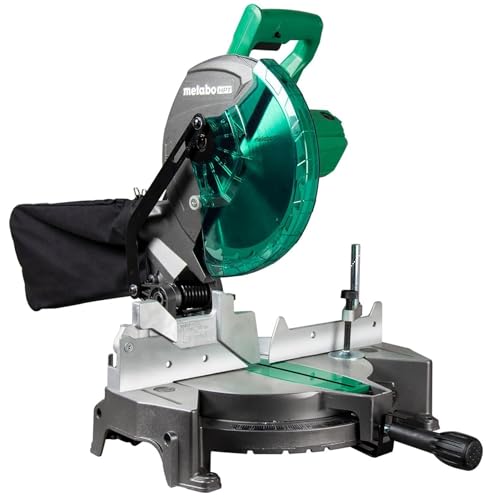
The Metabo HPT C10FCGS is the budget pick and the lightest saw here at about 24 pounds. A 15-amp motor spins the 10-inch blade at 5,000 RPM, the fastest no-load speed here, and the large 10-inch table gives good material support for a saw this size. The miter range runs 0 to 52 degrees left and right with thumb-actuated stops, and the single bevel tilts 0 to 45 degrees to the left.
The large flip fence rises to 4 inches for tall workpieces, and an electric brake stops the blade within seconds. A dust bag, vise assembly, and hex wrench come in the box, and the saw is covered by Metabo HPT’s 5-year warranty, the longest cover here. The limits are capacity and features: it is not a sliding saw, so wide boards need a different tool, there is no laser or shadow line, and the 24-tooth blade in the box is a framing blade rather than a finish blade. A newer version, the C10FCG2, adds a shadow line, so confirm the model number C10FCGS on the listing before ordering. For basic trim, baseboards, picture frames, and framing crosscuts, it delivers accurate cuts at the lowest tier.
Specs
- Blade size: 10 inches
- Motor: 15 amp, 5,000 RPM
- Bevel: single bevel, 0 to 45 degrees left
- Miter range: 52 degrees left, 52 degrees right
- Crosscut capacity: 2 by 6 at 90 degrees
- Cut guide: none
- Included: 24-tooth TCT blade, dust bag, vise assembly, hex wrench
- Weight: 24.2 pounds
- Warranty: 5-year
Frequently Asked Questions
What size miter saw should I buy first?
A 10-inch saw is the best first miter saw for most homeowners. It is lighter, easier to store, and handles trim, baseboards, and framing crosscuts. Step up to a 12-inch saw if you regularly cut wide boards or large crown molding.
Do I need a sliding miter saw?
You need a sliding saw if you cut boards wider than about 8 inches in one pass, such as wide shelving, deck boards, or 2 by 12 lumber. If your work is mostly trim, molding, and framing lumber up to 2 by 8, a non-sliding compound saw is lighter and cheaper.
What is the difference between single bevel and double bevel?
A single-bevel saw tilts to one side only, so you flip the workpiece to cut the mirror angle. A double-bevel saw tilts both ways, which saves time on crown molding and trim runs where matching angles repeat on both sides.
How do I keep a miter saw cutting accurately?
Check the saw against a square when it arrives, and recheck it after moving it. Keep the blade clean, replace a dull blade rather than forcing cuts, and clamp the workpiece so it cannot shift. A sharp finish blade makes the biggest difference on trim.
Conclusion
The right miter saw depends on the work you do most. The DEWALT DWS780 is the best all-around choice, with 12-inch sliding capacity, a dual bevel, and a shadow line that shows where the blade will land. The Bosch GCM12SD is the pick for a small shop, since its glide arm needs almost no room behind it. The Makita LS1019L packs 12-inch crown capacity into a 10-inch slider, the DEWALT DWS715 covers trim and framing without the cost of a slider, and the Metabo HPT C10FCGS is the budget pick for accurate crosscuts. Whichever saw you choose, confirm the exact model number on the listing, check it against a square when it arrives, and fit a sharp blade.
Product and ASIN Reference
| Miter Saw | ASIN |
|---|---|
| DEWALT DWS780 12-Inch Double Bevel Sliding Compound Miter Saw | B00540JS7C |
| Bosch GCM12SD 12-Inch Dual-Bevel Glide Miter Saw | B004323NNC |
| Makita LS1019L 10-Inch Dual-Bevel Sliding Compound Miter Saw with Laser | B073K99HWJ |
| DEWALT DWS715 12-Inch Single Bevel Compound Miter Saw | B07P8QTFRC |
| Metabo HPT C10FCGS 10-Inch Compound Miter Saw | B07PX44JQM |