Key takeaways
- Looking for the best scroll saws for fretwork, intarsia and craft projects? Compare four benchtop and compact models by throat depth, blade type and features.
As an Amazon Associate I earn from qualifying purchases.
The Short Answer
For most serious scroll work, the DEWALT DW788 is the pick. Its 20-inch throat, double parallel-link arm and tool-free blade clamps make it the most capable saw for fretwork, intarsia and portrait-style cutting. If your budget is tighter, the WEN 3921 gives you a 16-inch throat, two-direction blade mounting and a work light, while the WEN 3922 trades the light for a flip-open side panel that makes blade changes fast and simple. For small spaces, the Dremel MS20-01 Moto-Saw is the compact pick, though it uses its own short blades.
Throat depth sets how large a panel you can cut, blade type sets how fine your detail work can be, and vibration control sets how clean your cuts look.
Our Top Picks
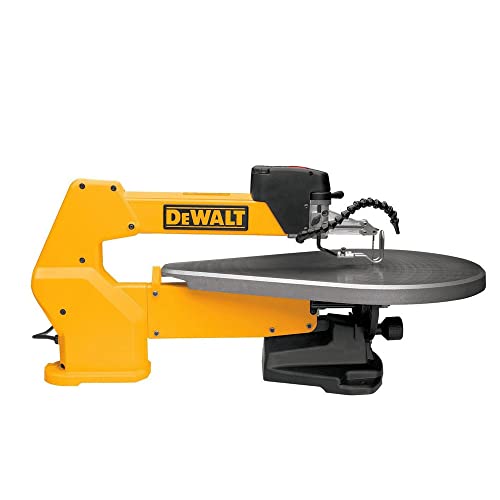
- Best overall: DEWALT DW788 20-Inch Variable Speed Scroll Saw — the most capable saw here for serious fretwork and intarsia, with the largest throat and the smoothest arm design.
- Best value: WEN 3921 16-Inch Variable Speed Scroll Saw with Work Light — a 16-inch throat, two-direction blade mounting and a built-in work light.
- Best budget pick: WEN 3922 16-Inch Variable Speed Scroll Saw with Easy-Access Blade Changes — the simplest of the three benchtop saws, with a flip-open side panel for fast blade changes.
- Best compact pick: Dremel MS20-01 Moto-Saw Variable Speed Compact Scroll Saw Kit — a small, clamp-on saw that also detaches into a handheld coping saw for model building and tight workspaces.
View the DEWALT DW788 on Amazon
View the WEN 3921 on Amazon
View the WEN 3922 on Amazon
View the Dremel MS20-01 Moto-Saw on Amazon
Quick Comparison
| Saw | Throat depth | Speed range | Blade type | Table | Best for |
|---|---|---|---|---|---|
| DEWALT DW788 | 20 inches | 400–1,750 SPM | Plain-end (pinless), 5-inch | Cast iron, bevels 45 degrees left and right | Serious fretwork and intarsia |
| WEN 3921 | 16 inches | 400–1,600 SPM | Pinned and pinless, 5-inch | 16 by 11 inches, tilts up to 45 degrees | Two-direction cutting and general hobby work |
| WEN 3922 | 16 inches | 550–1,600 SPM | Pinned and pinless, 5-inch | 16 by 10 inches, tilts 0–45 degrees | Fast blade changes on a budget |
| Dremel MS20-01 Moto-Saw | About 9.8 inches | 1,500–2,250 SPM | Pin-end, Dremel MS-series only, 3.8-inch | Clamp-on base, no fixed table | Small spaces and model building |
SPM means strokes per minute. Throat depth is the distance from the blade to the back of the saw frame, and it sets the widest panel you can cut to its centre: a 16-inch throat handles a panel up to about 32 inches wide, while a 20-inch throat handles about 40 inches.
How to Choose
Throat depth
Throat depth is the first number to check, because it cannot be changed later. A 16-inch throat covers most fretwork, ornaments, puzzles and small signs. If you plan to cut large portrait panels, clock faces or wide intarsia scenes, the 20-inch throat of the DEWALT DW788 gives you room that a 16-inch saw cannot. The Dremel Moto-Saw, at under 10 inches of throat, is meant for small pieces only.
Blade type: pinned versus pinless
Pinned blades hook into the saw with small pins at each end. They are easy to fit but too coarse for very fine interior cuts, because the pin needs a larger entry hole. Pinless (plain-end) blades clamp directly, need only a tiny drilled hole, and are the standard choice for detailed fretwork. The DEWALT DW788 takes pinless blades only. The WEN 3921 and WEN 3922 accept both types, which is handy if you start with pinned blades and move to fine pinless blades later. The Dremel Moto-Saw takes only its own short pin-end blades, so standard 5-inch blades do not fit it.
Variable speed and vibration
Every saw in this guide has variable speed. Slow speeds suit delicate veneers, plastics and tight curves where a fast blade would burn or wander. Faster speeds suit straight cuts in softwood. Vibration shows up as wavy lines and chipped edges. Two things fight it: a heavy base and a good arm design. The DEWALT DW788 uses a double parallel-link arm that keeps the blade moving in a near-vertical path. The WEN saws use a cast-iron base for stability, and they run best when bolted or clamped to a solid bench.
Table, dust control and lighting
A larger table supports a workpiece better when you guide a wide panel through a curve. The DEWALT table is the largest here, while the WEN 3922 table measures about 16 by 10 inches and the WEN 3921 table measures 16 by 11 inches. The three benchtop saws tilt for bevel cuts, reaching 45 degrees; the Dremel has a clamp-on base with no tilting table.
Scroll work throws fine dust directly onto the cut line, so a dust blower or a dust port makes a real difference to visibility. The WEN 3922 has an air pump and a dust port, and the WEN 3921 adds a work light. The DEWALT DW788 has a flexible dust blower on the front arm but no built-in light and no vacuum port, so plan for a separate lamp. The Dremel Moto-Saw includes a dust port adapter.
What to confirm on the listing
Listings change, and specifications sometimes differ between the maker page and the Amazon listing. Before you buy, confirm the throat depth, blade type, speed range, included accessories and warranty on the listing itself. The DEWALT DW788, for example, is listed at different weights in different places, with the maker stating about 56 pounds and the Amazon listing stating a higher figure.
The Picks in Detail
1. DEWALT DW788 20-Inch Variable Speed Scroll Saw — Best overall
View the DEWALT DW788 on Amazon
The DW788 is the benchmark that other scroll saws are measured against. Its double parallel-link arm keeps the blade travelling in a near-vertical path, which cuts vibration and noise and keeps the blade from drifting on tight curves.
The 20-inch throat is the largest in this guide. Wide portrait panels, clock faces and layered intarsia scenes fit without rotating the workpiece. The cast-iron table bevels 45 degrees. The 1.3-amp motor drives the blade through stock up to 2 inches thick, with electronic variable speed from 400 to 1,750 strokes per minute. Blade changes are tool-free, with the clamps, switch, speed dial, dust blower and tension lever all on the front upper arm.
One point to state openly: several guides list the DW788 as discontinued by the manufacturer, though DeWALT still lists it as current and Amazon shows current offers, so confirm parts availability on the listing.
Pros:
- Double parallel-link arm keeps vibration and noise low
- 20-inch throat handles large panels that 16-inch saws cannot
- Tool-free blade clamps, with the upper arm lifting for threading
- Large cast-iron table bevels 45 degrees in both directions
- Front-mounted controls keep the switch, speed dial and tension lever within reach
- 3-year limited warranty
Cons:
- Heavy at around 56 pounds, so it is a bench-dedicated machine
- Takes pinless blades only, so inexpensive pinned blades do not fit
- No built-in work light or vacuum dust port
- The largest footprint in this guide, so it needs a dedicated bench space
2. WEN 3921 16-Inch Variable Speed Scroll Saw with Work Light — Best value
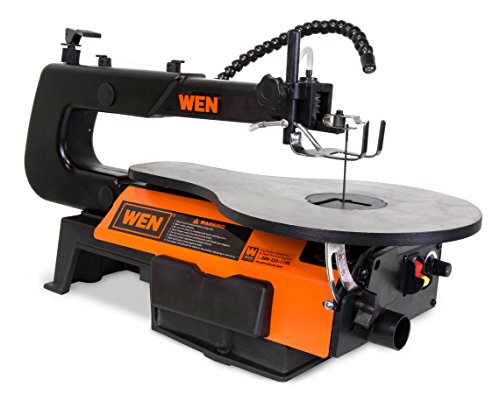
The WEN 3921 is the most flexible of the two 16-inch benchtop saws in this guide, and its signature feature is two-direction blade mounting. The blade can be mounted in the standard position or turned 90 degrees, which lets you feed long stock along the side of the saw instead of fighting the frame.
The saw cuts wood up to 2 inches thick with a 16-inch throat, and the variable speed runs from 400 to 1,600 strokes per minute. The built-in work light makes the cut line much easier to follow on pale woods and fine patterns. The 16-by-11-inch table tilts up to 45 degrees, and the saw accepts both pinned and pinless 5-inch blades. A cast-iron base keeps it planted on the bench, and the maker covers it with a 2-year limited warranty.
Pros:
- Two-direction blade mounting lets long stock feed past the frame
- Built-in work light keeps the cut line visible
- Accepts both pinned and pinless 5-inch blades
- Variable speed from 400 to 1,600 strokes per minute
- Cuts stock up to 2 inches thick with a 16-inch throat
- Cast-iron base adds stability on the bench
Cons:
- 16-inch throat limits very wide panels compared with the 20-inch DEWALT
- No flip-open side panel, so blade access is less open
- Vibration is higher than the parallel-link DEWALT, so bolting it down helps
- Weight figures vary between sources, so confirm on the listing
3. WEN 3922 16-Inch Variable Speed Scroll Saw with Easy-Access Blade Changes — Best budget pick

The WEN 3922 is the simplest saw in this guide, and that is its appeal. Its defining feature is a side panel that flips open for blade changes, paired with a thumb-screw blade adapter that makes changes tool-free. Fretwork means constant blade changes, since every interior cut starts with threading a blade through a drilled hole.
Capacity matches the WEN 3921: a 16-inch throat, a 2-inch maximum cut at 90 degrees, a table of about 16 by 10 inches tilting 0 to 45 degrees, and variable speed from 550 to 1,600 strokes per minute. The saw accepts both pinned and pinless 5-inch blades. Three 5-inch blades, a cast-iron base, an air pump, a dust port and a foot lock clamp are included. The saw weighs about 24.9 pounds and carries a 2-year limited warranty. What you give up against the WEN 3921 is the work light and the two-direction blade mounting.
Pros:
- Flip-open side panel and thumb-screw adapter make blade changes fast and tool-free
- Accepts both pinned and pinless 5-inch blades
- Cuts stock up to 2 inches thick with a 16-inch throat
- Cast-iron base, air pump and dust port included
- Table tilts 0 to 45 degrees for bevel cuts
Cons:
- No built-in work light, so you need your own lamp
- No two-direction blade mounting, unlike the WEN 3921
- Higher vibration than the DEWALT, so bolt it to a solid bench
- The 1.2-amp class motor needs a slower feed rate in dense hardwood
4. Dremel MS20-01 Moto-Saw Variable Speed Compact Scroll Saw Kit — Best compact pick
View the Dremel MS20-01 Moto-Saw on Amazon
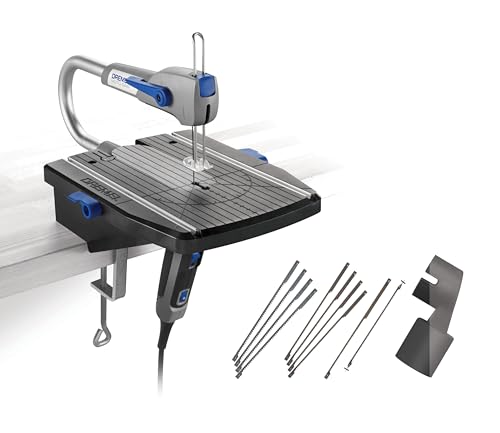
The Dremel Moto-Saw is a different kind of machine from the three benchtop saws above. It is a compact scroll saw with a clamp-on base that fits on a tabletop, a desk or a workbench edge, and it detaches into a handheld coping saw at the touch of a button.
The throat is about 9.8 inches, which suits model building, small ornaments, thin plywood and craft projects, and it is not enough for large fretwork panels. Speed is variable, blade changes use an auto-tensioning quick-change lever, and a dust port adapter is included.
The important limitation is the blade system. The Moto-Saw uses only its own short pin-end blades, about 3.8 inches long, and standard 5-inch scroll saw blades do not fit. That narrows the range of fine blades available and rules out the very fine pinless blades used for detailed fretwork on the benchtop saws. Buy spare Dremel MS-series blades with the saw, and confirm the included blade count on the listing.
Pros:
- Compact clamp-on design fits small workshops, desks and apartments
- Converts to a handheld coping saw
- Auto-tensioning quick-change lever
- Variable speed for different materials
- Dust port adapter included
Cons:
- Small throat of about 9.8 inches limits workpiece size
- Uses only proprietary short pin-end blades, so standard 5-inch blades do not fit
- Not suited to large fretwork panels or thick hardwood
- Light clamp-on base needs a firm edge to stay steady
Who Should Choose What
- Serious fretwork and intarsia: Choose the DEWALT DW788. The 20-inch throat and parallel-link arm suit detailed, large-panel work best.
- First benchtop saw: Choose the WEN 3921. The work light, two-direction blade mounting and both blade types cover the widest range of beginner and hobby projects.
- Tight budget and fast blade changes: Choose the WEN 3922. You keep the same 16-inch capacity as the 3921 and gain the fastest blade access, giving up only the light and the two-direction mount.
- Small space or model building: Choose the Dremel MS20-01 Moto-Saw. It clamps to a tabletop and converts to a handheld saw, but accept its small throat and proprietary blades.
- Large panels only: If your work is mostly wide portrait panels and clock faces, skip the 16-inch saws and the Dremel entirely and go straight to the DEWALT DW788, since throat depth cannot be added later.
Common Mistakes
Buying the wrong throat depth. A 20-inch saw is wasted on ornaments, and a 16-inch saw is frustrating on wide panels. Measure the largest panel you plan to cut, halve it, and match that number to the throat depth.
Ignoring blade type. A saw that takes only pinless blades, like the DEWALT DW788, needs pinless blades and a small drill bit for entry holes. A saw that takes only proprietary blades, like the Dremel Moto-Saw, needs its own blade stock. Buying the wrong blades is the most common first-week frustration with a new scroll saw.
Running too fast on delicate work. High speed burns thin veneer, melts plastic and wanders on tight curves. Start slow on any new material and raise the speed only when the cut stays clean.
Leaving a light saw loose on the bench. Vibration grows with speed and with cut thickness. Clamp or bolt a light benchtop saw to a solid bench, and keep the bench itself from rocking.
Skipping blade tension checks. A loose blade wanders and breaks. A blade that is too tight snaps. Check tension each time you change a blade, and re-check it after the first few minutes of cutting.
Forgetting dust control. Fine scroll saw dust settles on the cut line and in the air. Use the blower or dust port on your saw, keep a mask nearby for long sessions, and clear the table between pieces.
FAQ
What size scroll saw do I need for fretwork?
A 16-inch throat covers most fretwork, including ornaments, signs, puzzles and small panels. Move to a 20-inch throat, such as the DEWALT DW788, for wide portrait panels or large intarsia scenes.
Are pinless blades better than pinned blades?
Pinless blades are better for fine interior work because they need only a tiny drilled entry hole, while pinned blades need a larger hole for the pin. Saws that accept both, such as the WEN 3921 and WEN 3922, let you start with pinned blades and move to pinless blades as your work gets finer.
Can a scroll saw cut metal?
Scroll saws can cut thin non-ferrous metal and thin sheet stock with the right blade and a slow speed, but they are primarily woodworking tools, aimed at wood, plywood, veneer, plastics and laminates. For regular metal cutting, a different tool is a better choice.
How thick can a scroll saw cut?
The benchtop saws in this guide cut stock up to 2 inches thick at 90 degrees. Thick hardwood needs a slow feed rate and a coarse blade, and cutting at the maximum thickness is harder on the blade than cutting stock of an inch or less. The Dremel Moto-Saw is meant for thin material and small pieces.
Do I need a foot pedal for a scroll saw?
A foot pedal is not required, but it is useful because it lets you start and stop the blade without taking a hand off the workpiece. None of the four saws in this guide lists a foot pedal as included, so confirm compatibility before you buy one.
What is the difference between the WEN 3921 and the WEN 3922?
Both are 16-inch variable speed scroll saws that cut up to 2 inches thick and accept pinned and pinless blades. The WEN 3921 adds a work light and two-direction blade mounting, while the WEN 3922 adds a flip-open side panel for easier blade changes and leaves the light out.
Conclusion
The best scroll saws match the size of your work, the blades you want to use and the space you have. The DEWALT DW788 is the strongest choice for serious fretwork and intarsia. The WEN 3921 is the most flexible first benchtop saw, the WEN 3922 is the simplest way to get 16-inch capacity with fast blade changes, and the Dremel MS20-01 Moto-Saw is the compact pick for small spaces and model building, with the clear trade of a small throat and proprietary blades.
Whichever saw you choose, confirm the throat depth, blade type and included accessories on the listing before you buy, mount the saw firmly, and start with a slow speed on scrap stock.