Key takeaways
- Find the best 10-inch table saw for your home shop. Compare jobsite and cabinet models on blade depth, fence, rip capacity and stand, then choose.
Choosing a 10-inch table saw is a decision about the cuts you will make every week, not the size of the box it arrives in. A 10-inch blade cuts about 3-1/8 inches deep at 90 degrees, which handles two-by lumber, sheet goods and most joinery, while a smaller blade leaves thick stock half-cut and forces awkward flips. The trade-off is weight and space: a full 10-inch saw needs a solid stand, a clear outfeed path and a circuit that can feed a 15-amp motor without tripping.

This guide is for home woodworkers, remodelers and serious DIYers who need one saw for ripping, crosscutting and joinery. It covers portable jobsite saws with rolling stands and a contractor saw for a fixed shop, chosen from the names and specifications on their Amazon pages, with blade size, motor, fence and rip capacity checked for each model.
Quick Picks
As an Amazon Associate we earn from qualifying purchases
| Product | Best for | Key spec from title |
|---|---|---|
| DEWALT DWE7491RS | Jobsite work with a rolling stand | 32-1/2 in rip capacity |
| Bosch 4100-10 | Jobsite work with a gravity-rise stand | 30 in rip capacity |
| Metabo HPT C10RJS | Large sheet goods in a small shop | 35 in rip capacity |
| Delta 36-725T2 | A fixed shop with a contractor saw | 30 in rip capacity |
How to Choose
Start with depth of cut and blade size
A 10-inch blade cuts about 3-1/8 inches deep at 90 degrees and about 2-1/4 inches at 45 degrees, which covers two-by lumber, plywood and most furniture joinery in a single pass. That depth is the real reason to choose this size: an 8-1/4-inch blade stops short on thick stock and turns a simple rip into a flip-and-finish chore. Check the depth at 45 degrees too, because bevel cuts on thick boards expose a shallow saw fast. If you cut four-by-four posts or thick hardwood slabs, look at the maximum depth first and treat everything else as secondary, since no fence or stand can fix a blade that cannot reach through the board.
Judge the fence before anything else
The fence decides whether your cuts stay straight, so judge it before the motor. A rack-and-pinion fence moves both ends together and locks parallel to the blade with a single lever, which is why it dominates the jobsite class and saves a check with a tape measure before every cut. A T-square style fence on a contractor saw locks just as squarely once it is set, but it needs a careful setup the first time. Whatever style your saw has, push the fence sideways after locking it and watch for play, because a fence that drifts even slightly will taper every board that slides past it.
Match the motor and power supply to your work
Most 10-inch jobsite saws run a 15-amp motor on a standard 120-volt circuit, which handles sheet goods, softwood and most hardwood ripping without complaint. The limit shows up in dense hardwood: a saw that bogs down mid-cut leaves burn marks and forces you to slow the feed rate. A contractor saw with a larger induction motor cuts thick stock more calmly and runs quieter, but it may need a 230-volt circuit that a normal garage outlet cannot supply. Check your shop wiring before buying the bigger saw, and match the motor to the hardest material you cut weekly rather than the easiest.
Think about the stand, dust collection and storage
A table saw is only as useful as the space around it, so think about the stand before the saw itself. A rolling stand with large wheels moves over a driveway or a rough garage floor and folds flat against a wall when the job ends, which matters more than it sounds in a one-car garage. A fixed contractor saw needs a permanent spot with clear infeed and outfeed room for full sheets. Check the dust port as well: a saw that connects cleanly to a shop vacuum keeps the air clearer and the cut line visible, while a saw with no real dust collection coats the whole shop in fine dust after a single afternoon.
The 4 Best Options
DEWALT DWE7491RS
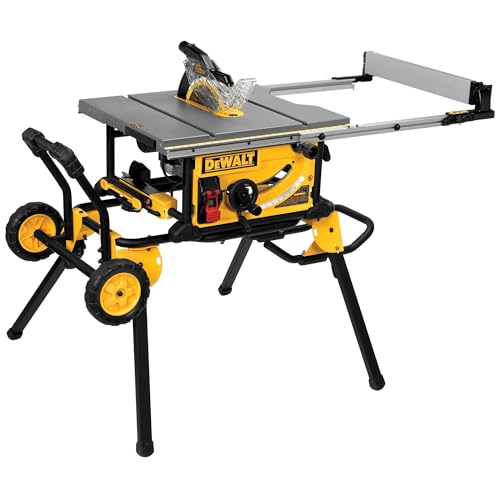
The DWE7491RS is the jobsite saw most home shops end up comparing everything else against, because it pairs a full 10-inch blade with a rolling stand that actually moves, even on uneven ground. The rack-and-pinion fence slides smoothly and locks square, the 32-1/2-inch rip capacity swallows full sheet goods with the fence extended, and the stand folds for storage without a wrestling match. It is heavy to lift into a truck bed on your own, so treat the wheels as part of the saw rather than an accessory. For a garage shop that also travels to weekend jobs, this is the practical default.
Specs
- 10-inch blade with 3-1/8-inch depth of cut at 90 degrees
- 15-amp motor
- 32-1/2-inch rip capacity
- Rack-and-pinion fence
- Rolling stand included
Best for: Jobsite work and garage shops that need a saw that travels.
Watch out for: Check the fence alignment after moving the saw, since transport can knock it out of square.
Bosch 4100-10
The Bosch 4100-10 earns its place with the Gravity-Rise stand, which lifts the saw from the floor to working height with one smooth motion and folds back down just as easily without help. The SquareLock fence holds its setting across repeated rips, the 30-inch rip capacity covers most cabinet work, and the saw stays stable under a full sheet of plywood. It is louder than an induction-motor contractor saw, so ear protection belongs on the bench beside it. For a small shop where the saw must disappear against the wall after every session, the folding stand is the deciding feature.
Specs
- 10-inch blade with 3-1/8-inch depth of cut at 90 degrees
- 15-amp motor
- 30-inch rip capacity
- SquareLock rip fence
- Gravity-Rise wheeled stand included
Best for: Small shops where the saw folds away after every session.
Watch out for: The saw is heavy to carry without the stand, so keep the stand attached when moving it.
Metabo HPT C10RJS
The Metabo HPT C10RJS is built for cutting sheet goods in a tight shop, because its 35-inch rip capacity is the widest in this guide and it still folds onto a rolling stand. The rack-and-pinion fence adjusts with one hand, the soft-start motor avoids the jolt that trips breakers on a shared circuit, and the stand folds flat for storage in a crowded garage. The table is smaller than a contractor saw, so long boards need a roller stand for support at the outfeed end. For plywood-heavy projects in a small space, the extra rip capacity is hard to give up.
Specs
- 10-inch blade with 3-1/8-inch depth of cut at 90 degrees
- 15-amp motor with soft start
- 35-inch rip capacity
- Rack-and-pinion fence
- Folding stand with wheels included
Best for: Cutting full sheets in a small garage.
Watch out for: Support long boards at the outfeed end, since the table is shorter than a contractor saw.
Delta 36-725T2
The Delta 36-725T2 is the fixed-shop option in this list, a contractor saw that trades portability for a cast-iron table and a calm induction motor. The 30-inch rip capacity handles cabinet panels, the fence locks square and stays put through a long day of rips, and the heavier build damps vibration that shows up as rough edges on lighter saws. It needs a dedicated corner of the shop and a solid outfeed setup, so measure your space before ordering. For woodworkers who cut hardwood every week and never move the saw in a home shop, this is the steady choice.
Specs
- 10-inch blade with 3-1/8-inch depth of cut at 90 degrees
- 15-amp induction motor
- 30-inch rip capacity
- Cast iron table
- Leg stand included
Best for: A fixed home shop cutting hardwood every week.
Watch out for: Confirm the saw fits your available floor space and outfeed clearance before it arrives.
Which One Fits Your Situation
You move the saw between jobs
Pick the DEWALT DWE7491RS. The rolling stand and large wheels carry the saw across a driveway or a job site without a second person, and the rack-and-pinion fence resets square after every move. It is the only saw here that treats transport as a normal day rather than a chore.
You cut sheet goods in a small garage
Pick the Metabo HPT C10RJS. The 35-inch rip capacity handles a full sheet of plywood where the other jobsite saws stop short, and the folding stand tucks the whole saw against the wall when the cut is done. Add a roller stand at the outfeed end for long panels before you start.
You want one saw that stays in the shop
Pick the Delta 36-725T2. The cast-iron table and induction motor run quieter and steadier than any portable saw, and the 30-inch rip capacity covers cabinet work without moving the saw an inch. Give it a permanent corner with clear infeed and outfeed room, and it will serve for many years.
You fold the saw away after every session
Pick the Bosch 4100-10. The Gravity-Rise stand raises and lowers the saw in one motion, so packing up takes seconds rather than a wrestling match, and the SquareLock fence holds its setting from one session to the next. It is the best fit for a shared garage that must park a car at night.
Common Mistakes
- Buying for the thinnest board you cut instead of the thickest, then finding the blade cannot reach through the stock on the first project.
- Ignoring the fence and discovering after assembly that it drifts and tapers every cut you make.
- Choosing a cabinet-style saw without checking whether the shop has the circuit it needs to run it.
- Forgetting outfeed space and having full sheets tip off the back of the table mid-cut while you are still pushing.
- Skipping dust collection and coating the shop in fine dust after the first afternoon of cutting.
Frequently Asked Questions
What depth of cut does a 10-inch table saw give?
About 3-1/8 inches at 90 degrees and about 2-1/4 inches at 45 degrees on most models in this guide. That covers two-by lumber, plywood and standard furniture stock in one pass. If you regularly cut four-by-four posts, check the exact depth in the specifications on the product page before buying, since a shallow saw turns thick cuts into a two-step job.
Can a 10-inch jobsite saw cut full sheets of plywood?
Yes, with the fence extended and the outfeed end supported. The saws here rip from 30 to 35 inches, which covers a full sheet ripped lengthwise, but a single person still needs a roller stand or a helper at the outfeed end. Without support, the sheet tips as it leaves the table and the cut wanders and ruins the edge.
Do I need a 230-volt circuit for a 10-inch table saw?
Not for the jobsite saws in this guide, which run a 15-amp motor on a standard 120-volt circuit. Larger contractor and cabinet saws sometimes need 230 volts, so check the motor specifications on the listing and your shop wiring before buying. A saw that cannot run on your available circuit is a saw you cannot use.
How do I keep cuts square on a jobsite saw?
Check the fence against the blade with a square after assembly and again after moving the saw, since transport knocks fences out of alignment. Lock the fence, push it sideways to test for play, and measure the distance to the blade at the front and the back. A fence that measures the same at both ends will cut straight session after session.