Key takeaways
- Compare the best satellite phones for off-grid travel and emergencies. Coverage, battery life, SOS features, and airtime plans explained before you buy.
A satellite phone makes voice calls where cell towers cannot reach: deep backcountry, open ocean, desert crossings, and disaster zones with downed networks. Unlike a satellite messenger, which only sends short texts and an SOS alert, a true satellite phone lets you hold a live conversation with a rescue coordinator, a family member, or a colleague.
Every phone in this guide is a voice handset that works on a satellite network, and none of them works without an airtime plan, so the handset is only the first half of the decision. The second half is the network: Iridium covers the whole planet including the poles, Inmarsat covers nearly everywhere except the poles, and Thuraya and Globalstar cover specific regions well and other regions poorly or not at all. Match the network to where you will travel, then pick the handset that fits your budget and your pack.
As an Amazon Associate, we earn from qualifying purchases.
Quick Answer
The Iridium 9575 Extreme is the best satellite phone for most buyers, pairing true global coverage with a rugged build, GPS, and a dedicated SOS button. The Iridium 9555 costs less with the same global network, the Inmarsat IsatPhone 2 lasts longest on a charge, the Thuraya XT-PRO DUAL suits travel inside Thuraya coverage, and the Globalstar GSP-1700 is the cheapest way into a real voice handset.
How to Choose a Satellite Phone
Coverage comes first. Iridium covers the entire planet, including polar regions and mid-ocean. Inmarsat covers most of the planet except the poles. Thuraya covers Europe, Africa, the Middle East, Asia, and Australia, but not the Americas. Globalstar covers North America best, with patchy coverage elsewhere. Check the coverage map for your exact route before you buy.
Voice handset or messenger. A voice handset makes live calls to any phone number. A messenger sends short texts and an SOS signal and usually pairs with a smartphone. Messengers cost less and weigh less, and they are the right tool when a short message is enough. If you need to talk through a medical problem or coordinate a rescue, you need a voice handset. This guide covers voice handsets only.
Airtime plans and activation. A satellite phone needs an active airtime plan with a SIM card. Prepaid plans give you a fixed number of minutes with an expiry date and suit occasional trips. Postpaid plans bill monthly and suit regular field work. Activation usually takes a day or two, so activate the phone and make a call from home before you leave. To undo the commitment, cancel the plan with the airtime provider, remove the SIM, and store the handset; most providers let you reactivate the same handset later.
Battery life, durability, and size. Talk time runs from about four hours to about nine hours, and standby from about 30 hours to about 160 hours. Long standby matters, so carry a spare battery or a small power bank on long trips. Look for a rugged build, water resistance, and a solid antenna, and learn where the SOS button sits before you need it. These are chunky devices, weighing roughly 200 to 320 grams; the lightest here is the GSP-1700 and the heaviest is the IsatPhone 2.
Best Satellite Phones
Iridium 9575 Extreme Satellite Phone — Best Overall
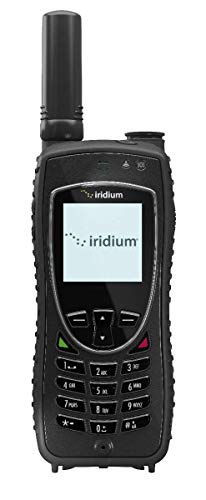
The Iridium 9575 Extreme is the toughest handset in this guide and the safest default for voice calls anywhere on Earth. It runs on the Iridium network, so it works at the poles, mid-ocean, and in every country on the map. It carries a dedicated SOS button, a GPS receiver, and a rugged build rated to military drop standards, and it keeps working in rain, dust, and cold that would end a normal phone.
The listing includes a prepaid SIM card, though you still need an airtime plan before the phone can dial out. Talk time runs up to four hours and standby up to 30 hours, so carry a spare battery on multi-day trips. The antenna stows inside the body, and the keypad is backlit.
Buy this phone for mountain rescue, offshore sailing, remote field work, and disaster response. It costs more than the other handsets here, but no other phone in this guide matches its combination of global coverage and ruggedness.
Specs
- Network: Iridium, global including polar regions
- Size: 140 x 60 x 27 mm
- Weight: 247 g
- Talk time: Up to 4 hours
- Standby time: Up to 30 hours
- Display: Monochrome, backlit keypad
- Features: GPS, SOS button, military drop rating, internally stowed antenna
- Connection: Mini-USB
Iridium 9555 Satellite Phone — Best Value

The Iridium 9555 is the simpler sibling of the 9575 Extreme, and it is the best value here for buyers who want the same global network at a lower cost. It makes voice calls and sends texts anywhere Iridium covers, which is everywhere, with a straightforward interface. If your main requirement is a reliable voice link from anywhere, this is the handset that delivers it for the least money.
The trade is ruggedness and extras. The 9555 has no dedicated SOS button and no GPS receiver, so it cannot send your position on its own, and its build is less hardened than the Extreme. Talk time and standby match the Extreme, and the phone ships as a factory-unlocked kit.
Buy the 9555 when you want global voice coverage and you already carry a separate GPS device or a personal locator beacon for emergencies. Skip it when a one-button SOS call matters to you, because that feature alone justifies the step up to the Extreme. Confirm availability, warranty, and battery supply before you buy, since this is an older handset.
Specs
- Network: Iridium, global including polar regions
- Size: 143 x 55 x 30 mm
- Weight: 266 g
- Talk time: Up to 4 hours
- Standby time: Up to 30 hours
- Display: Monochrome, backlit keypad
- Features: Voice calls, text messaging, internally stowed antenna
- Connection: Mini-USB
Inmarsat IsatPhone 2 Handheld Satellite Phone — Best Battery Life

The Inmarsat IsatPhone 2 is the endurance pick in this guide. It offers up to eight hours of talk time and up to 160 hours of standby on a single charge, roughly double the talk time and five times the standby of the Iridium handsets. For anyone who spends weeks away from power, that gap is decisive. It also has a dedicated SOS button, a GPS receiver for tracking, and a color display that stays readable outdoors.
Coverage is near-global but excludes the poles, and the fold-out directional antenna must point toward the satellite. The handset is the largest and heaviest here, with an IP65 rating against dust and water jets, and voice quality is consistently clear.
Choose the IsatPhone 2 when battery life and call quality matter more than polar coverage or pocket size. Avoid it when your route crosses the poles. Activate the phone before departure, and remember that the antenna needs a clear view of the sky to hold a call.
Specs
- Network: Inmarsat, near-global except polar regions
- Size: 169 x 75 x 29 mm
- Weight: 316 g
- Talk time: Up to 8 hours
- Standby time: Up to 160 hours
- Display: Color
- Features: GPS tracking, SOS button, IP65 rating, fold-out directional antenna
- Connection: Mini-USB
Thuraya XT-PRO DUAL Satellite Phone — Best for Regional Travel

The Thuraya XT-PRO DUAL is the best satellite phone for travel inside Thuraya coverage: Europe, Africa, the Middle East, Asia, and Australia. It pairs satellite calling with a GSM slot, so the same handset works as an ordinary cell phone when you return to coverage. Talk time runs up to nine hours with standby up to 100 hours, the longest in this guide.
The handset is built for harsh conditions, with an IP67 rating, a toughened glass display, and a dedicated SOS button. Navigation runs on GPS, BeiDou, and Glonass. The limits are geographic: Thuraya does not cover the Americas, so this phone is the wrong choice for North or South American travel.
Buy the XT-PRO DUAL when your work or travel stays inside Thuraya coverage and you want one device for both satellite and cellular calls. Do not buy it for the Americas, and check the coverage map for your exact destinations first.
Specs
- Network: Thuraya, regional; GSM slot for cellular use
- Weight: 221 g
- Talk time: Up to 9 hours
- Standby time: Up to 100 hours
- Display: Color, toughened glass
- Features: GPS, BeiDou, Glonass, SOS button, IP67 rating, dual-mode satellite and GSM
- Connection: USB
Globalstar GSP-1700 Satellite Phone — Best Budget

The Globalstar GSP-1700 is the cheapest way into a true satellite voice handset, and it is the smallest and lightest phone in this guide. It has a color display and an any-key answer function that makes it easy to use with gloves on. Globalstar assigns a US phone number to the handset, so people calling you pay no more than an ordinary domestic call.
The limits are coverage and age. Globalstar covers North America best, with patchy coverage in parts of South America, Europe, and Japan, and large dead zones elsewhere. The phone is no longer in production, so units on the market are old stock or refurbished. Talk time runs up to four hours with standby up to 36 hours.
Buy the GSP-1700 when you travel mainly in North America, your budget is tight, and you accept an older handset with regional coverage. Confirm that service plans are still offered for this model before you buy. If your travel leaves North America, one of the Iridium handsets is the safer choice.
Specs
- Network: Globalstar, regional with best coverage in North America
- Size: 135 x 55 x 37 mm
- Weight: 200 g
- Talk time: Up to 4 hours
- Standby time: Up to 36 hours
- Display: Color
- Features: GPS position display during calls, US phone number, 9.6 Kbps data
- Connection: Mini-USB
Who Should Skip It
A satellite phone is the wrong buy for many people. If you only need an SOS signal and short texts, a satellite messenger costs less, weighs less, and runs longer on a charge. If you never leave cell coverage, a satellite phone is an expensive paperweight. Without an airtime plan, the phone cannot make calls at all.
Regional phones deserve a second look before you commit. The Thuraya XT-PRO DUAL is an excellent handset that becomes useless the moment you land in the Americas, and the Globalstar GSP-1700 is a bargain that becomes useless outside its coverage footprint. A global Iridium handset costs more, but it is the only choice that works everywhere without a map check. Finally, if you need broadband data, video calls, or email with attachments, none of these handsets will satisfy you; satellite data on a voice handset is slow, and a satellite hotspot is the right tool for that job instead.
FAQ
Do satellite phones work without a cell signal?
Yes. A satellite phone connects directly to satellites in orbit, so it works wherever it can see the sky. You still need an active airtime plan, and calls can drop in deep canyons, dense forest, or inside buildings.
Do I need a subscription to use a satellite phone?
Yes. Every satellite phone needs an airtime plan with a SIM card before it can make calls. Prepaid plans give you a fixed number of minutes with an expiry date, while postpaid plans bill monthly. Buy the plan before your trip and make a call from home to confirm activation.
How do I cancel a satellite phone plan?
Contact the airtime provider and ask to cancel or suspend the plan, then remove the SIM from the handset. Most providers let you reactivate the same handset later, so keep the phone and its charger.
Which satellite network covers the most territory?
Iridium covers the whole planet, including the poles and mid-ocean. Inmarsat covers most of the planet except the poles. Thuraya covers Europe, Africa, the Middle East, Asia, and Australia. Globalstar covers North America best, with patchy coverage elsewhere.
Final Verdict
The Iridium 9575 Extreme is the best satellite phone for most buyers because it combines true global coverage with a rugged build, GPS, and a one-button SOS call. The Iridium 9555 is the value alternative without the SOS button and GPS. The Inmarsat IsatPhone 2 wins on battery life and call quality for long trips outside the poles. The Thuraya XT-PRO DUAL is the smart pick for regional travel with a GSM slot, and the Globalstar GSP-1700 is the budget entry for North American travel.
Whichever handset you choose, the plan matters as much as the phone. Activate it early, make a call before you leave, and carry a spare battery. A satellite phone earns its place in your pack on the one day you truly need it, and on that day coverage and charge are the only specs that count.
Product and ASIN Reference
| Product | ASIN |
|---|---|
| Iridium 9575 Extreme Satellite Phone | B007I782J4 |
| Iridium 9555 Satellite Phone | B00IJHGSIO |
| Inmarsat IsatPhone 2 Handheld Satellite Phone | B00J8OA220 |
| Thuraya XT-PRO DUAL Satellite Phone | B0CTHQN1V3 |
| Globalstar GSP-1700 Satellite Phone | B000O9FS1I |