Key takeaways
- Find the best borescope for walls, pipes, drains, and engine bays. Compare dual-lens, wireless, and articulating inspection cameras for home use.
A borescope is a small camera on the end of a stiff cable, and it answers questions no flashlight can. Is that damp patch on the drywall a leaking pipe or a cold spot? Is the drain clogged right at the trap or farther down the line? A borescope lets you look inside walls, pipes, ducts, drains, and engine compartments without taking things apart first. For a homeowner, that means fewer holes cut and fewer guesses before calling a professional.
The right one for home use has a probe slim enough for the spaces you need to see, a cable long enough to reach them, and a screen you can read in a dim basement or a bright garage. The five cameras below run from a budget wireless scope to a pro-grade inspection camera.
As an Amazon Associate, we earn from qualifying purchases.
Quick Answer
Buy the Teslong NTS300 Pro if you want one borescope for most home jobs. Its dual-lens probe looks straight ahead and sideways, the 5-inch screen reads well at arm’s length, and the 16.4-foot cable reaches deep into walls, ducts, and drains. Homeowners on a tight budget should look at the DEPSTECH wireless endoscope instead, and tradespeople should look at the tough Ridgid Micro CA-25.
How to Choose
Probe diameter decides where the camera can go. A slim probe near 5.5 mm slips into a spark plug hole and through small drilled holes in drywall. An 8 mm probe fits most sink and shower drains and still passes through a standard drilled access hole. A 9 or 10 mm head may not fit a shower P-trap or a narrow pipe, so match the head to the tightest space you plan to enter.
Cable length is a trade-off, not a contest. A 16-foot cable reaches down a drain line and across a wall cavity, but the extra length is awkward to manage with one hand. A 4- to 6-foot cable is easier to control for engine bays, cabinets, and wall cavities near an access hole. Buy only as much length as your jobs need, and look for a semi-rigid cable that holds its shape once bent.
A built-in screen beats a phone in some jobs, and loses in others. A dedicated screen works the moment you switch it on, with no app and no pairing. A Wi-Fi scope that sends the picture to a phone gives you a bigger, sharper display and easy photo sharing, but it depends on the app and on your phone battery.
Dual lenses save time. A front lens looks straight ahead, while a side lens on the same probe looks at the pipe wall or the side of a cavity. Switching between the two with a button beats pulling the probe out, turning it, and feeding it back in. A dual-lens head is the better choice for drains and wall cavities.
Articulation matters for engines. A tip that bends both ways lets you steer around a valve or peek behind a fitting inside an engine or a duct. If most of your use is automotive, articulation is worth paying for.
Light and waterproofing are not optional. Six or seven adjustable LEDs keep the picture readable inside a dark pipe, and dimming them stops glare on shiny metal. An IP67 rating means the probe can go under water for a short time, which drain work demands. The handset and screen are usually not waterproof, so keep them dry.
Storage and power are practical details. A scope that saves photos and video to a memory card lets you document a leak. Rechargeable batteries are convenient for regular use, while AA batteries suit a tool that sits in a drawer for months between jobs.
Best Borescopes
Teslong NTS300 Pro Inspection Camera — Best Overall

The Teslong NTS300 Pro is the best all-round borescope for home use because it pairs a dual-lens probe with a large, clear screen. The front lens looks straight down a pipe or cavity, and the side lens shows the wall of the pipe or the side of a stud bay at the press of a button. That matters when the problem is a crack in a pipe wall rather than a blockage ahead of the camera. The 5-inch IPS screen reads well at arm’s length, and the 1080p picture holds up when you zoom in.
The 16.4-foot cable is the longest in this guide, which helps when the drain run is long or the wall cavity is deep. A long cable is awkward to feed with one hand, so use both hands for deep runs. The probe is slim enough for a shower drain trap and a spark plug hole, and the waterproof rating lets it go under water in a drain. Photos and video save to a memory card, useful when you want to show a plumber what you found.
Specs
- Probe: 8 mm dual lens, front and side
- Screen: 5-inch IPS
- Resolution: 1080p
- Cable: 16.4 feet
- Waterproof rating: IP67
DEPSTECH Dual Lens Wireless Endoscope — Best Budget

The DEPSTECH wireless endoscope is the cheapest way into a capable inspection camera, and it is no compromise for occasional use. It sends the picture to a phone or tablet over Wi-Fi, so the display is the screen you already carry, and the zoom control helps for a closer look at a fitting. The dual-lens head switches between a forward view and a side view, which is rare at this end of the market.
The 16.4-foot semi-rigid cable holds its shape once bent, so it stays aimed inside a wall or a duct. Seven LEDs light the picture, and the 0.31-inch lens fits most household drains. Sharing a photo of a leak or a clog from your phone is quick. The catch is the app: your phone must be charged and the app running before the picture appears. For a homeowner who inspects something a few times a year, that is a fair trade for the lower cost and the large phone display.
Specs
- Lens: dual lens, 0.31 inch
- Resolution: 1080p
- Lights: 7 LEDs
- Cable: 16.4 feet semi-rigid
- Display: phone or tablet over Wi-Fi
- Waterproof rating: IP67
Ridgid Micro CA-25 Inspection Camera — Best for Pros

The Ridgid Micro CA-25 is the tool for someone who wants a borescope built like a trade tool. The pistol grip sits naturally in one hand, the aluminum camera head takes knocks that would crack a plastic scope, and the 2.7-inch color display is always on when the tool is on. There is no app to open and no phone to pair. It runs on AA batteries, which suits a tool that may sit unused for weeks.
The 4-foot fixed waterproof cable is short compared with the other scopes here. It covers engine bays, cabinets, wall cavities near an access hole, and short drain runs, but it will not reach deep into a long drain line. The head is also wider than the slim probes in this guide, so it may not fit a narrow shower trap. In return you get a rugged, simple camera that turns on and works, with a picture that stays sharp at close range.
Specs
- Display: 2.7-inch color
- Cable: 4 feet fixed waterproof
- Power: AA batteries
- Head: aluminum
- Model: 40043
Klein Tools ET20 WiFi Borescope — Best Wireless Display
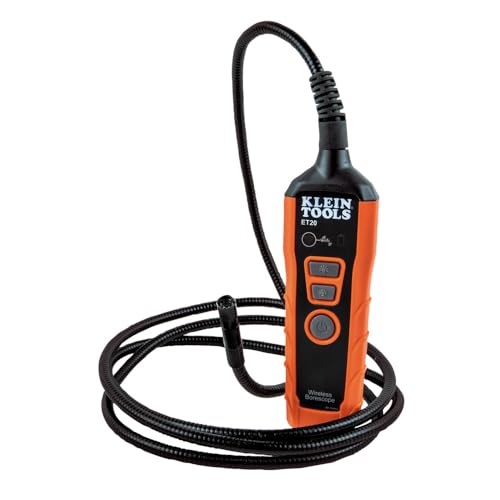
The Klein Tools ET20 suits electricians and homeowners who already trust Klein hand tools. It sends the picture to a phone over Wi-Fi, and the rechargeable lithium-ion battery means no spare batteries to buy. The 6-foot semi-rigid cable is short enough to control with one hand when feeding it through a wall cavity around insulation or through a conduit.
The 9 mm camera carries six adjustable LEDs, and dimming them keeps glare down on shiny metal fittings. A hook, a bag, and a pocket clip make it easy to carry on a belt or in a tool bag. The 6-foot reach will not cover a long drain run, and the picture depends on your phone, so keep it charged. For wall cavities, junction boxes, and short pipe runs, the ET20 is the easiest wireless scope in this guide to carry and use.
Specs
- Camera: 9 mm
- Cable: 6 feet semi-rigid
- Lights: 6 adjustable LEDs
- Power: rechargeable lithium-ion
- Display: phone over Wi-Fi
- Extras: hook, bag, pocket clip
Teslong NTS500 Dual Lens Inspection Camera — Best Extended Reach

The Teslong NTS500 is the pick for jobs where the probe itself has to be slim. Its 0.21-inch head is the narrowest in this guide, so it slips into a spark plug hole and through small drilled holes that a wider head cannot enter. The dual-lens design gives a front view and a side view, and the 5-inch IPS screen shows both clearly. A carrying case keeps the long cable from tangling in a toolbox.
The 9.8-foot cable is shorter than the NTS300 Pro, but it covers most wall cavities, ducts, and automotive checks, and it is easier to manage. The slim probe is the main reason to choose this model: when the opening is the limiting factor, a smaller head opens jobs a bigger scope cannot reach. It is also the better choice for a combustion chamber or a narrow pipe where a wide head would jam.
Specs
- Probe: 0.21 inch dual lens, front and side
- Screen: 5-inch IPS LCD
- Cable: 9.8 feet
- Waterproof rating: IP67
- Extras: carrying case
Who Should Skip It
A handheld borescope is not a sewer camera. If you need to inspect a main sewer lateral or a long drain run beyond about 16 feet, you need a push camera on a reel, often with a locator sonde, or hire a plumber who owns one. A borescope also cannot see through a wall: it needs a small access hole drilled first, and it cannot diagnose what it cannot reach.
Skip the purchase entirely if you only need to look once. A single inspection before buying a house is usually better handled by a home inspector who already owns the tool. Borrow or rent one for a weekend job instead. If your work involves flammable vapors, a furnace interior, or any space where a spark could be dangerous, do not use a consumer borescope there; those jobs call for rated equipment and a professional.
FAQ
What size borescope probe do I need for a home drain?
An 8 mm probe fits most sink and shower drains and passes through a standard drilled hole in drywall. A 0.21-inch probe near 5.5 mm is better for spark plug holes and very small openings. A 9 or 10 mm head may not fit a shower P-trap, so measure the tightest opening first.
Can a borescope see inside a wall without cutting a hole?
No. A borescope cannot see through drywall. You drill a small access hole, feed the probe through, and look around the cavity. The hole is small enough to patch with filler, far less work than opening a large section of wall to find a leak by eye.
Are wireless borescopes as good as ones with a built-in screen?
Each has a strength. A phone screen is usually bigger and sharper, and sharing photos is easy. A built-in screen works at once with no app, no pairing, and no phone battery to worry about, and it reads better in bright light. Pick wireless for the big display, and a built-in screen for simplicity.
Can I use a borescope in water?
Only the probe, and only with an IP67 rating, which means it can sit under water for a short time. The handset, screen, and battery compartment are usually not waterproof, so keep them dry. Dry the probe after drain work and store it in its case.
Final Verdict
The Teslong NTS300 Pro is the best borescope for most homeowners because it combines a dual-lens probe, a large 5-inch screen, and a long cable in one tool. It handles walls, drains, ducts, and engine bays without a phone or an app. Buy the DEPSTECH wireless endoscope if your budget is tight and you are happy using your phone as the display. Buy the Ridgid Micro CA-25 for a rugged pistol-grip tool that runs on AA batteries and simply works. Buy the Klein ET20 for short wall and conduit runs, and the Teslong NTS500 when the opening is too small for a wider probe.
Product and ASIN Reference
| Product | ASIN |
|---|---|
| Teslong NTS300 Pro Inspection Camera | B07TV2BFVR |
| DEPSTECH Dual Lens Wireless Endoscope | B08NJ8627V |
| Ridgid Micro CA-25 Inspection Camera | B008H1EAOQ |
| Klein Tools ET20 WiFi Borescope | B07Q78WXFP |
| Teslong NTS500 Dual Lens Inspection Camera | B07SQ4FLYX |